Featured Post

Tracking air pollution disparities -- daily -- from space

Studies have shown that pollution, whether from factories or traffic-snarled roads, disproportionately affects communities where economicall...

Tuesday, March 30, 2021

The earliest cherry blossom season in 1,200 years is here due to climate change

For well over a thousand years, cherry blossoms in Japan have held the scent of spring and reflected the transient beauty of nature itself. Today, these falling flowers also carry the gravity of climate change.


In 2021, after an unusually warm spring, Kyoto has burst into color far sooner than expected. To date, this is the earliest cherry blossoms in the city have bloomed in more than 1,200 years.

We know that because imperial court documents and ancient diary entries on the nation's cherry blossom festivals can be traced back to 812 CE. In all that time, the earliest blooming date was March 27 in the year 1409.

Over the centuries, the long-held tradition of cherry blossom viewing has grown from an aristocratic fancy to a fixture of Japanese life. Each year, from early to mid April, residents in Kyoto have held 'hanami' underneath the cherry trees to watch as hundreds of varieties of white and pink flowers bloom to their fullest.

While cherry blossoms in Kyoto may start to flower in March, their full bloom date - when the majority of buds are open to the skies - lies historically around April 17, although in the past century this date has retreated to April 5.

This year, before April even arrived, the moment had already passed. On Friday 26 March, officials announced cherry blossom trees in Kyoto had fully flowered.


"Evidence, like the timing of cherry blossoms, is one of the historical 'proxy' measurements that scientists look at to reconstruct past climate," climate scientist Michael Mann told The Washington Post.

"In this case, that 'proxy' is telling us something that quantitative, rigorous long-term climate reconstructions have already told us - that the human-caused warming of the planet we're witnessing today is unprecedented going back millennia."

The flowering of the Japanese mountain cherry alone has been carefully detailed 732 times since the 9th century, representing the longest and most complete record of a seasonal, natural phenomenon from any place in the world.

Sifting through this 1,200-year-long series, scientists have mapped out a clear trend that looks very similar to climate change itself. As spring in the Northern Hemisphere arrives earlier with global warming, some plants and animals are also shifting their patterns of activity, including these blooms.

When scientists graph Kyoto's full bloom dates over time, they look remarkably like the hockey stick shape of global warming itself. The flat part of the stick represents relatively stable cherry bloom dates in Kyoto, while the latter end shows a more rapid change in flowering events, as can be seen below.
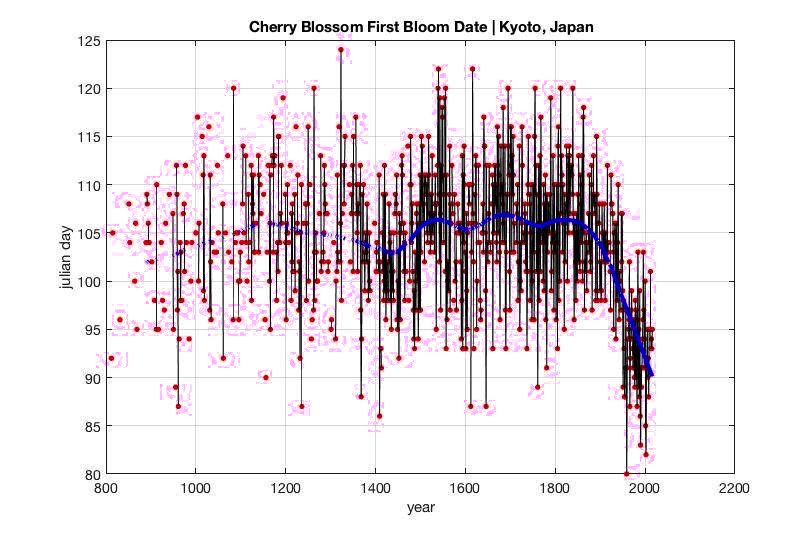
Cu1gKt7UMAEJv8TCherry blossom blooms since 812. (Osaka Prefecture University)

Since the 1830s, data show the Japanese mountain cherry tree has begun to flower earlier and earlier. Between 1971 and 2000, this specific type of tree was found to bloom on average a week earlier than all previous averages recorded in Kyoto.

The cutting down of trees for roads and buildings accounts for about a third of that change, researchers have found - equivalent to 1.1 °C warming and 2.3 days earlier flowering - while regional climate warming accounts for the rest - roughly 2.2 °C warming and 4.7 days earlier flowering.


Of course, these data are just for a single family of cherry tree in Japan; however, more recent records on cherry trees from 17 taxa have found similar rates of change. Over the past 25 years, these other species have begun blooming 5.5 days earlier on average, and scientists say this is mostly driven by warmer temperatures in February and March.

Nor is it just Kyoto where this is happening. This year in Tokyo, cherry blossom season has also arrived prematurely - 12 days earlier than historical records. In fact, this year ties with last year for the earliest bloom on record in Tokyo, joining the previous eight years in blooming well ahead of schedule of this city's 'normal' March 25 date.

These changing blooms are throwing off many Japanese traditions that have held steady for hundreds of years. Future projections based on historical data suggest that by 2.5 °C warming, cherry blossoms will have already dropped in the mountainous city of Takayama, about halfway between Kyoto and Tokyo, by the time its annual spring festival rolls around.

Even cherry trees in Washington DC have begun to flower earlier after unseasonably warm springs. In 2020, the blooms here arrived roughly two weeks ahead of the long-term average of April 3 (recorded since 1921).

Under a mid-range emissions scenario, scientists estimate the peak bloom dates in this area of the United States will accelerate by an average of five days by 2050 and 10 days by 2080.

Unfortunately, plants and animals changing their patterns in response to climate change can put vital interactions between species out of sync with each other - such as blooms missing out on pollination. This shifting also creates havoc for farmers, because it is not always predictable - three weeks early one year may become one week late the next.

Of course, cherry blossoms aren't the only plants affected by a rapidly warming world. The winter flowering of the Japanese apricot, for instance, has also shown recent changes associated with global warming. But most data on flora and fauna only go back a few decades.

Cherry trees in Japan, on the other hand, are considered the "best-documented examples of the biological effects of climate change in the world."

As beautiful as these flowers appear, their blooms hold a much darker warning of what is to come.


#Environment | https://sciencespies.com/environment/the-earliest-cherry-blossom-season-in-1200-years-is-here-due-to-climate-change/

A gamma-ray burst just revealed a 'goldilocks' black hole in the early Universe

Scientists have reported the discovery of a rare, medium-sized black hole that may help answer one of the more tantalizing questions in astronomy: how do their supermassive counterparts come into being?


There are two well-known sizes of black hole - at one end, so-called stellar-class ones which are typically three to ten times the mass of our Sun - and at the other, supermassive ones, found at the center of most galaxies, including the Milky Way, which are millions to billions times heavier.

The newly detected 'goldilocks' black hole - about 55,000 solar masses - could be a missing link between these two extremes, scientists suggested Monday in the journal Nature Astronomy.

Up to now, only a handful of intermediate-mass black holes - between 100 and 100,000 solar masses - have been detected, and none have been squarely in the middle of that range.

A black hole is a celestial object that compresses a huge mass into an extremely small space. Their gravitational pull is so strong nothing can escape them, not even light. 

Stellar-class black holes form when a dying star collapses, but astronomers have yet to figure out the origin story of the larger, matter-eating monsters.

"How do we get so many supermassive black holes in the Universe?" asked co-author Rachel Webster, a professor at the University of Melbourne. 


Senior author Eric Thrane, a professor at Monash University, said the newly discovered black hole "could be an ancient relic, a primordial black hole created before the first stars and galaxies formed."

"These early black holes may be the seeds of the supermassive black holes that live in the hearts of galaxies today."

Born that way?

The new specimen was observed indirectly thanks to a slight deviation in light from a stellar explosion in the early Universe, some 8 billion light-years distant.   

Using a technique pioneered by Webster, astronomers analyzed thousands of these gamma-ray bursts - caused either by the violent collapse of a star or the merger of two stars - looking for signs of gravitational lensing. 

This occurs when an object - in this case, the intermediate black hole - acts as a lens and fleetingly bends the path of the light as it travels toward Earth, such that astronomers see the same flash twice.

While Thrane, Webster and lead author James Paynter, a PhD candidate, were able to measure the mass of their intermediate black hole with precision, they could only speculate on how it was formed.


"Broadly, there are three possibilities," Webster told AFP.

It could have been forged from the merger between two lesser black holes, as was true for another, much smaller intermediate black hole discovered in May 2019.

Alternatively, it might have been born as a stellar-class black hole and slowly accumulated mass as it sucked matter into its maw.

"But this is a slow process," said Webster. "It is hard to grow supermassive black holes from a solar mass seed over the age of the Universe."

A more likely scenario is that their discovery "was born that way," she said. "This could provide the answer."

The authors think that there are about 40,000 intermediate black holes in our own galaxy alone.

The gravitational waves that can bend light - allowing for the detection of black holes - were first measured in September 2015, earning the lead scientists a physics Nobel two years later.

Albert Einstein anticipated gravitational waves in his general theory of relativity, which hypothesized that they spread through the Universe at the speed of light.  

© Agence France-Presse


#Space | https://sciencespies.com/space/a-gamma-ray-burst-just-revealed-a-goldilocks-black-hole-in-the-early-universe/

The genetic signal of ancient Australians in South America goes deeper than we knew

The extent of Australasian influence into the ancient bloodlines of early South American cultures looks to be even greater than scientists thought, according to new research.

In 2015, a pair of scientific studies identified an intriguing link: evidence of Indigenous Australian, Melanesian, and South Asian genetics embedded in modern Native American populations living in the Amazon.


How this mysterious connection was forged between peoples living a globe apart has never been fully understood or agreed upon, although it's thought Australasian genes flowed into the Americas via an epic, land-based migration through Eurasia roughly 20,000 years ago, back when the ancient, now submerged landmass of Beringia still served as a convenient bridge to Alaska.

By about 15,000 years ago, some of the trekkers had made it as far as South America, where the Australasian genes can still be found in the blood of Indigenous Amazonian groups today.

But not all those on the journey necessarily settled in the rainforest. A new study suggests the Australasian contribution to the Native American gene pool of South America was broader in scope than we realized.

One of the previously identified hallmarks of the Australasian influence in South America is what's known as the 'Ypikuéra population' signal (Y signal) – a genetic variant so far only seen in present-day Amazonian populations.

Now, however, this signal has been seen outside the Amazon for the first time, with a genomic analysis comprising 383 individuals from a number of indigenous groups in South America revealing that the Y signal not only exists in Amazonian groups – but also in the indigenous peoples of Chotuna (living near the Pacific coast of Peru), Guaraní Kaiowá (central west Brazil), and Xavánte (close to the center of Brazil).


"Our results showed that the Australasian genetic signal, previously described as exclusive to Amazonian groups, was also identified in the Pacific coastal population, pointing to a more widespread signal distribution within South America, and possibly implicating an ancient contact between Pacific and Amazonian dwellers," the researchers, led by first author and evolutionary biologist Marcos Araújo Castro e Silva from the University of São Paulo (USP) in Brazil, explain in their study.

In addition to suggesting that the Australasian genetic signature spread within Native American populations from the coast to the center of South America, the new findings indicate that at least two migratory waves likely occurred, with one branch of people with the Y variation settling in the Pacific coastal regions, before another group with the same Australasian ancestry later migrated eastwards, inhabiting the Amazon and central Brazil.

As for how the Y signal hasn't been picked up northwards of South America – even though these ancient migrants must once have passed through that territory – it's possible that by sticking to the Pacific coastal route, the migrants' bloodlines, and the Australasian genetic component it carried, may not have thoroughly mixed in with the contemporaneous populations of North and Central America.

Another possibility, as senior author and USP evolutionary geneticist Tábita Hünemeier told Science, is that those carrying the Y variant in North and Central America may simply not have survived the violent transitions of European colonization.

It may also be that the Y signal just hasn't been searched for widely enough in more northerly located populations. As these ongoing discoveries show, it may be just a matter of time and further testing before more of these ancient, surprising connections become known.

The findings are reported in PNAS.


#Humans | https://sciencespies.com/humans/the-genetic-signal-of-ancient-australians-in-south-america-goes-deeper-than-we-knew/

Monday, March 29, 2021

Probing wet fire smoke in clouds: Can water intensify Earth's warming?

A first-of-its-kind instrument that samples smoke from megafires and scans humidity will help researchers better understand the scale and long-term impact of fires -- specifically how far and high the smoke will travel; when and where it will rain; and whether the wet smoke will warm the climate by absorbing sunlight.


"Smoke containing soot and other toxic particles from megafires can travel thousands of kilometers at high altitudes where winds are fast and air is dry," said Manvendra Dubey, a Los Alamos National Laboratory atmospheric scientist and co-author on a paper published last week in Aerosol Science and Technology. "These smoke-filled clouds can absorb much more sunlight than dry soot -- but this effect on light absorption has been difficult to measure because laser-based techniques heat the particles and evaporate the water, which corrupts observations."


The new instrument circumvents this problem by developing a gentler technique that uses a low-power, light-emitting diode to measure water's effect on scattering and absorbtion by wildfire smoke and hence its growth. By sampling the smoke and scanning the humidity from dry to very humid conditions while measuring its optical properties, the instrument mimicks what happens during cloud and rain formation, and the effects of water are measured immediately. Laboratory experiments show for the first time that water coating the black soot-like material can enhance the light absorption by up to 20 percent.


The instrument will next be tested and the water effects probed in smoke from wildfires sampled at Los Alamos' Center for Aerosol-gas Forensics (CAFÉ). In addition, the effect of water uptake by soot in polluted air on deep convective storms will be measured at the DOE's Atmospheric Radiation Monitoring TRACER-CAT campaign led by Los Alamos in Houston next year.


Dubey worked with Christian M. Carrico of the New Mexico Institute of Mining and Technology on a research team that included scientists from Los Alamos, New Mexico Tech, Michigan Technological University, and Aerodyne Research, Inc. The novel findings of experiments were performed by the Los Alamos Director's postdoctoral fellow Kyle Gorkowski and Department of Energy graduate awardee Tyler Capek.


Story Source:


Materials provided by DOE/Los Alamos National Laboratory. Note: Content may be edited for style and length.


#Environment | https://sciencespies.com/environment/probing-wet-fire-smoke-in-clouds-can-water-intensify-earths-warming/

Inmarsat takes Dutch government to court over 3.5 GHz auction plan

TAMPA, Fla. — Inmarsat is launching legal action over the Dutch government’s plan to auction 3.5 GHz spectrum, which the British satellite operator uses for maritime safety services.


The London-based company said it will seek a judge’s ruling on the potential illegality of the plan to sell the spectrum to terrestrial 5G providers next year. 


Giving wireless operators full use of the frequencies would force Inmarsat to move a ground station in Burum, in the northern part of the Netherlands, where it provides satellite-based safety and distress services for seafarers and aviation passengers.


“Inmarsat uses approximately 25% of the 3.5 GHz band for safety services and our technical studies have shown that we can co-exist alongside 5G in the region,” an Inmarsat official said.


“Therefore this is not about a choice between Inmarsat’s safety & distress services or 5G in the Northern Part of the Netherlands, but which measures need to be taken to allow co-existence between Inmarsat’s services and 5G. So the Dutch Government’s demand for us to move this part of our operations from Burum is unnecessary.”


The operator has another ground station in that part of the world at Fucino, Italy, but says two are needed to ensure high reliability and performance levels.


“Every day, around 1.6 million people and around 160,000 ships worldwide depend on Inmarsat’s service, and thus on the ground station in Burum, for their safety and distress communications,” the official added.


Inmarsat said March 29 it will seek an injunction, through legal proceedings in a civil court in the Netherlands, to review the Dutch government’s proposal.


The satellite operator said it has tried to find an amicable solution for more than 18 months. 


The Dutch Ministry of Economic Affairs & Climate Policy was unable to comment before this article was published.


Behind other European countries, the Netherlands sold its first batch of 5G-suitable spectrum last year in the 700 MHz, 1.4 GHz and 2.1 GHz bands.


Dutch telecom operators KPN, VodafoneZiggo and T-Mobile spent around €1.23 billion ($1.45 billion) in total for the frequencies, helping them meet increasing demand for mobile data.


The country’s government has outlined plans to auction the 3.5 GHz frequencies in early 2022, enabling wireless operators to use their new spectrum licenses from September that year.


However, Inmarsat called this timing unrealistic, saying it will require a long transitional term to transfer the frequencies.


The satellite operator provides its maritime safety services free of charge to users, stemming from its history as an intergovernmental organization founded in the 1970s.


#Space | https://sciencespies.com/space/inmarsat-takes-dutch-government-to-court-over-3-5-ghz-auction-plan/

Humans have the biological toolkit to have venomous saliva, study finds

Could humans ever evolve venom? It's highly unlikely that people will join rattlesnakes and platypuses among the ranks of venomous animals, but new research reveals that humans do have the tool kit to produce venom - in fact, all reptiles and mammals do.


This collection of flexible genes, particularly associated with the salivary glands in humans, explains how venom has evolved independently from nonvenomous ancestors more than 100 times in the animal kingdom.

"Essentially, we have all the building blocks in place," said study co-author Agneesh Barua, a doctoral student in evolutionary genetics at the Okinawa Institute of Science and Technology in Japan. "Now it's up to evolution to take us there."

Related: Why do Cambrian creatures look so weird?

Oral venom is common across the animal kingdom, present in creatures as diverse as spiders, snakes and slow lorises, the only known venomous species of primate. Biologists knew that oral venom glands are modified salivary glands, but the new research reveals the molecular mechanics behind the change.

"It's going to be a real landmark in the field," said Bryan Fry, a biochemist and venom expert at The University of Queensland in Australia who was not involved in the research. "They've done an absolutely sensational job of some extraordinarily complex studies."

A flexible weapon

Venom is the ultimate example of nature's flexibility. Many of the toxins in venom are common across very different animals; some components of centipede venom, for example, are also found in snake venom, said Ronald Jenner, a venom researcher at the Natural History Museum in London who was not involved in the research. 


The new study doesn't focus on toxins themselves, as those evolve quickly and are a complex mix of compounds, Barua told Live Science.

Instead, Barua and study co-author Alexander Mikheyev, an evolutionary biologist at Australian National University who focuses on "housekeeping" genes, the genes that are associated with venom but aren't responsible for creating the toxins themselves. These regulatory genes form the basis of the whole venom system.

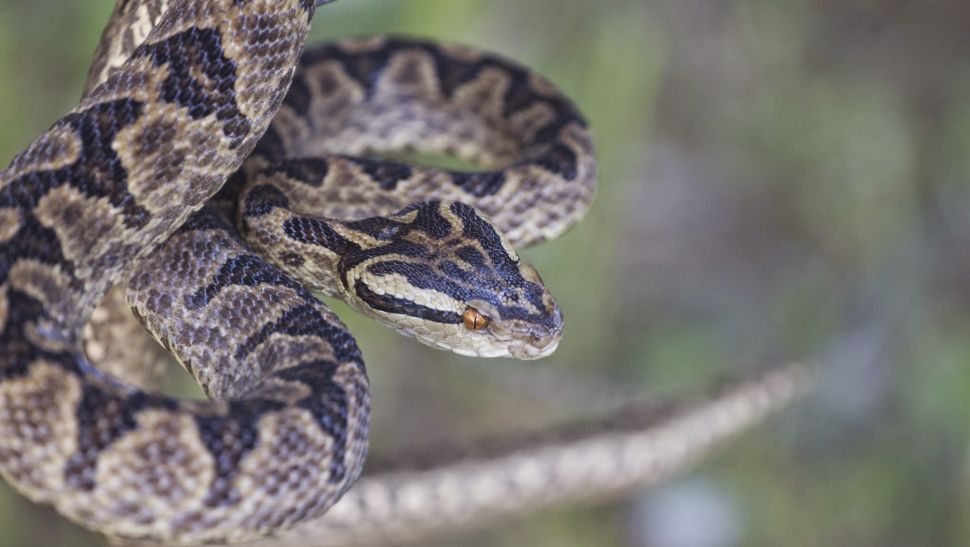
The researchers started with the genome of the Taiwan habu (Trimeresurus mucrosquamatus), a brown pit viper that is well studied, in part because it's an invasive species in Okinawa.

"Since we know the function of all the genes that were present in the animal, we could just see what genes the venom genes are associated with," Barua said.

The team found a constellation of genes that are common in multiple body tissues across all amniotes. (Amniotes are animals that fertilize their eggs internally or lay eggs on land; they include reptiles, birds and some mammals.)

Many of these genes are involved in folding proteins, Barua said, which makes sense, because venomous animals must manufacture a large quantity of toxins, which are made of proteins.


"A tissue like this really has to make sure that the protein it is producing is of high quality," he said.

Unsurprisingly, the same sorts of regulatory housekeeping genes are found in abundance in the human salivary gland, which also produces an important stew of proteins - found in saliva - in large quantities. This genetic foundation is what enables the wide array of independently evolved venoms across the animal kingdom.

Researchers studied the genome of the Taiwan habu, a venomous brown pit viper. (Alexander Mikheyev)Researchers studied the genome of the Taiwan habu, a venomous brown pit viper. (Alexander Mikheyev)

Related: Are you genetically more similar to your mom or your dad?

From nonvenomous to venomous

In other words, every mammal or reptile has the genetic scaffolding upon which an oral venom system is built. And humans (along with mice) also already produce a key protein used in many venom systems. Kallikreins, which are proteins that digest other proteins, are secreted in saliva; they're also a key part of many venoms.

That's because kallikreins are very stable proteins, Fry said, and they don't simply stop working when subjected to mutation. Thus, it's easy to get beneficial mutations of kallikreins that make venom more painful, and more deadly (one effect of kallikreins is a precipitous drop in blood pressure).


"It's not coincidental that kallikrein is the most broadly secreted type of component in venoms across the animal kingdom, because in any form, it's a very active enzyme and it's going to start doing some messed-up stuff," Fry said.

Kallikreins are thus a natural starting point for theoretically venomous humans.

If after the drama of 2020, Barua joked, "people need to be venomous to survive, we could potentially start seeing increasing doses of kallikreins." 

But that's not so likely - not unless humans' currently successful strategies of acquiring food and choosing mates start falling apart, anyway. Venom most commonly evolves as either a method of defense or as a way of subduing prey, Jenner told Live Science. Precisely what kind of venom evolves depends heavily on how the animal lives.

Evolution can essentially tailor venom to an animal's needs via natural selection, Fry said.

There are some desert snakes, for example, that have different venom despite being the same species, just due to where they live, he said: On the desert floor, where the snakes hunt mostly mice, the venom acts mostly on the circulatory system, because it's not difficult for a snake to track a dying mouse a short distance on flat ground. In nearby rocky mountains, where the snakes hunt mostly lizards, the venom is a potent neurotoxin, because if the prey isn't immediately immobilized, it can easily scamper into a crevice and disappear for good.

A few mammals do have venom. Vampire bats, which have a toxic saliva that prevents blood clots, use their chemical weapon to feed from wounds more effectively. Venomous shrews and shrew-like solenodons (small, burrowing mammals) can outpunch their weight class by using their venom to subdue larger prey than they could otherwise kill.

Shrews also sometimes use their venom to paralyze prey (typically insects and other invertebrates) for storage and later snacking. Meanwhile, platypuses, which don't have a venomous bite but do have a venomous spur on their hind legs, mostly use their venom in fights with other platypuses over mates or territory, Jenner said.

Humans, of course, have invented tools, weapons and social structures that do most of these jobs without the need for venomous fangs. And venom is costly, too, Fry said. Building and folding all those proteins takes energy. For that reason, venom is easily lost when it isn't used.

There are species of sea snakes, Fry said, that have vestigial venom glands but are no longer venomous, because they switched from feeding on fish to feeding on fish eggs, which don't require a toxic bite.

The new research may not raise many hopes for new superpowers for humans, but understanding the genetics behind the control of venom could be key for medicine, Fry added.

If a cobra's brain were to start expressing the genes that its venom glands expressed, the snake would immediately die of self-toxicity. Learning how genes control expression in different tissues could be helpful for understanding diseases such as cancer, which causes illness and death in large part because tissues start growing out of control and secreting products in places in the body where they shouldn't.

"The importance of this paper goes beyond just this field of study, because it provides a starting platform for all of those kinds of interesting questions," Fry said.

The research was published online Monday (March 29) in the journal Proceedings of the National Academy of Sciences.

Related mysteries: 
What if temperature determined a baby's sex?
What if humans had photosynthetic skin?
What if all humans on Earth had albinism?

This article was originally published by Live Science. Read the original article here.


#Nature | https://sciencespies.com/nature/humans-have-the-biological-toolkit-to-have-venomous-saliva-study-finds/

Carried with the wind: Mass migration of Larch Budmoth to the Russian High Arctic

Arctic habitats have fascinated biologists for centuries. Their species-poor insect faunas, however, provide little reward for entomologists -- scientists who study insects -- to justify spending several weeks or even months in the hostile environments of tundra or polar deserts. As a result, data on insects from the High Arctic islands are often based on occasional collecting and remain scarce.


Vize Island, located in the northern part of the Kara Sea, is one of the least studied islands of the Russian High Arctic in terms of its biota. Scientists Dr Maria V. Gavrilo of the Arctic and Antarctic Research Institute in Russia and Dr Igor I. Chupin of the Institute of Systematics and Ecology of Animals in Russia visited this ice-free lowland island in the summer of 2020.


"Our expedition studied the ecology of Ivory Gull," Maria Gavrilo says, "but we also looked for other wildlife." Because of the lack of data, scientists appreciate any observation on insects they can get from the High Arctic.


On the island, the team found hundreds of small moths. They were identified by Dr Mikhail V. Kozlov of the University of Turku, Finland, as Larch Budmoths -- the first and only terrestrial invertebrate to ever be observed and collected on Vize Island. Their observations are published in the open-access, peer-reviewed journal Nota Lepidopterologica.


The scientists first observed live and freshly dead moths on the sandy banks of a pond near the meteorological station. Then, they saw hundreds of them at the sandy bottom of a river valley with shallow streams. Moths, single or in groups, were mostly found at the water's edge, along with some fine floating debris. Despite extremely low daily temperatures (+2-5°C), flying moths were also spotted on several occasions.


The larvae of Larch Budmoth feed on the needles of different coniferous trees. Because Vize Island is located 1000 km north of the tree limit, the scientists can be sure about the migratory origin of the moths observed on Vize Island. They were likely transported there on 12-14 July 2020 by strong winds coming from the continent. The nearest potential source population of Larch Budmoth is located in the northern part of the Krasnoyarsk Region, which means they travelled at least 1200 km.


Importantly, some moths remained alive and active for at least 20 days after their arrival, which means that long-distance travel did not critically deplete resources stored in their bodies. The current changes in climate are making it easier for more southerly insects to invade species-poor areas in the High Arctic islands -- provided they can reach them and survive there.


"The successful arrival of a large number of live moths from continental Siberian forests to Vize Island has once more demonstrated the absence of insurmountable barriers to initial colonisation of High Arctic islands by forest insects," concludes Mikhail Kozlov, who has studied Arctic insects for decades. "The Arctic islands will be colonised by forest insects as soon as changing environmental conditions allow the establishment of local populations."


Story Source:


Materials provided by Pensoft Publishers. The original story is licensed under a Creative Commons License. Note: Content may be edited for style and length.


#Environment | https://sciencespies.com/environment/carried-with-the-wind-mass-migration-of-larch-budmoth-to-the-russian-high-arctic/