Featured Post

Tracking air pollution disparities -- daily -- from space

Studies have shown that pollution, whether from factories or traffic-snarled roads, disproportionately affects communities where economicall...

Wednesday, October 30, 2019

WRC-19 begins • Hiber buys green thrusters • Ariane 6 facility inaugurated in Germany

To receive FIRST UP Satcom, a weekly SpaceNews newsletter for satellite and telecom professionals, sign up here.


TOP STORIES


The 2019 World Radiocommunication Conference began this week in Sharm el-Sheikh, Egypt. The satellite industry and the cellular industry are both hoping to gain new spectrum — cellular operators for 5G networks, and satellite operators for earth stations in m​otion (ESIMs) used to link aircraft, maritime vessels and land vehicles. Regulators at WRC-19 will debate several other topics, including deployment milestones for non-geosynchronous satellite constellations like OneWeb and SpaceX, spectrum for high-altitude platforms, and protection of environmental satellites. The conference, hosted by the International Telecommunication Union, runs until Nov. 22. [ITU]


Dutch smallsat IoT startup Hiber signed a contract with propulsion startup Dawn Aerospace to use green thruster systems on its third and fourth satellites. Hiber launched its first two satellites in late 2018. The next two satellites, scheduled to launch in early 2020, will use a 1-unit Attitude and Orbit Control System from Dawn Aerospace that runs on Nitrous Oxide and Propene. Dawn claims its chemical propulsion system has 1,000 times the thrust of competing electric propulsion systems. Maarten Engelen, Hiber’s chief technology officer, said the company concluded Dawn’s propulsion system was the only of its kind that could support Hiber’s cubesats while keeping them at a 3U size. [Dawn Aerospace]


ArianeGroup has inaugurated its new integration facility for rocket upper stages in Bremen, Germany, and is finalizing integration of two Ariane 6 upper stages there. Roughly 100 of the 550 people employed at ArianeGroup’s Bremen site are working in the new integration facility. Ariane 6 will use a re-ignitable upper stage engine called Vinci, designed to place multiple satellites into different orbits, including constellations. ArianeGroup Germany CEO Pierre Godart said the “qualifying phase” for Ariane 6’s first flight in the second half of 2020 is now underway. [ArianeGroup]


MORE STORIES


China Satcom selected Gilat Satellite Networks to upgrade its infrastructure with hardware using the DVB-S2X transmission protocol. Gilat said it will work with China Satcom to bolster the delivery of satellite communications services in aviation and maritime, as well as fixed and mobile land applications. China Satcom has the only available Ka-band satellite system, ChinaSat-16, approved for in-flight Wi-Fi in China. [Gilat]


EchoStar has acquired a Canadian IoT satellite company. EchoStar said it has purchased Helios Wire Corporation and its Australian subsidiaries. Helios Wire had been developing a satellite constellation to provide IoT services at S-band, with one satellite launched late last year. An EchoStar executive said the deal “advances our strategy and further lays the foundation for a global S-band solution for the future.” Terms of the acquisition were not disclosed. [EchoStar]


Eutelsat has signed an agreement with Thales Alenia Space for a new communications satellite. Eutelsat-10B, slated for launch in 2022, will be an all-electric satellite with more capacity than Eutelsat-10A, the satellite it will replace. The satellite, based on the Spacebus NEO platform, will produce 14 kilowatts of power to support the Ku-band high-throughput payloads, plus traditional C- and Ku-band widebeam capacity. Eutelsat said multiple in-flight Wi-Fi providers, including Gogo, have committed to lease more than a third of the new high-throughput satellite capacity. [SpaceNews]


KVH has released a satellite terminal that enables boats to receive 4K Ultra-HD television out at sea. The company’s TracVision UHD7 uses a 60-centimeter antenna to access HD and Ultra-HD content from DirecTV. The terminal features multi-axis tracking to maintain satellite links while vessels move. [KVH]


SES said its revenues fell in the first three quarters as the year as new data services failed to make up for declining video services. The $1.591 billion in revenue SES reported was down 3.6% from the same period last year. TV broadcasting revenue dropped even more, down 8.1%. SES blamed the video decline on U.S. broadcasters dropping standard-definition channels, along with changes in how customers in general watch television. The company is emphasizing cloud services, including new ones for broadcast customers where they can use Microsoft Azure to transfer video files, prepare content for broadcast and other functions. [SpaceNews]


Brazilian satcom provider Arycom has partnered with Web Manuals, a company that provides digital documents for the aviation sector, to make digital aviation manuals available via satellite. The partnership helps expand access to aviation manuals across the Americas, according to the companies. [Arycom]


SpaceNews Senior Staff Writer Jeff Foust contributed to this newsletter.


#Space | https://sciencespies.com/space/wrc-19-begins-%e2%80%a2-hiber-buys-green-thrusters-%e2%80%a2-ariane-6-facility-inaugurated-in-germany/

The language of rugby inspires world-first study


The language of rugby inspires world-first study

Stuart Benson and his Japanese rugby team. Credit: Victoria University of Wellington
More

Rugby union may have one sporting code but Stuart Benson says it has many technical terms that can be misinterpreted by players from different cultural and language backgrounds. As part of his Ph.D. in Linguistics, he has created a list of these words, and developed a first-of-its-kind English for Special Purposes (ESP) course for rugby players.

"I went to Japan as a high school exchange student, and to assimilate into a new country and culture, I joined the school's rugby team," says Stuart. "The technical was not the only linguistic barrier I needed to overcome. Pronunciation of this vocabulary and new and altered phrases were tricky, and in Japan at that time there was no rugby on television."


Stuart surveyed 86 coaches and players in Japan and New Zealand on the language difficulties they had found when traversing cultural barriers.


"I was surprised at the number of people that had also experienced language difficulties when playing rugby. Of the 86 survey participants, 84 noted that language difficulties affect their ability to play or the game. This is worrying, as there is an ever-increasing number of players and coaches taking their expertise abroad to play or coach professionally."


He says the lexicon of sport has not been researched extensively in any code until now. "The few studies that have been conducted are in football/soccer. Although the majority of those studies are sociological investigations, in which language is just one part of the study, is shown to be a major aspect that hinders the immersion of players and coaches in any foreign team."


Stuart discovered that arose playing the game as well as during practice, due to a lack of fluency in both everyday and technical vocabulary. The ESP course he developed as part of his research includes a needs-analysis for players when effectively communicating in rugby.


"This has led to a principle-based course that contains tasks and goals to meet the players' needs. I have created four technical vocabulary word lists for use in the rugby classroom. This course uses these word lists so players can learn the most frequent vocabulary in rugby."


He says ESP courses have become more prevalent over the past decade or so. "If you can learn specialised English that is on a topic you are interested in, you will be more motivated to learn. We usually see these courses for business English or other professional concerns," says Stuart.


"This is the first ESP for sports, so I am interested not only in providing this course for , separately targeted at coaches and players, but also for other sports, like football."


Explore further


Rugby-style tackling may have lower force of impact than football-style tackling


Citation:
The language of rugby inspires world-first study (2019, October 30)
retrieved 30 October 2019
from https://phys.org/news/2019-10-language-rugby-world-first.html


This document is subject to copyright. Apart from any fair dealing for the purpose of private study or research, no
part may be reproduced without the written permission. The content is provided for information purposes only.


#Humans | https://sciencespies.com/humans/the-language-of-rugby-inspires-world-first-study/

In one direction or the other: That is how DNA is unwound


In one direction or the other: That is how DNA is unwound

The 'book of life' must be opened to be read. An international research group sheds light on one of the key mechanisms of cell life by joining computer simulations and lab experiments. The research has been published on PNAS. Credit: Francesco Colizzi
More

Joining computer simulations and lab experiments, an international research group sheds light on one of the key mechanisms of cell life.

From home to office and back. The road is the same, and yet the outbound journey is longer than the inbound journey. Why is that? The reason is the obstacles the car driver usually finds on his way to work, which are absent on the way back. Now, replace the road with DNA strands and you will have grasped the crux of the discovery just published by an international research group on the journal PNAS.


The of DNA is subject to the action of specific proteins, called helicases, which have the task of separating the two strands so that the information contained in the genome is made available for a variety of activities that are essential to cell life. In short, DNA is like a book, it needs to be opened to be read! Helicases have the task of opening this "book."


Through this work, researchers have shown that helicases succeed in carrying out their task more easily, and therefore quickly, working on one of the two strands with respect to the other. They explained that the reason lies in the sequence composition of the DNA section. As we know, DNA has four nitrogenous bases, which constitute the alphabet that is used to write our genome. When there are "hindered" bases like adenine and guanine on the strand opposite to that on which the helicase moves, they bump against the helicase and make the process slower. If, on the contrary, there are "small" bases, like cytosine and thymine, the opening process is faster.


The scientists infer that this could mean that the genome has yet-another way, which has not been considered until now, of regulating the flow of information: indeed, the genetic information connected with the direction in which the helicase proceeds more slowly will be read less frequently—with possible consequences on gene expression. The research was initially conducted with . The predictions obtained in this manner were then confirmed by experiments.


The study emerged from an idea of two SISSA scientists, Professor Giovanni Bussi and Francesco Colizzi, who has since moved to the Institute for Research in Biomedicine (IRB Barcelona), Spain, and has involved the laboratories led by Carlos Penedo and Malcolm White at the University of Saint Andrews, Great Britain, with their collaborators.


First theory and then experiment


We know that the difficulty in unwinding a double strand of DNA or RNA depends on the strength which binds the two, but that the same double was easier to unwind in one direction rather than the other has been a real surprise. We have come to propose this hypothesis through computer simulations and subsequently designed real lab experiments that could prove or disprove the hypothesis. Eventually, the lab experiments proved that the hypothesis was correct.


Thanks to fluorescent tracers, the researchers observed that in the experiment the double helix is processed more easily in one direction rather than the other. In short, there is one strand and one preferential direction for unwinding DNA according to the message written in it. Scientifically, this is very interesting. Since the helicase opens the double helix moving on a strand separating it from the opposite one, we have hypothesised and verified that the speed of this process depends on the composition of the bases of the latter. If there are many bumpy bases, like guanine and adenine, then the will have a more complex task and proceed more slowly. And vice versa. What we can say is that the direction with which it is easier to separate a double helix depends on the sequence of bases in a specific region.


The implications of the discovery


This discovery bears different points of interest. The first, as we said, is connected with the approach that brings together computer simulations and lab experiments in a combination that leads us straight to the frontiers of science.


The second is of a more general nature: The regulation of all the activities in which DNA is involved is one of the most interesting and crucial issues of biology, in which much more still needs to be discovered. With this study we put forward a hypothesis that has not been considered so far: namely, that the various types of regulation already known are joined by another which relates specifically to the preferential direction in which a double strand is read, based on the ease of being unwound.


There is an additional, more speculative consideration, based on the observation that DNA unwinds in a different way to RNA. For DNA, we find helicases able to work in both directions. Instead, for RNA, the helicases found in nature follow mostly one-way roads. The hypothesis of the scientists is that the double helix of RNA has some sort of geometrical asymmetry (different to DNA) that, throughout evolution, has dictated the one-way direction of RNA helicases. It can therefore be speculated that evolution has selected the helicases that process RNA in the direction in which it is easy to travel.


Unfortunately, a of this kind cannot be refuted or verified: to do so, it would be necessary to retrace the natural evolution for millions of years, eliminating this preference and seeing what happens! It is definitely fascinating to think that the geometry of the double helix can have deeply influenced the development of molecular machines necessary for life.


Explore further


Motor enzyme protects genome through several mechanisms


More information:
Francesco Colizzi et al, Asymmetric base-pair opening drives helicase unwinding dynamics, Proceedings of the National Academy of Sciences (2019). DOI: 10.1073/pnas.1901086116


Citation:
In one direction or the other: That is how DNA is unwound (2019, October 30)
retrieved 30 October 2019
from https://phys.org/news/2019-10-dna-unwound.html


This document is subject to copyright. Apart from any fair dealing for the purpose of private study or research, no
part may be reproduced without the written permission. The content is provided for information purposes only.


#Biology | https://sciencespies.com/biology/in-one-direction-or-the-other-that-is-how-dna-is-unwound/

First experimental study for traceological interpretation at Olduvai sites


First experimental study for traceological interpretation at Olduvai sites

Credit: CENIEH

Patricia Bello-Alonso of the Centro Nacional de Investigación sobre la Evolución Humana (CENIEH) has reported on experimental results for the traceological interpretation of activities carried out using stone tools made from the most representative raw material at the Olduvai Gorge sites (Tanzania), naibor soit quartzite. The results are published in Quaternary International.


This study presents the macro and micro-marks produced on the edges of experimental during their use on a diversity of types of plants (roots, tubers, , canes and wood), and bone and carcass processing, with the objective of identifying these kinds of marks in the .


"By doing this, we have obtained an extensive reference collection of unretouched flakes made by knapping blocks of naibor quartzite," says Bello-Alonso, whose paper forms part of the traceological studies she is conducting at the Acheulean site of Thiongo Korongo (TK), around 1.3 million years old.


One of the novelties included in the work is the description and interpretation of the macro and micro-topographical changes in the surface of naibor soit quartzite. Based on the results, the researchers have developed criteria to distinguish the kinds of activities and materials by recording attributes including pitting and micro-polish.


This has made it possible to compile an interpretive database, both macroscopic and microscopic, which could enable and enhance functional interpretation of lithic utensils from the Acheulean site of TK and the majority of the other Olduvai Gorge sites where this same raw material was employed.


Explore further


Experimental work reproduces the knapping process at Olduvai


More information:
Patricia Bello-Alonso et al. A use-wear interpretation of the most common raw materials from the Olduvai Gorge: Naibor Soit quartzite, Quaternary International (2019). DOI: 10.1016/j.quaint.2019.09.025


Provided by
CENIEH


Citation:
First experimental study for traceological interpretation at Olduvai sites (2019, October 30)
retrieved 30 October 2019
from https://phys.org/news/2019-10-experimental-traceological-olduvai-sites.html


This document is subject to copyright. Apart from any fair dealing for the purpose of private study or research, no
part may be reproduced without the written permission. The content is provided for information purposes only.


#Biology | https://sciencespies.com/biology/first-experimental-study-for-traceological-interpretation-at-olduvai-sites/

Fire crews race to contain California blazes ahead of dangerous winds


A rescue helicopter flies over Brentwood while the Los Angeles skyline is seen behind smoke from the Getty Fire

A rescue helicopter flies over Brentwood while the Los Angeles skyline is seen behind smoke from the Getty Fire
More

Fire crews battled to contain two major blazes in California on Tuesday as authorities warned that winds with dangerous gusts of up to 70 miles per hour threaten further havoc.

The National Weather Service issued a 24-hour advisory beginning from noon Tuesday for the northern part of California, where more than 4,500 firefighters have been deployed to fight the Kincade Fire—the largest in the state this year.


Farther south, where a fire near the Getty Center west of downtown Los Angeles has forced evacuations in upscale neighborhoods, the warned of "extremely critical fire weather" beginning late Tuesday.


"This Santa Ana wind event will likely be the strongest we have seen so far this season," the weather service said, referring to dangerous winds that kick up in southern California every year.


"These combined with a long duration of single-digit humidities and dry fuels will likely bring very critical fire weather conditions, making this an extreme red flag warning event."


Los Angeles Mayor Eric Garcetti said that the more than 7,000 residents evacuated in the wake of the Getty Fire, which erupted Monday and has burned at least eight homes, should not plan on returning until conditions are safe.


"Our goal today is to increase containment as much as possible," Los Angeles Fire Department Chief Ralph Terrazas told a news conference. He said the fire has scorched 656 acres and was five percent contained as of early Tuesday.


"Lord Snort," a steel sculpture of a boar, is seen amid the rubble after the Soda Rock Winery was lost in the Kincade

"Lord Snort," a steel sculpture of a boar, is seen amid the rubble after the Soda Rock Winery was lost in the Kincade Fire in Healdsburg, California
More


'Takes one ember'


"It only takes one ember to blow downwind and start another fire," Terrazas said. "Embers have been known to travel several miles, so we are very concerned about tonight's wind event."


The critical warnings came just days after Governor Gavin Newsom declared a statewide emergency because of the fires.


California's largest utility, Pacific Gas & Electric, has meanwhile been imposing rolling blackouts in the northern and central part of the state that have affected millions of people in a bid to reduce the risk of fire.


The company, which said that one of its transmission lines had malfunctioned near the origin of the Kincade Fire, north of San Francisco, announced on Tuesday that it was cutting power to nearly 60,000 customers as a precaution.


The Kincade Fire erupted last Wednesday, prompting the evacuation of nearly 200,000 people and destroying dozens of homes and wineries in the famed Sonoma region.


A photo from NASA's Terra satellite shows the smoke plume cascading down the coast from California's devastating Kincaid Fire in

A photo from NASA's Terra satellite shows the smoke plume cascading down the coast from California's devastating Kincaid Fire in Sonoma County
More


Authorities said they don't expect to contain the —which has grown to 118 square miles—before November 7, after which it could still smolder for weeks.


At least a dozen other fires have broken out throughout the state in the last eight days, fed by strong winds, low humidity and high temperatures.


The wildfires come as California is still reeling from the aftermath of the most destructive wildfire in state history—the Camp Fire, which destroyed the town of Paradise and killed 86 people.


Similar blazes in northern California, including in the Napa and Sonoma wine regions, killed 44 people in 2017 and destroyed thousands of structures.


Fire authorities determined that PG&E transmission lines caused the Camp Fire. The utility, which filed for bankruptcy earlier this year, has been held responsible for a number of other wildfires in recent years.


Explore further


State of emergency declared as California wildfires rage


© 2019 AFP


Citation:
Fire crews race to contain California blazes ahead of dangerous winds (2019, October 29)
retrieved 30 October 2019
from https://phys.org/news/2019-10-crews-california-blazes-dangerous.html


This document is subject to copyright. Apart from any fair dealing for the purpose of private study or research, no
part may be reproduced without the written permission. The content is provided for information purposes only.


#Environment | https://sciencespies.com/environment/fire-crews-race-to-contain-california-blazes-ahead-of-dangerous-winds/

Classic energy theory fails to explain coral distribution across depth


Classic energy theory fails to explain coral distribution across depth

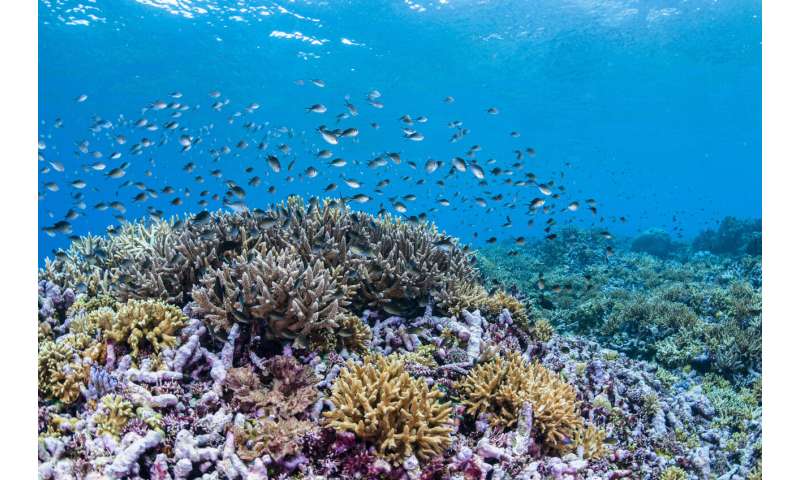
Coral reefs in Kimbe Bay, Papua New Guinea. Credit: T.E. Roberts, Tethys Images
More

Coral species richness at different depths is unrelated to energy availability, according to a new study analysing diversity across an Australasian reef.

Research from James Cook University, Lancaster University, the University of Copenhagen and Queensland University of Technology, published in Biology Letters, reveals neither alone, nor in combination with other local factors, accounts for differences in the diversity of coral species across depth.


The research, funded by the Australian Research Council Centre of Excellence Programme, generated an unprecedented dataset of 8,460 coral colonies across six reefs in Kimbe Bay, Papua New Guinea.


This allowed the team to conduct a robust test of the drivers that underlie how corals are distributed over depth for the first time, enabling them to test the theory that there will be a greater species diversity where there is greater available energy.


For corals, the highest diversity was expected in the shallows because they depend on energy from sunlight. To test this idea, researchers surveyed diversity at depths of between 0 and 45 metres, reaching significantly deeper than most previous surveys, and covering 98 per cent of the light gradient.


Classic energy theory fails to explain coral distribution across depth

Coral reefs in Kimbe Bay, Papua New Guinea. Credit: T.E. Roberts, Tethys Images
More


In contrast to the expectations based on the theory, the research revealed that coral diversity among the team's samples was highest at depths of between 15 and 20 metres.


Lead author Dr. Edward Roberts, of James Cook University, said: "Our understanding of how coral diversity varies across depth has been limited by a lack of high quality data due to the difficulty of deeper surveys.


"We were able to overcome that in our survey in Kimbe Bay. This allowed us to test the classic Species Energy hypothesis that proposes the greater the energy available, the greater the diversity, as theoretically more energy allows more individuals to co-exist. This in turn allows more species to maintain large enough populations to avoid local extinction.


"Our results do not agree with this classic explanation of how diversity changes with energy. Instead, the shallowest depths had fewer , a pattern also poorly explained by alternative explanations such as competition between corals or environmental disturbance."


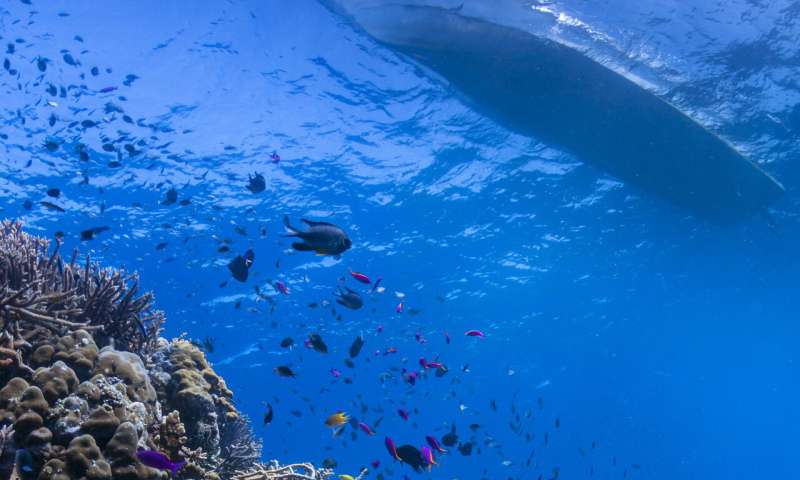
Coral species richness at different depths is unrelated to energy availability. Narrated by Dr Edward Roberts. Credit: T.E. Roberts, Tethys Images
More

The results of the research provide cause to find new theories about diversity distribution.


Co-author Dr. Sally Keith, of Lancaster Environment Centre, said: "Hyper-diverse corals reefs are ideal ecosystems to theories about how diversity is distributed in nature, so it is really interesting that our results do not support the classic hypotheses."


"More broadly, our analyses cast doubt on the suitability of these hypotheses more generally across terrestrial, marine and freshwater systems, suggesting that ecologists might need to rethink the underlying causes of these fundamental patterns of ."


Explore further


Fussy fish can have their coral, and eat it too


More information:
Testing biodiversity theory using species richness of reef-building corals across a depth gradient, Biology Letters (2019). royalsocietypublishing.org/doi … .1098/rsbl.2019.0493


Citation:
Classic energy theory fails to explain coral distribution across depth (2019, October 29)
retrieved 30 October 2019
from https://phys.org/news/2019-10-classic-energy-theory-coral-depth.html


This document is subject to copyright. Apart from any fair dealing for the purpose of private study or research, no
part may be reproduced without the written permission. The content is provided for information purposes only.


#Biology | https://sciencespies.com/biology/classic-energy-theory-fails-to-explain-coral-distribution-across-depth/

Tuesday, October 29, 2019

NYC Monument Will Honor African-American Family Displaced to Make Way for Central Park


During the mid-19th century, a predominantly African-American community known as Seneca Village blossomed between New York’s West 83rd and 89th Streets. Many of its members owned their own property, set apart from the crowds—and discrimination—of the city’s more populated downtown area. But when local authorities began moving forward with plans to build Central Park, Seneca Village’s residents were forced to leave their homes.


A planned monument announced by Mayor Bill de Blasio’s office earlier this month is set to honor a prominent African-American family that once lived in the bustling community. As Julia Jacobs reports for the New York Times, the monument will pay tribute to the Lyons family, a trio of abolitionists, educators and property owners made up of Albro, Mary Joseph and their daughter Maritcha.


According to Carla L. Peterson, a scholar at the University of Maryland who is related to the family, the Lyonses ran a boarding house for African-American sailors that doubled as a stop on the Underground Railroad. Maritcha, an esteemed educator and political activist, also co-founded the the Woman’s Loyal Union of New York and Brooklyn, which advocated for women’s rights and racial justice.


Interested artists can submit design proposals for the new monument via an open-call portal. Per Jacobs, the memorial will be privately funded by the Ford Foundation, the JPB Foundation, the Andrew W. Mellon Foundation and the Laurie M. Tisch Illumination Fund.


The project, or more specifically its proposed location on 106th Street, some 20 blocks north of where Seneca Village was actually located, has attracted criticism: “It’s disrespectful and it’s insulting,” Jacob Morris, director of the Harlem Historical Society, tells Hyperallergic’s Kate Gill. “The naming or honoring of a person or an organization should be connected to the life and work of the person. … Where is just an important as why or who.”


Some critics contend that the city has rushed efforts to shake up its selection of public monuments. In recent years, New York has been working to increase the diversity of its public statues—and manage ones that are seen as controversial. Last year, for instance, the city took down a statue of J. Marion Sims, a doctor who performed gynecological operations on enslaved black women, at times without anesthesia. Also in 2018, New York City’s first lady, Chirlane McCray, announced the launch of She Built NYC, an initiative that seeks to bolster women’s representation among the city’s statuary.


Local officials have defended the planned Lyons memorial. In a statement quoted by the Times’ Jacobs, a city spokesperson said the monument is “not just to Seneca Village, but the Lyons’ family’s broader experiences.”


A spokesperson for the Department of Cultural Affairs echoed this sentiment, telling Gill, “A range of factors are considered when selecting sites for public monuments, including feasibility, cost, historical significance, contemporary context, and public prominence. The Lyons family’s contributions exemplified values that still resonate powerfully here and beyond.”


Seneca Village can trace its origins to 1825, when, according to the Central Park Conservancy, two landowners subdivided their property and began selling it off as lots. One Andrew Williams, a 25-year-old African-American shoeshiner, was the first to purchase land in the new settlement. By 1855, around 225 people lived in the village: Two-thirds were African-American, and the remaining one-third were Irish immigrants.


The residents of Seneca Village appear to have been fairly prosperous, with many owning their own land and living in two-story homes. Isolated on the Upper West Side, the community was set apart from the unsanitary neighborhoods of the downtown core. Most importantly, the conservancy notes, “Seneca Village’s remote location likely provided a refuge” from the racism that continued to pervade the city even after slavery was abolished in New York in 1827.


The thriving enclave came to an end in the mid-19th century, when officials decided to create a nature expanse to offset the congested conditions of New York’s growing urban sprawl. The city legislature enacted a law that dedicated 775 acres of land in Manhattan to the project, and the government, acting under the power of eminent domain, requisitioned private land for public use. Landowners were compensated, but as the conservancy notes, many residents complained that their land had been undervalued.


Seneca Village’s residents weren’t the only ones who had to surrender their property to the new park; according to the conservancy, some 1,600 people were ultimately displaced. Still, Diana Wall, an anthropologist who spearheaded an excavation of the Seneca Village area in 2011, tells City Metric’s Barbara Speed that something unique was lost when Seneca Village disappeared.


“Many of the residents stayed relatively local to New York [after the village was demolished], but what they did not do was stay together,” Wall explains. “And that’s what’s so tragic: It was a community, and then the community was gone.”


A text-heavy commemorative plaque currently stands on the Seneca Village site. By spotlighting the Lyons family with a new memorial, Tom Finkelpearl, New York City’s cultural affairs commissioner, says to Jacobs, officials hope to better recognize “the kind of history that tends to get left out of our public monuments.”


#History | https://sciencespies.com/history/nyc-monument-will-honor-african-american-family-displaced-to-make-way-for-central-park/