Featured Post

Tracking air pollution disparities -- daily -- from space

Studies have shown that pollution, whether from factories or traffic-snarled roads, disproportionately affects communities where economicall...

Monday, November 1, 2021

ABL Space Systems to launch Project Kuiper’s first satellites in 2022

TAMPA, Fla. — Amazon has signed a multi-launch deal with rocket developer ABL Space Systems, which plans to loft two prototype satellites for its Project Kuiper broadband megaconstellation next year.


ABL Space Systems aims to place the KuiperSat-1 and Kuiper-Sat-2 prototypes in low Earth orbit (LEO) by the fourth quarter of 2022 with its small launch vehicle RS1, which is counting down to its first launch late this year.


Amazon filed an experimental license application with the Federal Communications Commission Nov. 1 for the test spacecraft, which will not be part of the roughly 3,200 broadband satellites that Project Kuiper envisages for its operational constellation.


An Amazon official said KuiperSat-1 and Kuiper-Sat-2 will be designed for “atmospheric demise,” enabling them to be actively de-orbited following a testing mission it expects to last less than two years.


“All of the systems are testing well in simulated and lab settings, and we’ll soon be ready to see how they perform in space,” Project Kuiper vice president of technology Rajeev Badyal said in a blog post.


“There is no substitute for on-orbit testing, and we expect to learn a lot given the complexity and risk of operating in such a challenging environment.”


Amazon declined to disclose the performance it expects to achieve from KuiperSat-1 and KuiperSat-2, but said they will include much of the technology and subsystems that will power its production version.


The company has previously said Project Kuiper will offer speeds on par with terrestrial broadband networks. In a blog post late last year, Amazon said its customer terminal antenna prototype was “delivering speeds up to 400 Mbps (Megabits per second), and performance will continue to improve in future iterations.”


The Amazon official said the phased array and parabolic antennas that will connect to KuiperSat-1 and KuiperSat-2 will also be prototypes of its final design.


“They are similar to the final version, but we expect we’ll have learnings that get incorporated into final antenna designs,” the official said.


Each individual test will take no more than six minutes, the official added, and each KuiperSat will have five or fewer active testing contact windows per day.
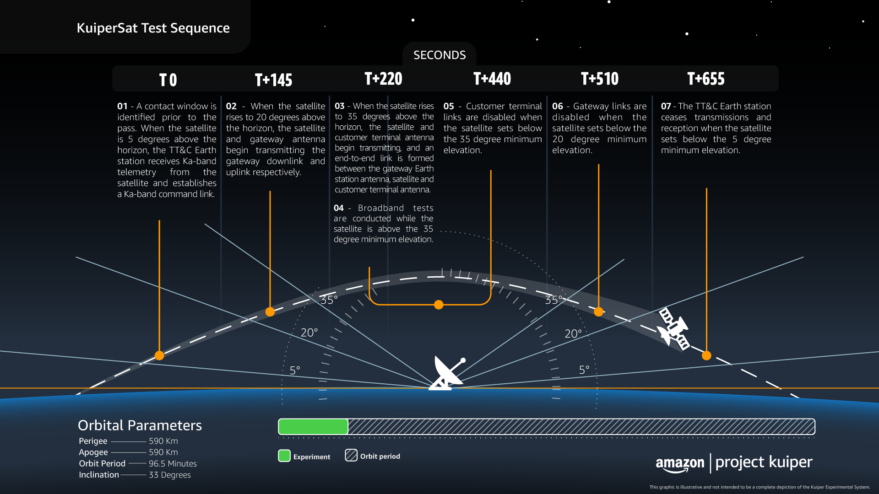

Launching two prototype satellites provides redundancy and enables Amazon to learn more from the tests than it would from a single mission, according to a company official. Credit: Amazon

Amazon has to deploy half its Project Kuiper constellation by July 2026 under its license conditions, and deploy the rest by July 2029.


The company said the development and manufacturing of Project Kuiper’s operational satellites will continue in parallel with its upcoming prototypes.


“Our manufacturing schedule will allow for us to incorporate any learnings from KuiperSat-1 and KuiperSat-2 into our final designs,” the Amazon official added.


According to regulatory filings, Amazon expects to deploy the Project Kuiper constellation in five phases. The first calls for 578 satellites to be placed at 630 kilometers altitude at an inclination of 51.9 degrees.


In April, Amazon said it ordered nine Atlas 5 rockets from United Launch Alliance to help deploy the network, without a time frame.


The company has committed an initial $10 billion to develop Project Kuiper and said Nov. 1 that more than 750 people are currently working on the constellation. It expects to add hundreds more to the team in the coming year.


Betting on a startup


ABL is preparing to perform its first RS1 launch from Kodiak Island, Alaska, with a launch period extending to Dec. 15.


Despite its lack of launches, the rocket builder recently raised an additional $200 million in a funding round valuing it at $2.4 billion. 


The financing came just seven months after ABL secured $170 million in a funding round valuing it at $1.3 billion.


ABL plans to use proceeds to scale up RS1 production to meet its projections for eight launches in 2022 and 16 in 2023.


The California-based company said RS1 can place up to 1,350 kilograms into LEO, using a launch system called GS0 that can be fully containerized and moved to different locations.


Amazon said the mobile launch platform provides the speed and flexibility it will need for its early launch missions.


“We have been impressed by ABL’s unique capabilities, rapid development progress, and dedication to customers, and RS1 delivers the right capacity and cost-efficiency to support our mission profile,” the Amazon official added.


The internet giant said it has already completed two integration design reviews with ABL after working together for several months, including plans for an adapter design.


Amazon expects to complete an initial fit check with ABL early next year for KuiperSat-1 and KuiperSat-2, which it said will launch from the Cape Canaveral Space Force Station in Florida.


#Space | https://sciencespies.com/space/abl-space-systems-to-launch-project-kuipers-first-satellites-in-2022/

Remoteness does not enhance coral reef resilience, according to marine ecologists

There's a widespread hypothesis that links the resilience of coral reefs with their remoteness from human activities -- the farther away they are from people, the more likely corals are to bounce back from disturbances.


"The idea is that these coral reefs might serve as arks, that they could harbor biodiversity and intact ecosystems," said UC Santa Barbara marine ecologist Adrian Stier of these ancient and fragile colonial organisms, most of which are under threat both locally, as from destructive fishing practices, and globally, as from ocean warming and acidification. "The hope is that these isolated areas might serve as a safe haven and, in the future, potentially repopulate areas that have been degraded.


However when Stier and colleagues put that hypothesis to the test, they found it didn't hold. No matter how remote some populations of corals were, on average they demonstrated no more resilience to acute disturbances than reefs with a greater human influence. And, contrary to expectations, there is some evidence that areas with greater human development may recover from disturbance faster than their more isolated counterparts.


"As an ecophysiologist, I'm usually studying how one individual coral or a population of corals responds to stress," said lead author Justin Baumann, a marine biologist at the University of North Carolina at Chapel Hill, and also at Bowdoin College in Maine. "This study was a chance to zoom out and think globally about what drives coral resilience at much larger spatial scales and to really explore relationships between human influence and resilience globally."


Their results are published in the journal Global Change Biology.


People and Corals


The researchers' findings challenge the long-held notion that humans are generally bad for ecosystems, and their results have significant implications for coral reef conservation and management, according to Stier.


"I got really curious about that idea, because after working regularly for the past 15 years on coral reefs, I've seen these big changes happen to coral reefs -- seeing corals die, big thermal events, lots and lots of mortality," he said.


But he's also seen amazing comebacks, such as around the island of Mo'orea in French Polynesia about 10 years ago, when a sea star outbreak devastated the local coral reefs -- habitats upon which the local community relies heavily for food and income. Stier expected to see the demise of the ecological communities that rely on the corals for protection from storms and as a source of food, but they were surprised to find the opposite.


"Over the past 10 years or so, we've seen some of these ecosystems recover and evolve. In some areas corals have come back and repopulated the reef in an incredible way," Stier said.


So if an area with a heavy human presence can regain its coral reefs, does remoteness really promote resilience?


To find out, the researchers dove deep into data taken from studies that monitored coral resilience and recovery after major disturbances at hundreds of sites around the world, including in the Caribbean Sea, the Indian Ocean and the west and east Pacific Ocean. Coral resilience "varied tremendously" across both remote, protected sites and places with more intense human activity.


"Some places get knocked down and stay down and other places get knocked down and get back up," Stier said. "As scientists, we're still trying to figure out what underlies that capacity to bounce back for some systems and not others."


In some areas, resilience was "positively associated with human influence," a surprising finding, according to the researchers. One explanation for this counterintuitive scenario could be that the disturbances may have resulted in a substitution of one coral species for another.


"One reason we may be seeing higher resilience associated with higher human influence is a shift in coral population from competitive dominants to stress tolerant and weedy genera due to previous disturbances," Baumann said. "This shift, which is widely documented, can result in more coral cover, but loss of function on a reef."


They also found that while some factors contributed to the ability of coral to withstand or recover from disturbances, such as pre-disturbance coral cover, or co-occurring disturbances, other factors, including recovery time, travel time to nearest human population or marine protected area status showed no correlation with estimates of recovery.


But that doesn't mean we shouldn't still be trying to manage human influence, the researchers are careful to point out.


"It's important for us to consider sustainably managing fisheries in an equitable way, and it's important for us to think about land pollution in the ocean," Stier said. "But we can't rely on local management and preservation of remote areas to be this silver bullet that's going to be our safeguard." Many efforts to preserve local ecosystems and manage human influence are important for the habitats and animals and humans who live there. But when we look at coral reefs, the tendency is to gravitate to local management practices, such as fishing regulations and marine protected areas.


"Those are great and needed, but we've seen again and again that globally it is climate change that is responsible for the brunt of the damage," Baumann said. "We desperately need global scale decreases in greenhouse gas emissions -- likely to net zero -- to mitigate this stress."


Such a global approach would require a change in how corals reefs are managed -- ideally, in a way that spreads the work of conservation more equitably between the often poorer nations that are more acutely feeling the effects of global warming-driven marine events and the richer countries that contribute the majority of greenhouse gases to the atmosphere, said UCSB graduate student researcher Lily Zhao, an author on this paper who studies social and ecological systems.


"Marine conservation has a history of using spatial exclusion and protected-area designations to separate local communities from their reefs and culture, often in ways that have benefited white people," Zhao said. "While international conservation practices are improving, it is still common for Western institutions and funding agencies to tell communities in the tropics how to manage their reefs using power or money.


"Our findings allude to the idea that even if we removed local human stressors from a lot of these reefs, it still wouldn't be enough," she added. "To protect coral reefs, I think we should be spending less time telling coral reef dependent nations what to do with their resources and more time supporting their adaptation and advocating for drastic emissions reductions from the high-income countries that have caused the climate crisis."


#Nature | https://sciencespies.com/nature/remoteness-does-not-enhance-coral-reef-resilience-according-to-marine-ecologists/

Falcon Heavy could launch three U.S. Space Force missions in 2022

USSF-57 is the third U.S. national security launch to be added to the Falcon Heavy’s crowded 2022 manifest


WASHINGTON — Two U.S. Space Force missions on Falcon Heavy rockets that had been scheduled for 2021 have slipped into next year. There is now a third U.S. national security launch that will be added to the Falcon Heavy’s crowded 2022 manifest.


USSF-67, a classified national security mission to geostationary Earth orbit awarded to SpaceX last year under a $332 million contract, is “on track for mid-to-late 2022 launch,” a U.S. Space Systems Command spokesman confirmed Oct. 30. The mission will fly on a Falcon Heavy rocket with an expendable center core, although SpaceX will be able to recover the two side boosters.


The addition of a third national security mission for Falcon Heavy will make for quite a scheduling challenge for SpaceX’s three-core rocket that also is projected to launch in 2022 a Viasat-3 commercial broadband satellite with an Astranis communications satellite as a secondary payload, as well as NASA’s Psyche planetary science mission.


The Space Force missions USSF-44 and USSF-52 both were scheduled to fly in 2021 but have been delayed by payload readiness and range scheduling issues. No target launch dates have been announced yet although the Space Force said they would happen in 2022. Falcon Heavy rockets lift off from NASA’s Kennedy Space Center.


USSF-44 would be Falcon Heavy’s first national security direct-inject mission to geostationary orbit and SpaceX’s first mission to attempt a double droneship landing. The only known payload to fly on USSF-44 is the TETRA-1 small satellite made by Millennium Space Systems.


The Space Force has not disclosed payloads for USSF-52 or USSF-67. 


Whenever Falcon Heavy flies next will mark the vehicle’s first launch since June 2019 when the rocket carried two dozen small satellites on a demonstration mission for the U.S. Air Force called STP-2. Prior to STP-2, Falcon Heavy launched the Arabsat-6A communications satellite in April 2019 and Elon Musk’s Tesla Roadster in February 2018.


#Space | https://sciencespies.com/space/falcon-heavy-could-launch-three-u-s-space-force-missions-in-2022/

'Extreme morphologies' in ancient insects show how little we know them at all

Nothing makes for a time capsule quite like amber. Sealed in the golden gloop, ancient life-forms are transported across eternity to the modern day, preserved in impeccable detail, in all their weirdness and glory.


While the use of Burmese amber raises serious and complicated ethical concerns over how it is mined and sold, amber deposits in Myanmar yet represent a vast treasure trove of scientific discovery, showing what all kinds of diverse life looked like almost 100 million years ago.

Sometimes, what they look like is the opposite of what we expect, scientists report in a new study, documenting "extreme morphologies" in the fossilized larvae of ancient lacewings, of the insect order Neuroptera.

Lacewings, along with other kinds of Neuropterans, are part of a superorder of insects called Holometabola (aka Endopterygota), in which the insect undergoes holometabolism – a complete metamorphosis, as its body develops and transitions between each life stage.

"The enormous evolutionary and ecological success of Holometabola has been attributed to the niche differentiation between the adult and the often highly aberrant-appearing larva," explains a team of researchers, led by first author and paleobiologist Joachim Haug from Ludwig Maximilian University of Munich in Germany.

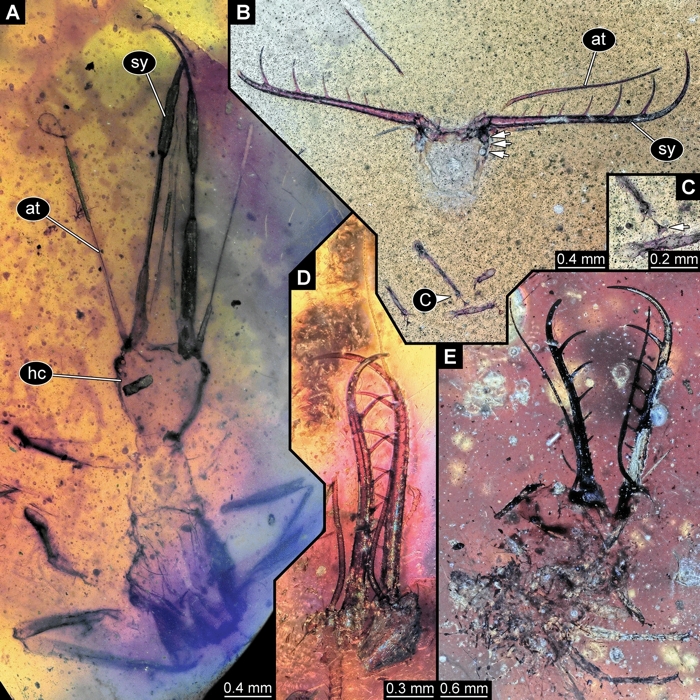
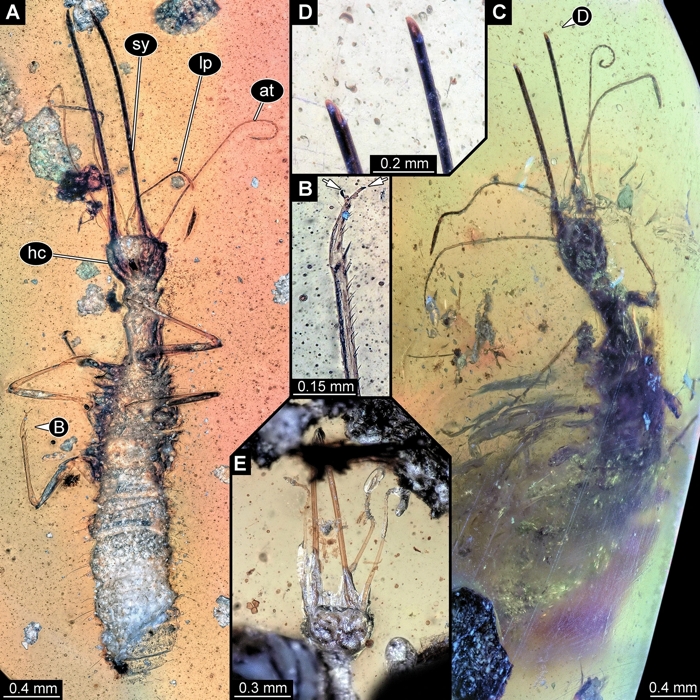
LacewingLarvae2(Haug et al., Scientific Reports, 2021)

Above: Elongated appendages and stylets in Cretaceous lacewing larvae.

Amongst these different life stages, there is a persistent idea in biological circles that the larvae of holometabolans – the immature forms of the insects, before they reach their adult stage – are necessarily undeveloped, worm-like things, having not yet had a chance to grow pronounced features such as eyes, antennae, mouthparts, and legs.


"It also has been suggested that holometabolan larvae are something like early hatched embryos, hence possessing a type of 'not-yet-ready' morphology," the researchers write in their paper.

"All these notions indirectly imply that holometabolan larvae are to a certain degree constrained in their possibilities to evolve morphologically diverse forms."

However, some very old lacewing larvae trapped in time from the late Cretaceous (about 100 million years ago) appear to challenge this line of thinking. Perhaps it is we who are constrained, in our thinking; not the lacewings, in their protruding.

In amber deposits sourced from from the Hukawng Valley, Myanmar, Haug and fellow researchers identified numerous lacewing larvae specimens showing a variety of elongated antennae, jawbones, limbs, trunks, and necks.

In particular, the lacewing larvae studied show straight venom-injecting, piercing-sucking mouthparts that protrude from the jaw, forming what is known as a 'stylet'.

LacewingLarvae2(Haug et al., Scientific Reports, 2021)

Above: Elongated appendages and stylets in Cretaceous lacewing larvae.

"The long stylet may have acted as a means of keeping their wounded victims at a distance until the toxin began to take effect," Haug says, conceding the hypothesis is difficult to investigate now, 100 million years later.


"As in the case of all modern species of lacewings, these larvae were probably predators, but we know nothing about their prey."

Even so, while we can't say for sure just how all these body parts might have functioned (and on whom) in the late Cretaceous, there's enough here to challenge the old argument that creatures like lacewings can only grow such prominent body features in adulthood.

Rather, Haug and his team suggest that the "general pattern" of holometabolan larvae being defined as stubby things with a lack of diverse body parts reflects, in part, scientific ignorance of larval forms, and of how complex they can sometimes be.

If we look 100 million years back, we can see a rare example of that complexity frozen in time – even if for evolutionary reasons, later lacewing larvae might have then lost their pointy bits.

Such an evolutionary loss would help to explain our lack of understanding about immature holometabolans, but that doesn't mean we should underestimate them. Absence of evidence is not, after all, evidence of absence.

"There is no principal constraint that hinders holometabolan larvae to develop such structures," the scientists explain.

"[The specimens here] demonstrate, again, that considering only modern-day fauna will lead to the impression that certain morphological or developmental constraints exist, but which are in fact only artifacts due to 'filtering history'."

The findings are reported in Scientific Reports.


#Nature | https://sciencespies.com/nature/extreme-morphologies-in-ancient-insects-show-how-little-we-know-them-at-all/

Beresheet 2 to include two landers and an orbiter

DUBAI, U.A.E. — The company that built the first Israeli spacecraft to attempt to land on the moon is starting work on the second mission with a significantly different design.


Israel Aerospace Industries (IAI) was the prime contractor for Beresheet, the lander it built for the nonprofit organization SpaceIL, one of the competitors of the former Google Lunar X Prize. Beresheet attempted to land on the moon in April 2019, but its main engine shut down prematurely during its descent, causing the spacecraft to crash. A later analysis found that one of two inertial measurement units on the spacecraft shut down during its descent, and the process of restarting it caused resets in the lander’s avionics that caused the engine to shut down.


After some initial uncertainty about its future plans, SpaceIL is moving ahead with a Beresheet 2 mission, and will once again have IAI build the spacecraft. However, Beresheet 2 will be significantly different from its predecessor.


“SpaceIL came up with a very interesting idea: let’s land twice,” said Shlomi Sudri, vice president and general manager of the space division of IAI, in an interview. “We’ll develop an orbiter that will carry two small landers.”


As currently envisioned, the combined spacecraft will go out to the moon and enter orbit. The orbiter will deploy the two landers to attempt to land in different parts of the moon, then perform an imaging mission that could last for several years.


Work on the mission design started half a year ago, he said, with the orbiter recently passing its preliminary design review. The spacecraft will take about three years to develop.


Each of the landers will be “much smaller” than the original Beresheet lander, which weighed 585 kilograms at launch, but he did not give a specific mass. The overall spacecraft, including both landers and the orbiter, will combined weigh a little more than Beresheet.


Sudri didn’t discuss details about the Beresheet 2 landers’ design other than it will be different from Beresheet. “We’re practically doing a new design because of the mission and the size,” he said. “But it is based on components that were very reliable on the earlier mission. And, of course, the landing process will be improved.”


IAI is handling the design of Beresheet 2 while SpaceIL works to bring in new partners for the mission. That includes a memorandum of understanding between SpaceIL and the U.A.E. Space Agency announced Oct. 20 during “Space Week” events at Expo 2020 Dubai. Under the agreement, the U.A.E. will develop instruments to fly on the Beresheet 2 landers, although officials from neither country elaborated on the instruments proposed for the mission.


#Space | https://sciencespies.com/space/beresheet-2-to-include-two-landers-and-an-orbiter/

These scientists mapped every large solar plant on the planet, with brilliant results

An astonishing 82 percent decrease in the cost of solar photovoltaic (PV) energy since 2010 has given the world a fighting chance to build a zero-emissions energy system which might be less costly than the fossil-fueled system it replaces.


The International Energy Agency projects that PV solar generating capacity must grow ten-fold by 2040 if we are to meet the dual tasks of alleviating global poverty and constraining warming to well below 2°C.

Critical challenges remain. Solar is "intermittent", since sunshine varies during the day and across seasons, so energy must be stored for when the sun doesn't shine. Policy must also be designed to ensure solar energy reaches the furthest corners of the world and places where it is most needed. And there will be inevitable trade-offs between solar energy and other uses for the same land, including conservation and biodiversity, agriculture and food systems, and community and indigenous uses.

Colleagues and I have now published in the journal Nature the first global inventory of large solar energy generating facilities. "Large" in this case refers to facilities that generate at least 10 kilowatts when the sun is at its peak. (A typical small residential rooftop installation has a capacity of around 5 kilowatts).

We built a machine learning system to detect these facilities in satellite imagery and then deployed the system on over 550 terabytes of imagery using several human lifetimes of computing.

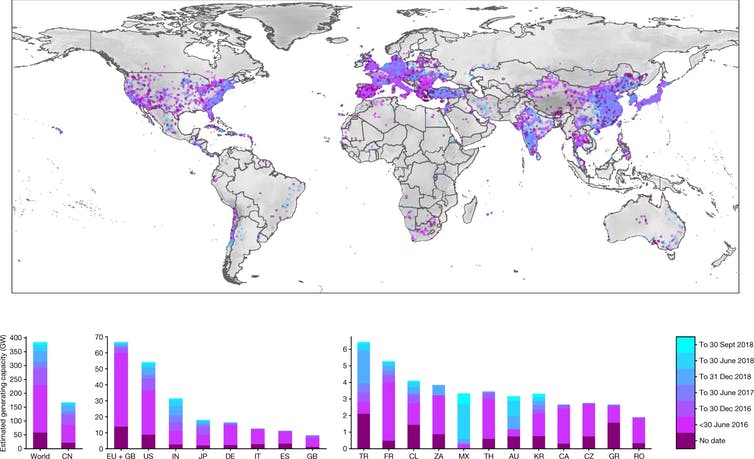
""Map of solar facilities up to 2018. (Kruitwagen et al, Nature, 2021)

We searched almost half of Earth's land surface area, filtering out remote areas far from human populations. In total we detected 68,661 solar facilities. Using the area of these facilities, and controlling for the uncertainty in our machine learning system, we obtain a global estimate of 423 gigawatts of installed generating capacity at the end of 2018.

This is very close to the International Renewable Energy Agency's (IRENA) estimate of 420 GW for the same period.


Tracking the growth of solar energy

Our study shows solar PV generating capacity grew by a remarkable 81 percent between 2016 and 2018, the period for which we had timestamped imagery. Growth was led particularly by increases in India (184 percent), Turkey (143 percent), China (120 percent) and Japan (119 percent).

Facilities ranged in size from sprawling gigawatt-scale desert installations in Chile, South Africa, India and north-west China, through to commercial and industrial rooftop installations in California and Germany, rural patchwork installations in North Carolina and England, and urban patchwork installations in South Korea and Japan.

The advantages of facility-level data

Country-level aggregates of our dataset are very close to IRENA's country-level statistics, which are collected from questionnaires, country officials, and industry associations. Compared to other facility-level datasets, we address some critical coverage gaps, particularly in developing countries, where the diffusion of solar PV is critical for expanding electricity access while reducing greenhouse gas emissions.

In developed and developing countries alike, our data provides a common benchmark unbiased by reporting from companies or governments.

Geospatially-localized data is of critical importance to the energy transition. Grid operators and electricity market participants need to know precisely where solar facilities are in order to know accurately the amount of energy they are generating or will generate.


Emerging in-situ or remote systems are able to use location data to predict increased or decreased generation caused by, for example, passing clouds or changes in the weather.

This increased predictability allows solar to reach higher proportions of the energy mix. As solar becomes more predictable, grid operators will need to keep fewer fossil fuel power plants in reserve, and fewer penalties for over- or under-generation will mean more marginal projects will be unlocked.

Using the back catalogue of satellite imagery, we were able to estimate installation dates for 30 percent of the facilities. Data like this allows us to study the precise conditions which are leading to the diffusion of solar energy, and will help governments better design subsidies to encourage faster growth.

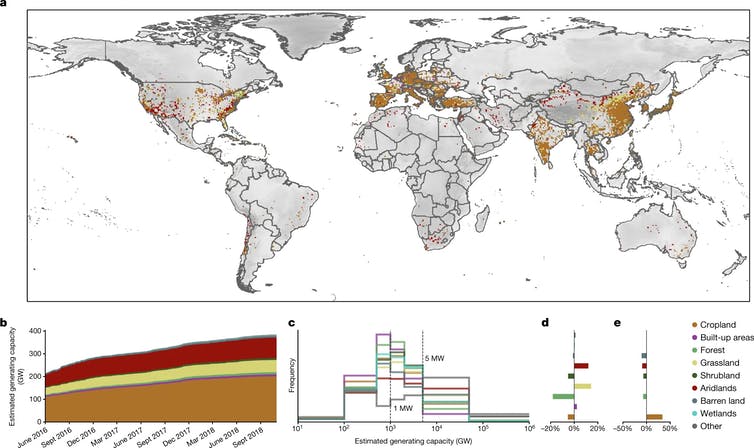
""Solar facility locations compared to land use. Cropland was most common. (Kruitwagen et al, Nature, 2021)

Knowing where a facility is also allows us to study the unintended consequences of the growth of solar energy generation. In our study, we found that solar power plants are most often in agricultural areas, followed by grasslands and deserts.

This highlights the need to carefully consider the impact that a ten-fold expansion of solar PV generating capacity will have in the coming decades on food systems, biodiversity, and lands used by vulnerable populations. Policymakers can provide incentives to instead install solar generation on rooftops which cause less land-use competition, or other renewable energy options. The Conversation

Lucas Kruitwagen, Climate Change and Artificial Intelligence Researcher, University of Oxford.

This article is republished from The Conversation under a Creative Commons license. Read the original article.


#Tech | https://sciencespies.com/tech/these-scientists-mapped-every-large-solar-plant-on-the-planet-with-brilliant-results/

The largest climate summit in years just started in Glasgow. Here's what to expect

The United Nations Climate Change Conference of the Parties (COP26) begins on Sunday 31 October in Glasgow, and the outcome may determine whether the world moves closer to a net-zero carbon economy by 2050. 


The climate conference will bring together delegates from around the world to discuss their plans for reducing emissions and limiting climate change.

The key question is whether nations will expand their commitment to the Paris Agreement, an international plan set in 2015 that aims to keep global warming below 2 degrees Celsius (3.6 degrees Fahrenheit) above pre-industrial levels, and preferably below 1.5 C (2.7 F) by 2100. 

Though 197 parties to the 2015 conference agreed to the Paris Agreement, commitments by nations to reduce emissions are not sufficient to stabilize the climate below 1.5 C.

Climate scientists say that to reach this goal, the globe would need to rapidly shelve fossil fuels as an energy source, achieving a 45 percent reduction over 2010 levels by 2030 and hitting net zero in 2050.

Politicians within member nations have not always been as committed as the original signers of the agreement: In 2019, the United States exited the Paris Agreement under President Donald Trump, Live Science reported. President Joe Biden re-committed to the agreement upon taking office in 2021. 

Related: 10 Signs Earth's climate is off the rails

The goals of COP26, according to the organizers, are to get countries to agree to plans for ambitious reductions in greenhouse gas emissions by 2030; to work together to support adaptation to climate change that has already occurred; to mobilize developed countries to provide US$100 billion in climate finance per year for investment in global net zero, meaning the amount of emissions we produce is no more than the amount removed by the atmosphere.

The final goal would be to finalize the Paris Rulebook, the step-by-step guide on reaching the Paris Agreement. 


The COP meeting happens every year (this year's is the 26th ever). But eyes are on this year's conference: As part of the Paris Agreement, countries agreed to provide an update every five years on their highest ambitions for reducing emissions.

That should have occurred in 2020, but that year's COP meeting was delayed by the coronavirus pandemic. Thus, those updates will occur in Glasgow this year. 

All countries are also asked to provide an "Adaptation Communication", which will outline the challenges that each faces in adapting to a changing climate, and what they plan to do to overcome those hurdles. 

Nations, especially developed nations, will also be asked to put their money where their mouth is. The Paris Agreement committed developed countries to raising US$100 billion each year to help developing countries finance their climate goals.

According to the intergovernmental Organisation for Economic Cooperation and Development (OECD), developed nations provided a joint total of $78.9 billion in financing in 2018. 

The delegates to COP26 will also attempt to finalize the Paris Rulebook, much of which was formally adopted in 2018 at the UN COP24 conference in Poland. But there are still a few outstanding guidelines at play. One of the most crucial outstanding issues is that countries still need to agree upon how to ensure that emissions reductions aren't double-counted.


Part of the structure underpinning the Paris Agreement is carbon markets: Countries or companies that have a hard time reducing emissions, like airlines, can buy emissions credits from companies that are more capable of reducing emissions. This should create a balance that keeps overall emissions low. 

But it's very easy for double-dipping to occur: Imagine if a US-based company like Amazon converted its delivery vans to electric-only. Both Amazon and the US might try to claim carbon credits for the resulting reduction in emissions. Without clear rules preventing this, the carbon markets could end up enabling more emissions, not fewer, according to climate policy experts.

There are signs that COP26 faces strong headwinds in meeting these goals. Leaked documents acquired by the BBC reveal that some developed nations are lobbying against the financial goals and hoping to downplay the need to move away from fossil fuels.

Related Content:

Images of melt: Earth's vanishing ice

The reality of climate change: 10 myths busted

Time-lapse images of retreating glaciers

This article was originally published by Live Science. Read the original article here.


#Environment | https://sciencespies.com/environment/the-largest-climate-summit-in-years-just-started-in-glasgow-heres-what-to-expect/