Featured Post

Tracking air pollution disparities -- daily -- from space

Studies have shown that pollution, whether from factories or traffic-snarled roads, disproportionately affects communities where economicall...

Saturday, October 2, 2021

First SLS launch likely to slip to 2022

WASHINGTON — A top NASA official says the agency will soon set a target launch date for the first Space Launch System mission, but that it’s “more than likely” it will slip into early 2022.


Speaking at a Maryland Space Business Roundtable webinar Sept. 30, NASA Associate Administrator Bob Cabana said a firm date for the launch of the Artemis 1 mission hadn’t been set, but suggested it was unlikely to take place before the end of this year.


“I’ll get you a firm date on that hopefully after next week. We’ll set an initial date after the team comes and briefs us on where we are,” he said. “We’ll be flying this Artemis 1 mission hopefully, more than likely, early next year.”


NASA officials have been holding out hope that Artemis 1 could still launch before the end of the year, although they were increasingly hedging their bets. “Artemis 1 will be at the end of this year or the first part of next year,” NASA Administrator Bill Nelson said in a call with reporters Sept. 21.


Cabana said workers just completed the night before “modal testing” of the SLS, where the vehicle is subjected to vibrations to determine its natural frequencies. The next milestone is the installation of the Orion spacecraft, taking the place of a mass simulator currently on top of the rocket. He said the Orion spacecraft will be moved to the Vehicle Assembly Building (VAB) at the Kennedy Space Center Oct. 13 to be integrated onto the SLS.


Once in place, the entire stack will be rolled out to Launch Complex 39B for a wet dress rehearsal, where the core stage is filled with liquid oxygen and liquid hydrogen in a practice countdown that stops just before ignition of the stage’s four RS-25 engines. After that, the rocket will roll back to the VAB for any final work and reviews before going back to the pad for launch.


Asked later in the presentation to give his best guess for both the Artemis 1 launch date as well as future Artemis missions, he declined, citing the upcoming briefing. “Next week, Jim Free and Kathy [Lueders] are coming to brief me and the rest of the team up here on all of the work they were doing at Kennedy this week,” he said. “Hopefully, we’ll have some realistic dates for where we’re going to hit these missions as we go forward. So stand by.”


NASA named Free its new associate administrator for exploration systems development Sept. 21, part of a restructuring that split the former Human Exploration and Operations Mission Directorate (HEOMD) into two organizations. Lueders, who previously was in charge of HEOMD, is now associate administrator for space operations, responsible for the International Space Station and related programs.


Cabana endorsed the reorganization because it offered a “more focused look” on exploration programs in particular. “He’s just a great engineer and an outstanding program manager,” he said of Free, who returned to the agency from the private sector to lead the new exploration directorate. “It’s going to be his focus to deliver the systems we need to execute Artemis and a sustainable return to the moon, and then to continue to move us on to Mars.”


#Space | https://sciencespies.com/space/first-sls-launch-likely-to-slip-to-2022/

Giant 'mushballs' could be hiding the missing ammonia on Neptune and Uranus

One advantage to planetary science is that insights from one planet could explain phenomena on another. We understand Venus' greenhouse gas effect from our own experience on the Earth, and Jupiter and Saturn share some characteristics.


But Jupiter also provides insight into other, farther out systems, such as Uranus and Neptune.

Now, a discovery from a spacecraft orbiting Jupiter might have solved a long-standing mystery about Uranus and Neptune – where has all the ammonia gone?

Scientists have long noticed an absence of ammonia in the atmospheres of Uranus and Neptune when compared to the amounts seen on Jupiter and Saturn.

Many considered that fact strange as planetary formation models suggested that all gas giants originated from the same "primordial soup," so their compositions should be similar.

Theories abounded as to where the ammonia had gone, but a closer inspection of Jupiter itself hints at a potential explanation.

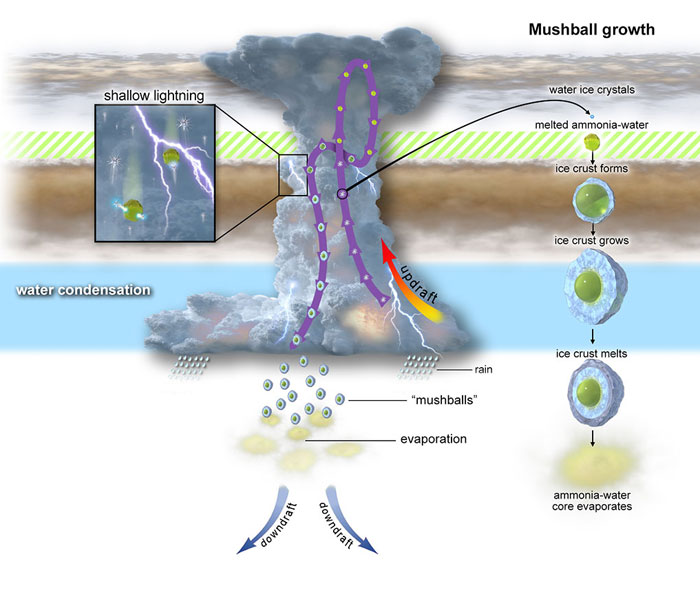
Juno, a probe that is currently exploring the Jupiter system, noticed that ammonia in the upper atmosphere formed "mushballs" by merging with water also present in the atmosphere.

Like hailstones, these mushballs are more liquid than traditional hailstones, as the ammonia liquefies water comes into contact with even at extremely low temperatures, such as those found in Jupiter's upper atmosphere.

These amalgamated mushballs can grow to be bigger than some of the more giant hailstones on Earth. They are also prone to rapidly falling through the atmosphere, dragging their constituent parts down out of the upper reaches of the atmosphere.

As they get closer to the center of Jupiter, the temperature rises, vaporizing the ammonia and water and allowing them to climb back towards the observable upper reaches.

An illustration of the mushball growth cycle (NASA /JPL-Caltech/SwRI /CNRS)

According to Tristan Guillot of the CRNS Laboratoire Lagrange, the same process might be happening on Neptune and Uranus, but the mushballs hold the ammonia down in the lower atmosphere for longer, without as much chance of releasing it back up to observable altitudes.   

At such low altitudes, the ammonia would appear to be missing with current observational capabilities. The upper layers of clouds would obscure any ammonia reading, making it appear as if it vanished.  


To see the vanished ammonia would require a dedicated mission specifically to explore the lower atmospheres of the outer planets. Some missions have been touted in the past, but none are currently operational.

As Dr. Guillot points out, understanding the outer planets in our own solar system would help us understand the atmospheres of exoplanets far beyond our own solar system. Perhaps it is time to send a dedicated probe out to learn more about our farthest out planetary neighbors.

This article was originally published by Universe Today. Read the original article.


#Space | https://sciencespies.com/space/giant-mushballs-could-be-hiding-the-missing-ammonia-on-neptune-and-uranus/

Scientists are on a mission to save Florida's coral reefs from a mysterious disease

At a laboratory in central Florida, biologist Aaron Gavin uses tiny pipettes to carefully feed shrimp to more than 700 corals living in huge saltwater tanks, with sunlight-mimicking lamps glowing above them.


The work of the scientists here could be the last chance to save the species that make up the only coral reef in the United States' continental waters. 

Gavin and his team have diligently recreated the coral reef habitat found in the waters off the southern tip of the state, complete with artificial currents and local fish.

They hope to prevent the 18 species of coral in their care from suffering the same mysterious ailment, called SCTLD (stony coral tissue loss disease), that is afflicting their wild cousins.

Among the sprawling mangroves and darting schools of fish off the Florida Keys, the damaged corals – normally dark – now appear as large white patches on the floor of the Atlantic Ocean.

The situation is the same all along the Florida Reef Tract, which stretches 360 miles (580 kilometers) from the Dry Tortugas, which are the westernmost islands in the Florida Keys, all the way to the town of St Lucie, located about 120 miles north of Miami. 

"It's heartbreaking, and I think the most alarming (thing) about it is that most people don't know it's happening," said Michelle Ashton, the communications director of the Fish and Wildlife Foundation of Florida. 


Rescue

What Gavin and his colleagues discover at the Florida Coral Rescue Center could change the future of the state's marine ecosystems.

"We are holding the corals safely and healthy in our care," explained Justin Zimmerman, the director of the Orlando-based lab, which opened in 2020 and is managed by aquatic theme park company SeaWorld. 

"If they were still in the wild, up to 90 percent of them would have been dead," Zimmerman said. 

The potentially catastrophic SCTLD was first discovered in 2014, near Miami, and has continued to spread rapidly, killing about half of stony coral species, a cornerstone of marine biodiversity. 

The disease, whose causes are unknown, is now plaguing the animals further into the Caribbean, all the way in Mexico and Belize. 

The rescue lab's work is part of a project created in 2018 by the National Oceanic and Atmospheric Association and the Florida Fish and Wildlife Conservation Commission and includes dozens of public and private organizations. 

The group, faced with the threat of more than 20 of the 45 species of hard corals in the area going extinct, devised the unprecedented plan to extract healthy corals from the region's waters and care for them in these artificially equipped aquariums in the hope they can be returned to their wild habitats in the future. 

"You are looking at the future of Florida Reef Tract in this room," Aston said of the corals in the Orlando aquariums. "And their grandchildren will be what goes back out to the water."


Return to the sea

The first part of the rescue plan has allowed wildlife authorities to save nearly 2,000 colonies of corals, now stored at more than 20 institutions in 14 different states. 

The second part of the plan requires researchers to successfully return the corals to the ocean – though such an operation would likely take place a long time from now, as corals reproduce very slowly. 

The scientists are studying the genetics of the rescued animals in an effort to cultivate new specimens that could be more resistant to disease, as well as other threats such as warming water temperatures and pollution. 

The success or failure of these endeavors could have huge consequences for the region. 

Stony corals, made up of limestone skeletons, are what create coral reefs, which in turn provide a home for a quarter of marine life. 

Plus, the structures are natural barriers between the open ocean and land, reducing the strength of waves that hit the coastline, especially during hurricanes and other storms. 

And a hit to coral health could mean a hit to Florida tourism revenue, as one study estimated that visitors drawn to the state for fishing and diving along the reef generate US$8.5 billion. 


Key Largo resident Steve Campbell, 59, is worried about what comes next. He is sitting next to the small tourist boat he captains, currently anchored in the port. 

He said the coral disease has already had an impact on his business. 

"I've been in the Florida Keys now for 20 years, and I'm out on the water every day," he said. 

"Obviously, we make our living out here, so we take people out to the reef for the enjoyment of seeing the reef."

"So for us it's extremely important."

© Agence France-Presse


#Nature | https://sciencespies.com/nature/scientists-are-on-a-mission-to-save-floridas-coral-reefs-from-a-mysterious-disease/

Friday, October 1, 2021

DoD seeks ideas for connecting government and commercial satellites

WASHINGTON — The Defense Innovation Unit in a new solicitation is asking space and information-technology companies for ideas on how to build a “hybrid architecture” of government and commercial satellites. 


“The Department of Defense seeks a hybrid space architecture to integrate emergent commercial space sensor and communications capabilities with U.S. government space systems while incorporating best-in-class commercial practices to secure and defend the network across multiple domains,” DIU says in the request. Submissions are due Oct. 18. 


DIU works with commercial companies to address DoD technology needs. It awards contracts for studies and prototypes that, if successful, transition to larger programs. 


The idea of a hybrid architecture that brings together commercial and government satellites has been talked about for years but there is still no plan for how to exactly do that. The U.S. military is a large consumer of commercial satellite services for communications, imagery, weather and other capabilities. DoD operates its own satellites and is looking for ways to access commercial capacity when needed.


A hybrid architecture would give DoD more flexibility to access commercial systems during conflicts if U.S. satellites came under attack.


“This architecture must be demonstrated as a payload (hosted or bespoke) capable of communicating across disparate government and commercial networks,” DIU says.


Specific requirements listed by DIU: 


  • Data transport across multiple networks at multiple classification levels without compromising information assurance or cybersecurity. 

  • A variable trust protocol so users can adjust trust factors commensurate with risk or mission application. High trust may be required for weapons employment. 

  • Fuse data from multiple sources of intelligence available to the U.S. government now and in the future. 

  • Develop analytics tools that are compatible with multiple sources of commercial and government data.


The solicitation says DIU encourages participation from commercial satellite manufacturers, systems integrators and information technology companies specializing in software defined network architecture design.


#Space | https://sciencespies.com/space/dod-seeks-ideas-for-connecting-government-and-commercial-satellites/

This simple fix can reduce everyone's email stress, according to a new study

In this day and age, it's harder than ever before to disconnect from work.

Once a person has signed off for the day, they might feel pressured to reply to an after-hours email that pops up on their phone, even if it's not urgent.


A new psychology study by researchers from the London Business School in the UK and Cornell University in the US has identified simple email etiquette that sets healthier work/life boundaries and relieves some of the stress of having to be 'always on'.

All that's required is a single sentence tacked onto the end of an after-hours email that goes something like this: "This is not an urgent matter, so you can get to it whenever you can."

Seriously, that's it. And while you might think the message goes unsaid, it doesn't.

The findings come specifically from a study that included 852 full-time employees in the United States who were randomly split into two groups: the hypothetical email sender and the hypothetical email receiver.

In the experiment, researchers asked senders how quickly they expected whoever was receiving their email to respond, while receivers explained how quickly they felt they needed to reply.

The findings reveal a breakdown in communication, which leads to what the authors have called "the email urgency bias".

While email senders often do not expect a quick reply when they shoot off an after-hours request, email receivers tend not to 'get' that message. Instead, they often default to thinking all emails require a rapid response, a stressful state of mind to be sure.


The good news is that when an email sender explicitly states that an urgent reply isn't required, the email urgency bias and its ensuing stress appear to be alleviated.

"From a practical perspective, our research can help mitigate the spread of unhealthy work cultures where employees feel pressured to stay connected to their work even when they are not expected to do so," the authors of the study write.

"Given that email continues to be one of the primary modes of workplace communication and among the most widespread online activities, our goal for limiting its negative impact should not necessarily be less email, but rather better email."

The authors based their recommendations on a series of psychological experiments conducted among six different cohorts. 

The first study included more than 700 public sector employees living in Spain who rated how happy they were with their current work/life balance. They then wrote down their experience with either receiving or sending emails outside of their regular work hours.

Specifically, researchers wanted to know, on a sliding scale, how quickly participants expected someone else to reply to their email or how important it was that they answer someone else's in the real world.


Like with the US group, the findings found a mismatch in expectations between the sender and the receiver. Often, the sender didn't expect an urgent response, while the receiver tended to think they needed to reply right away. 

Those employees more prone to this 'email urgency bias' scored lower on subjective wellbeing.

The second study explored the possible stress of high expectations, this time among 251 participants, who were also split into hypothetical email receivers and hypothetical email senders.

The email receiver was asked to imagine that they'd just arrived home from work and checked their email to find a non-urgent message from their colleague. The email senders were asked to imagine the reverse scenario: They knew their colleague had already gone home but that they had a question at the end of the day.

Both groups were then asked how quickly a response was expected. Once again, the authors found receivers assumed they needed to respond more quickly than senders expected.

The third study included over 600 participants and found that urgent and non-urgent emails sent after hours are treated relatively the same way. A fourth study with 411 participants confirmed that emails sent during work hours and emails sent after work hours are treated similarly, too.


In other words, all work emails, regardless of when they're sent and how urgent they actually are, seem to be urgent to us. That urgency is not necessarily good for our health, especially when it seeps into our off hours.

A fifth study with 450 participants suggested response speed expectations for emails can add stress to a person's life, lowering their overall wellbeing. In fact, emails sent after work hours, even if they aren't urgent, seem to cause more stress to the receiver than when they are actually working.

The final and sixth study was the culmination of all these pursuits. It confirmed the idea that emails sent after we've clocked off can add stress to our lives by making us feel as though we need to reply straight away.

It also suggested an email sender can reduce the stress of their colleagues by being very explicit about what they want and when they want it in an after-hours email.

"Namely," the authors conclude, "we found that senders can help receivers feel less pressure to respond right away to non-urgent work emails sent off-hours simply by making their expectations of response speed explicit through a note in their email that specifically states they do not expect a response right away." 

Seems like a simple fix.

The study was published in Organizational Behavior and Human Decision Processes. 


#Humans | https://sciencespies.com/humans/this-simple-fix-can-reduce-everyones-email-stress-according-to-a-new-study/

New satellite photo of tiny Perseverance on Mars will give you all the feelings

Occasionally, as various orbiters make their rounds of Mars, they spot their ground-based friends far below.

In a new image from NASA's Mars Reconnaissance Orbiter (MRO), Perseverance has made a guest appearance. From hundreds of kilometers above the red planet, the rover appears as a tiny speck in the South Séítah region of the Jezero Crater.


It's an image that demonstrates the very different instruments that we are using to explore the mysterious planet, from afar and from up very close indeed.

Brown landscape with a tiny blue speck in the middle(NASA/JPL-Caltech/University of Arizona)

The mission of MRO, which has been in orbit since 2006, is primarily to study the atmosphere and large-scale geology of Mars.

To a lesser extent, it's also helping the ground-based missions – the rovers Curiosity and Perseverance, and the stationary, quake-monitoring Mars InSight lander.

Curiosity's mission is to explore the Gale Crater on Mars to learn more about the planet's climate and geology, and the history of both, as well as help us assess whether or not Mars is, or has ever been, hospitable to life.

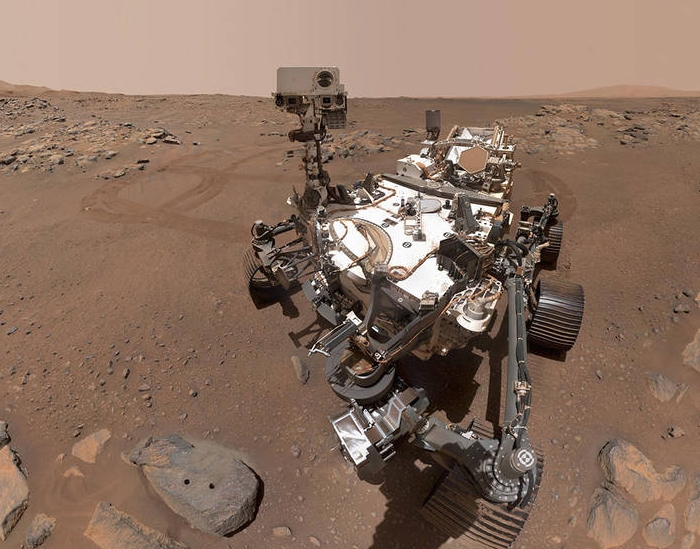
percyA Mars selfie from Percy. (NASA/JPL-Caltech/MSSS)

Perseverance, on the other hand, in addition to collecting more data on the climate and geology of Mars, is specifically tasked with looking for signs of life, such as the fossils of microbes that may have emerged when Mars was a wetter place than it is today.

The South Séítah region consists of a series of ridges covered with sand dunes and sprinkled with boulders and shards of rock. Perseverance has just collected a sample of rock to be returned to Earth by a future mission; that sample was collected from a relatively young region of Mars. South Séítah is thought to be much older, and therefore should provide an interesting contrast.


On arrival in South Séítah in August, Perseverance sent its helicopter, Ingenuity, ahead to take images so that the Perseverance team could assess whether the area was worth exploring further.

However, further science is going to have to wait. Currently, Mars is in opposition – that is, on the opposite side of the Sun from Earth, an event that happens every two years.

During this time, communications between Mars missions and Earth are blocked by our star. We won't be able to receive or send transmissions until mid-October.

We hope the rovers, lander and orbiters are all enjoying their holiday.


#Space | https://sciencespies.com/space/new-satellite-photo-of-tiny-perseverance-on-mars-will-give-you-all-the-feelings/

Happy Consumers In A Suicidal Economy: A Review.

The world is beset by fire, flood, famine and pestilence (pandemic) at unprecedented levels. We can see our climate changing, we can feel the weather, but we are still mired in controversy about what to do. Why?


Brian McClaren thinks the problem starts with what he calls toxic orthodoxies: institutionalized systems of belief, whether religious, political or economic, that cannot be questioned. Because to do so would be heresy. “I'm concerned with how faulty religious beliefs and approaches are actually plunging our species towards self destruction,” McClaren told me in an interview. “But that’s equally true of economic orthodoxy.”


His book, Faith After Doubt: Why Your Beliefs Stopped Working And What To Do About It, starts by identifying the crisis of doubt within American religion, and then draws parallels with other sacrosanct American beliefs. Like “the idea that economic growth is the solution to all problems. I think those are those are matters of belief for an awful lot of people who don't consider themselves religious,” says McClaren.


When beliefs don’t work in our reality and people are told not to question them, doubt emerges. For McClaren, doubt is crucial path to growth, both personal and in our thinking. He believes doubt might just save the world, because when people grapple with doubt they often emerge with more empathy, intellectual humility and nuanced thinking.


Crisis in the American Church


McClaren understands why 65 million U.S. adults have dropped out of active religious attendance, and why that number increases by roughly 2.7 million a year. An insider, McClaren was raised in a Christian fundamentalist church, where he was warned that, “An open mind is like an open window, you need a good screen to keep the bugs out.” (7) Later, he went on to become a pastor, thinking that “more time exposed to hymns and worship songs, more time in Christian fellowship meant my doubts would decrease, not increase.” (25) But after years of listening to people and counseling them in his role, McClaren found himself sharing his parishioners doubts. And that doubt launched him and the church he served for 24 years on a journey of exploration that led to (sometimes painful) growth. Since retiring from the pastorate, he’s continued his work as a spiritual teacher and author.


“Most Christian denominations have painted themselves into a corner,” says McClaren. “They have defined themselves by beliefs. And that leaves them unable to change their beliefs. When you define the boundaries and those boundaries are beliefs, then if you change your beliefs you're out.” In the book, McClaren shares heartbreaking stories of people who were “disfellowshiped” from their communities and even their families when they confessed to doubting some of their church’s beliefs.


“You're setting up people for dishonesty,” says McClaren, “Because in order to maintain their identity in the community, they have to keep saying they believe things that are harder and harder for them to believe.”


His goal is not to give up on religion, but to transform it. “Something is wrong, dangerously wrong, not just in my religion but in all the interconnected religions of the world,” McClaren writes. “People like you and me can play a part in detoxifying and healing our religious traditions,” a process in which “doubt can play a surprisingly constructive role.” (xviii)


Doubt could save the world


For McClaren doubt is a process that can lead to growth and change. “What if our doubts are actually like medicine, like nourishment, and we need them, and so does our world?” he writes. (xviii) Doubt is a powerful corrective for what McClaren thinks is the root issue that keeps us from coming together and addressing the world’s problems: dualistic thinking. Black or white, right or wrong, us or them, friend or enemy, sinner or saint: dualistic thinking creates either/or categories that limit our growth and our ability to think in sophisticated ways.


We are attracted to dualistic thinking because it makes the world seem clear cut. “If your only tool is a hammer, everything looks like a nail,” McClaren says. And religious institutions have a way of organizing around this kind of thinking because it allows for definite boundaries and teaching. Buy into the either/or beliefs and you get a warm supportive community. Question them and you could lose your friendships, the activities that structure your life, and even your sense of identity as a religious person.


“People fear doubt because it feels like they may peel all the layers of the onion and only be left with tears,” says McClaren. But that is exactly where the opportunity for genuine growth lies. Early in the struggle with doubt “we're often very angry. We're angry at the structures and individuals that gave us incomplete answers and made us feel guilty for asking questions. And who told us that we had to believe certain things, even though they now seem to us to be untrue and even harmful,” says McClaren.


“But eventually, you begin to turn [that anger] on yourself. And when that happens, you realize that just because you have a kind of X-ray vision for other people's hypocrisy, other people's ignorance, it doesn't make you a morally superior person,” says McClaren. He finds that when you turn that scrutiny back on yourself, it has a humbling effect. “It's messy. I don't think there's any way for it not to be messy.”


Harmony after doubt


When the anger of doubt drives people to stop judging other people by dualistic categories and forces them to question themselves, it creates a portal for what the book calls “harmony,” a state of empathy, humility and higher level thinking that is the goal of McClaren’s model of spiritual growth. People often emerge from doubt with a greater sense of the oneness of all humanity, and at the same time a more passionate motivation to seek social and climate justice. And when it comes to their religions, those who emerge from doubt into McLaren’s "harmony" often reengage with their religion in a more meaningful way.


And the climate is a big issue for McLaren. In the book he points out that as our world becomes inhospitable due to climate change, the suffering we will face will affect all of us, regardless of wealth status or religious affiliation. But instead of facing this and working together, McLaren takes aim at another orthodoxy which drives us to continue polluting the world.


Economic orthodoxy


“I called an economist friend of mine a while back, and I said to him that I'm starting to think that economics has a way more powerful of shaping people's lives than theology,” McLaren said. His friend responded, “‘Oh no, don't tell me that. If you think religious fundamentalists are bad, you've never met an economic fundamentalists.’”


McLaren points out that many of us have a blind trust in economic systems. “It really does feel that the United States Gates is engaged in a kind of struggle over strong economic fundamentalism,” says McLaren. “Especially when we talk about the environment and the changes that are going to have to happen to capitalism to keep capitalism from destroying the world through through carbonizing the atmosphere.”


In the book, McLaren points out the impact of economic orthodoxy: that we are all trained to be "happy consumers in a suicidal economy.”


The book may initially seemed to be about those who have struggled with religious doubt, but in the end it provides a compassionate and often heartbreaking roadmap through doubt in any institution or belief system. And the book is powerful because it shows how doubt can lead to a harmony in thinking and a greater sense of connection to those around us.


And while he didn't address parents directly, the book just as easily apply to the toxic orthodoxy of intensive parenting that has arisen over the last two generations. An orthodoxy that tells parents they should do this, they should do that, and they should not do that other thing. Or they will mess up their child for life. A ShouldStorm the drives parents and kids with criticism and anxiety. And this is another belief system that deserves our doubt, so that parents and kids can emerge with greater empathy and connection.


#News | https://sciencespies.com/news/happy-consumers-in-a-suicidal-economy-a-review/