SAN FRANCISCO – Tomorrow.io won a $19.3 million contract from the U.S. Air Force to support its planned constellation of approximately 32 weather satellites.
The Air Force issued the contract for Tomorrow.io’s constellation of radar-equipped weather satellites through its AFVentures Strategic Funding Increase program, which is focused on large-scale, strategic capabilities in support of Department of Defense missions.
Boston-based Tomorrow.io, which calls itself a meteorological intelligence company, plans to provide weather and ocean observations, including detailed global coverage of precipitation as a service to government agencies around the world.
With its 32-satellite constellation, Tomorrow.io plans to gather data at an average rate of once per hour globally, which it will share with customers through its proprietary modeling suite, the Weather Intelligence Platform. Government customers also can opt to receive raw data in addition to model outputs.
Astro Digital is building Tomorrow.io’s first two mini-fridge-size satellites under a contract announced in September. The satellites are scheduled to be launched in late 2022. Tommorow.io does not have manufacturing or launch contracts in place for the remainder of its constellation, which it plans to complete in 2024.
Tomorrow.io, formerly known as ClimaCell, provides weather data to commercial customers including Delta Air Lines, Uber Technologies and Amazon Web Services. In March, the company announced that it raised $77 million in a Series D funding round.
When Nicole Oliveira was just learning to walk, she would throw up her arms to reach for the stars in the sky.
Today, at just eight years of age, the Brazilian girl is known as the world's youngest astronomer, looking for asteroids as part of a NASA-affiliated program, attending international seminars and meeting with her country's top space and science figures.
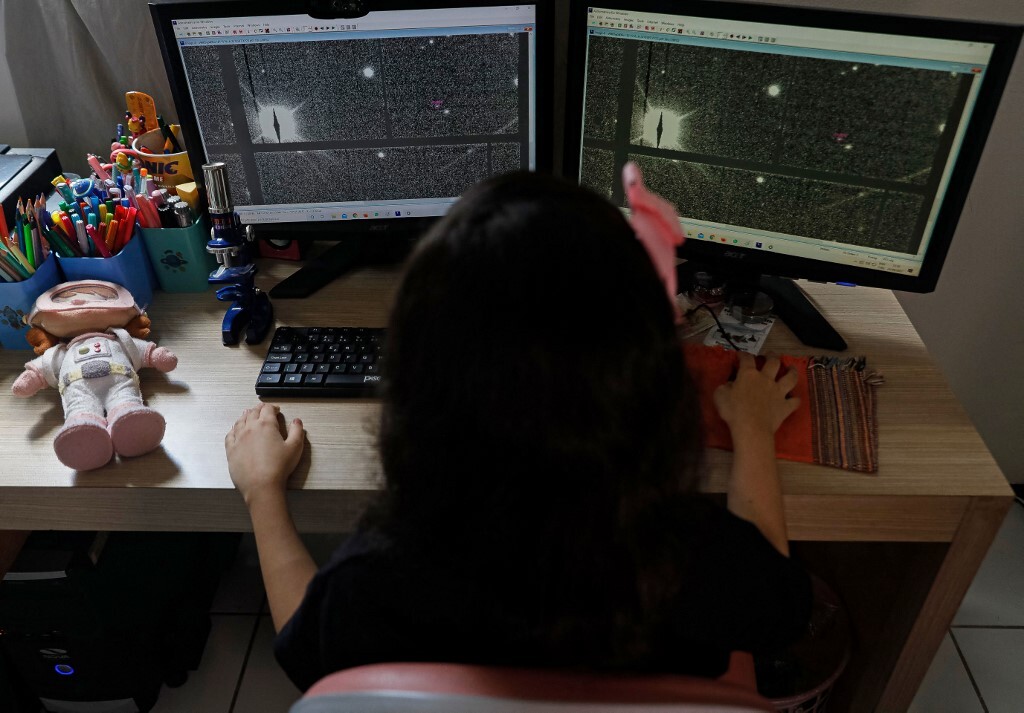
In Oliveira's room, filled with posters of the Solar System, miniature rockets and Star Wars figures, Nicolinha, as she is affectionately known, works on her computer studying images of the sky on two large screens.
The project, called Asteroid Hunters, is meant to introduce young people to science by giving them a chance to make space discoveries of their own.
Beaming with pride, Nicolinha told AFP she has already found 18 asteroids.
"I will give them the names of Brazilian scientists, or members of my family, like my mom or my dad," said the lively girl with dark brown hair and a high-pitched voice.
If her findings are certified, which may take several years, Oliveira will become the youngest person in the world to officially discover an asteroid, breaking the record of 18-year-old Italian Luigi Sannino.
"She really has an eye. She immediately spots points in the images that look like asteroids and often advises her classmates when they are not sure they have really found any," said Heliomarzio Rodrigues Moreira, Oliveira's astronomy teacher at a private school in the city of Fortaleza in northeastern Brazil, which she is attending thanks to a scholarship.
"The most important thing is that she shares her knowledge with other children. She contributes to the dissemination of science," added Rodrigues Moreira.
Nicole Oliveira works on her computer at her house in Fortaleza, Brazil. (Jarbas Oliveira/AFP)
Passion for astronomy
Nicolinha's family relocated to Fortaleza from their hometown of Maceio, about 1,000 kilometers (620 miles) away, at the beginning of this year, after Nicolinha received a scholarship to attend the prestigious school. Her father, a computer scientist, was allowed to keep his job and telework.
"When she was two, she would raise her arms to the sky and ask me, 'Mom, give me a star,' said her mother, Zilma Janaca, 43, who works in the craft industry.
"We understood that this passion for astronomy was serious when she asked us for a telescope as a birthday present when she turned four. I didn't even really know what a telescope was," Janaca added.
Nicolinha was so set on getting a telescope that she told her parents she would swap it for all her future birthday parties. Still, such a gift was too expensive for the family and the girl got it only when she turned 7 and all her friends pooled money for the purchase, her mother said.
As she continued her studies, Nicolinha enrolled in an astronomy course that had to lower its age limit for students down from 12.
On her YouTube channel, Nicolinha has interviewed influential figures like the Brazilian astronomer Duilia de Mello, who took part in the discovery of a supernova called SN 1997D.
Last year, Oliveira traveled to Brasilia to meet with the minister of science as well as with the astronaut Marcos Pontes, the only Brazilian to date to have been to space.
As for her own ambitions, Nicolinha wants to become an aerospace engineer.
"I want to build rockets. I would love to go to the Kennedy Space Center at NASA in Florida to see their rockets," she said.
"I would also like all children in Brazil to have access to science," she says.
Brains aren't the easiest of organs to study, what with their delicate wiring and subtle whispering of neurotransmitter messages. Now, this research could be made a little easier, as we've learned we can swap some critical chemical systems with the host animal being none the wiser.
In a proof-of-concept study run by a team of US researchers, the microscopic worm Caenorhabditis elegans was genetically gifted pieces of a nervous system taken from a radically different creature – a curious freshwater organism known as Hydra.
The swap wasn't unlike teaching a specific brain circuit a foreign language, and finding it performs its job just as well as before.
"There's a lot of diversity of synaptic connection in any animal's brain," explains Josh Hawk, a neuroscientist with the Marine Biological Laboratory in Massachusetts.
"Being able to pick and choose what to put in another organism will help us untangle and understand how and why brains do what they do."
Similar to us, the nematode C. elegans has a tightly-linked nervous system governed by chemical messengers called neurotransmitters. Different circuits make use of their own kinds of neurotransmitter, which are released into the thin gaps between neurons called synapses.
For the most part, these narrow voids are where a brain does much of its work. Synapses are the logic gates of the brain's computer circuitry – blocking some signals, enhancing others, transforming chemical fluctuations into something profound.
Neuroscientists can understand a great deal about the functions of a nervous system by tinkering with this traffic-light system using a variety of drugs, genetic tweaks, and light-operated switches.
Turning things on and off and watching the chaos can tell you a lot about how a nervous system operates. After all, much of what we've learned in neuroscience has emerged from observing the consequences of a broken brain.
"But to really understand how they work, you want to know if you can rebuild them – fix them – after they are broken. And that is very hard to do," says the study's senior author, Daniel Colón-Ramos from Yale University School of Medicine.
The trick in this case was to 'fix' a broken circuit in nematodes with parts borrowed from another organism, one that runs on very different biochemical software. Hydra aren't worms. They're more closely related to sea anemone, with tiny, tentacled bodies governed by a loosely-connected spread of neurons arranged in a simple, net-like structure.
Weirder still, the cells making up this neural mesh communicate with one another by squirting out peptides that then diffuse through the hydra's body, activating matching receptors on other cells.
"There are hundreds of neural peptides in Hydra, each of which could be a different channel of communication," says Hawk.
"To me, that's the most exciting thing. This should open up a whole area that no one has ever explored before."
To test the concept, Hawk and his colleagues genetically altered specimens of C. elegans to lose their ability to feel full. These hungry worms exhibited foraging behaviors no matter how much food they'd consumed, giving the researchers a clear activity to watch for in their mutants.
From this group of worms they created two new lines – one with the gene for a hydra neuropeptide, and another with the corresponding receptor gene.
The offspring between the two families brought the two halves together into a single nervous system. Without their usual 'I'm full' brain circuit in operation, they had to rely on the hydra neuropeptides to signal an end to meal time.
The successful swap is just the first step. Thanks to the way hydra neuropeptides operate, it's possible to separate the neurons that use them to signal and have them communicate long-distance.
"It gives you more flexibility as a researcher to manipulate neurons that are not adjacent to each other," says Colón-Ramos.
This specific combination of messenger and receptor, dubbed HySyn, could be just the start of a vast tool-kit of replacement transmitters that researchers could use to decipher the intricacies of neural circuitry.
Inspiration struck Toby Marlow during a comparative poetry class at Cambridge University in fall 2016. Participating in a discussion on William Blake, he found his mind wandering and began scribbling a series of unrelated notes: “Henry VIII’s wives → like a girl group … Need Lucy!!”
Then an undergraduate student tasked with writing an original show for the upcoming Edinburgh Fringe Festival, Marlow brought his idea to classmate Lucy Moss, who agreed to help bring his vision of a Tudor-themed pop musical to life. The product of the pair’s collaboration—Six, a modern reimagining of the lives of Henry VIII’s six wives—premiered on London’s West End in 2019 to much acclaim. (A cast soundtrack released in September 2018 similarly became an unqualified success.) Now, after an extended delay caused by the Covid-19 pandemic, the musical is finally making its Broadway debut.
L to R: Abby Mueller (Jane Seymour), Samantha Pauly (Katherine Howard), Adrianna Hicks (Catherine of Aragon), Andrea Macasaet (Anne Boleyn), BrittneyMack (Anna of Cleves) and Anna Uzele (Catherine Parr)
Liz Lauren
Six “didn’t come out of a love of the Tudor period particularly,” says Marlow, 26. “It came from us having an interest in the representation of women in musical theater, having women on stage doing funny and hilarious things.” Moss, 27, adds, “What we were interested in doing was reframing the way that women have been perceived in history and telling their side of the story.”
The Tudor period, with its “soap opera”-esque political machinations and rich cast of female characters, offered the duo the opportunity to explore contemporary issues like feminism through a historical lens. Though Six prominently features the rhyme historically used to describe the fates of the Tudor king’s queens—“divorced, beheaded, died, divorced, beheaded, survived”—the musical moves beyond these reductive one-word summaries to present its subjects as fully realized individuals. “With all of them,” says Moss, “there was so much of interest beyond the moment they got married or divorced.”
Marlow and Moss drew on a range of sources when writing Six, including Antonia Fraser’s The Wives of Henry VIII and documentaries hosted by historianLucy Worsley. The musical’s layered repartee deftly balances references to Tudor culture with nods to modern music, like the line “Stick around and you’ll suddenly see more” (a play on “Suddenly, Seymour” from Little Shop of Horrors). Still, Marlow explains, the show’s goal isn’t to convey history with 100 percent accuracy. Instead, “It’s [asking], ‘What if Anne Boleyn was like this?’ And how does that change the way you think about this very famous historical figure?”
Six frames its story as a makeshift talent competition in which the wife whose life was most tragic “wins.” The rules are simple: “The queen who was dealt the worst hand … shall be the one to lead the band.” Each wife sings a solo summarizing her experiences, engaging in acerbic banter in between verses. (During these numbers, the other wives act as both backup singers and dancers; beyond the six solos, the 80-minute show features three group numbers.) Ultimately, the women decide to form a girl band instead, leaving the king out of the narrative and imagining an alternate future featuring far happier ends for all of them.
Historian Jessica Storoschuk, who has writtenaboutSix extensively on her blog, has found that in school and popular culture, the queens are usually only talked about in terms of their fate. “[Six] is this kind of ridiculous satire of [that],” she says. “It’s a really intelligent way to explore their experiences, or, I should say, one part of their experiences, because their downfalls are not all of their lives.”
Below, find a song-by-song (or wife-by-wife) breakdown of the true history behind Six. Click through the interactive tools to learn more about specific lyrics from the show.
The song: “No Way,” a Beyoncé- and JLo-inspired “girl boss feminism” anthem, says Moss
Though Catherine of Aragon’s marriage to Henry lasted 24 years—collectively, his five other marriages spanned just 14 years—she has long been overshadowed by her successors. The daughter of Spanish monarchs Ferdinand and Isabella, Catherine came to England as the bride of Henry’s older brother, Arthur, Prince of Wales. But Arthur died shortly after the pair’s wedding, leading the Spanish princess to (eventually) marry his heir, Henry.
By all accounts, the couple enjoyed a loving relationship that only deteriorated due to a lack of a male heir and the king’s infatuation with Anne Boleyn. In the late 1520s, Henry sought a divorce from his first wife, arguing that her previous relationship with Arthur was the reason for the couple’s lack of a surviving son. Determined to protect her daughter Mary’s rights, Catherine refused to concede.
Apple News readers, click here to view this interactive.
Six’s account of these events, “No Way,” takes its cue from a June 21, 1529, meeting at Blackfriars in London. After years of debate over the validity of the royal couple’s marriage, a papal court was conceived to address the king’s so-called Great Matter. Appealing directly to her husband, Catherine fell to her knees and delivered an impassioned monologue:
Intending (as I perceive) to put me from you, I take God and all the world to witness, that I have been to you a true and humble wife, ever conformable to your will and pleasure. … If there be any just cause by the law that ye can allege against me, either of dishonesty or any other impediment to banish and put me from you, I am well content to depart, to my great shame and dishonor; and if there be none, then here I most lowly beseech you let me remain in my former estate, and receive justice at your princely hand.
A 1544 portrait of the future Mary I, Henry and Catherine's daughter
After uttering these words, Catherine left Blackfriars, ignoring the clerk’s calls for her to return. Without turning around, she declared, “On, on, it makes no matter, for it is no impartial court for me, therefore I will not tarry.” The queen was correct in her assessment: Henry had no intention of remaining in the marriage. Determined to wed Anne, he broke from the Catholic Church in order to make her his wife.
Catherine’s Six solo could’ve been a “super emotional [sad] ballad,” says Moss. Instead, she and Marlow chose to emphasize the queen’s defiance, emulating Beyoncé’s “Run the World (Girls)” and setting the tone for the rest of the musical.
The real Catherine followed through on her fictionalized counterpart’s pledge to remain “queen till the end of my life,” refusing to acknowledge her marriage’s annulment even on her deathbed in 1536. Catherine’s legacy, historian Julia Fox told Smithsonian magazine last year, “is that of a wronged woman … who did not accept defeat, who fought for what she believed to be right until the breath left her body.”
The song: “Don’t Lose Ur Head,” a “cheeky” number modeled on Lily Allen and Kate Nash, according to Moss
Arguably the most (in)famous of the six wives, Anne is alternatively portrayed as a scheming, power-hungry seductress; a victim of her callous father’s vaulting ambition; or a worldly, charismatic woman who rose to the kingdom’s highest office only to be targeted by jealous men.
The truth of the matter depends on which scholar one asks. Most of Anne’s letters and papers were destroyed following her May 1536 execution on contrived charges of adultery, incest, witchcraft and conspiring to kill her husband, so much of what is known about her comes from outside observers, some of whom had reason to paint her in an unforgiving light. Even the queen’s date of birth, writes historian Antonia Fraser, is a fact “that can never be known with absolute certainty (like so much about Anne Boleyn).”
Anne’s song in Six, “Don’t Lose Ur Head,” draws its name from her method of execution: beheading by sword. Moss says she and Marlow view the number as a playful response to historians’ continued vilification of the queen as “calculating and manipulative”: “We were like, wouldn’t it be fun to mock [that trope] and make it that she was like ‘Well, I’m just living. I did this thing randomly, and now everything’s gone crazy.’”
Apple News readers, click here to view this interactive tool.
Though the tone of “Don’t Lose Ur Head” is intentionally more irreverent than the real queen, who Storoschuk says “was incredibly shrewd, very well educated, well read and well spoken,” the broad strokes of the song are historically accurate. Anne spent her teenage years in the courts of Margaret of Austria and Francis I of France, gaining a cosmopolitan worldview that helped her stand out in England. When she caught Henry’s eyes, she was a maid of honor in service of his first wife; rather than becoming Henry’s mistress, as her sister Mary had, Anne refused to sleep with the king until they were married. To wed Anne, Henry broke with the Catholic Church and established himself as head of the Church of England. Finally, the once-besotted king fell out of love in dramatic—and, for Anne, fatal—fashion just three years after their long-awaited marriage.
Henry’s third wife, Jane Seymour, has gone down in history as the “boring” one. According to Fraser, she was intelligent and “naturally sweet-natured,” with the “salient characteristics [of] virtue and common good sense.” Historian Alison Weir similarly describes Jane as “endowed with all the qualities then thought becoming in a wife: meekness, docility and quiet dignity.”
Moss and Marlow tried to flesh out these descriptions by highlighting Jane’s political savvy. During her comparatively brief courtship with Henry, Jane drew on many of the same tactics used by Anne Boleyn, most notably by refusing to sleep with him until they were married. Presenting a submissive front may have been a tactic, says Moss. It’s also worth noting that Jane used her position to advance causes she cared about, including restoring her stepdaughters, Mary and Elizabeth, to their father’s favor and speaking out against the closure of England’s religious houses.
Apple News readers, click here to view this interactive.
On one occasion, Henry reportedly dismissed his new wife by advising her to “attend to other things, [for] the last queen had died in consequence of meddling too much in state affairs.” “Heart of Stone” acknowledges this risk, but Six’s version of Jane chooses to remain steadfast in her love of Henry and their son, the future Edward VI.
Following Jane’s death in childbirth in 1537, Henry memorialized her as “the fairest, the most discreet and the most meritorious of all his wives”—a distinction no doubt motivated by the fact that she’d given the king his only surviving male heir, writes Weir. (Edward took the throne “Six” reflects this enviable status by identifying Jane as “the only one he truly loved.” As she herself acknowledges in “Heart of Stone,” however, Henry’s affection is conditional on her ability to provide him with a son.
Henry chose to include Jane, rather than his then-wife, Catherine Parr, in this dynastic portrait. Painted around 1545, the work depicts Edward, Henry and Jane at its center and Mary and Elizabeth in the wings.
Speaking with Vulture last year, Moss said, “The idea was about the strength of choosing to love someone and committing to someone, and that being an equally valid feminist experience.” She added, “I love that [Jane] gets to say, ‘I wasn’t stupid, I wasn’t naïve.’”
The song: “Get Down,” a 16th-century take on the rap and hip-hop “trope of being popular and bragging about your Ferrari and your Grey Goose,” says Moss
Anne (or, as the musical calls her, Anna) of Cleves was, in some historians’ view, the most successful of Henry’s six queens. After just six months of marriage, she earned the king’s enduring affection by agreeing to an annulment. Then, she proceeded to outlive her former husband, not to mention the rest of his wives, by a decade. “[Anne] did get pushed to the side in a rather unceremonious way, but she had a pretty good life,” says Storoschuk. “She was given several properties. She gambled a lot. She got to go hunting, she had the best clothes and the best food. She was loved at court.”
A 1540s portrait of Anne of Cleves by Bartholomaeus Bruyn the Elder
St. John's College, University of Oxford, via Art U.K. under CC BY-NC-ND
“Get Down” focuses on this victorious period in Anne’s life, celebrating her independence as a wealthy, unmarried woman at Tudor court. In line with the musical’s goal of reclaiming the narrative, the number also reframes the incident that led to Anne’s annulment. Henry, enchanted by a flattering Hans Holbein portrait of his bride-to-be, was reportedly repulsed by the “tall, big-boned and strong-featured” woman who arrived in England at the beginning of 1540. Declaring “I like her not! I like her not!” after their first meeting, the king only went through with the wedding to maintain diplomatic ties with Anne’s home, the German Duchy of Cleves, and other Protestant allies across the European continent.
After just six months of marriage, Henry, eager to replace his short-reigning queen with the young, vivacious Katherine Howard, had the union annulled on the grounds of non-consummation and Anne’s pre-contract with Francis, Duke of Lorraine. Anne, from then on known as the “king’s beloved sister,” spent the rest of her days in luxury.
Apple News readers, click here to view this interactive.
Moss studied history at Cambridge and says much of her schoolwork centered around early modern German visual culture. Six actually includes a standalone song, “Haus of Holbein,” that satirizes 16th-century beauty culture and Henry’s portrait-driven search for a fourth wife: “Hans Holbein goes around the world / Painting all of the beautiful girls / From Spain / To France / And Germany / The king chooses one / But which one will it be?”
Given Holbein’s reputation for accuracy and Henry’s own declining looks (at the time of the couple’s wedding, the king was 48 years old), Marlow and Moss chose to turn the tables, having Anne proclaim herself a fan of the much-vilified portrait. Further cementing Anne’s mastery of the situation, “Get Down”’s refrain finds the supposedly unattractive queen hanging up her likeness “for everyone to see.”
The song: “All You Wanna Do,” a catchy number modeled on the work of “young pop stars sexualized early on in their careers,” like Miley Cyrus, Britney Spears and Ariana Grande, as Marlow told Vulture
For much of history, Henry’s fifth wife, Katherine Howard, has been dismissed as a wanton woman of little import. Writing in 1991, Weir described her as a “frivolous, empty-headed young girl who cared for little else but dancing and pretty clothes.” Fraser, meanwhile, wrote that “[h]ere was no intelligent adult woman, wise in the ways of the world—and of course courts.” More recent scholarship has taken a sympathetic view of the queen, with Gareth Russell’s 2017 book, Young and Damned and Fair, leading the conversation. As Russell argues, “[Katherine] was toppled by a combination of bad luck, poor decisions, and the Henrician state’s determination to punish those who failed its king.”
Katherine’s Six solo, titled “All You Wanna Do,” echoes Russell’s characterization of its subject as a victim of circumstance and predatory older men. Though her exact birthdate is unknown, Katherine may have been as young as 17 when she was beheaded on charges of treasonous adultery in February 1542. Henry, comparatively, was 50 at the time of his disgraced wife’s execution.
Apple News readers, click here to view this interactive.
The king was far from the first man to sexualize Katherine. “All You Wanna Do” details the queen’s relationships in heart-wrenching detail, from a liaison with her music teacher, Henry Manox (the song suggests that he was 23 to Katherine’s 13, but as Storoschuk points out, he may have been closer to 33), to an affair with Francis Dereham, secretary to the dowager duchess, Katherine’s step-grandmother. When each new romance begins, the teenager declares herself hopeful that this time will be different. By the end of the song, however, she realizes that all of her suitors have the same goal in mind.
According to Moss, she and Marlow wanted Katherine’s song to start out with a “sexy, seductive” tone before transforming into a “narrative of abuse” with echoes of today’s #MeToo movement. Marlow adds, “It was kind of like us talking about what happened to one of the queens and finding a way of relating it to something that we would recognize as a modern female experience.”
Katherine’s “life was so tragic,” says Storoschuk. “She was so young, and she really had very little agency over her own life. ‘All You Wanna Do’ really encompasses that.”
Often reduced to the one-word summary of “survived” or the role of nursemaid to a succession of ailing husbands, Henry’s sixth wife, Catherine Parr, was actually a renowned scholar, religious reformer and perhaps even protofeminist. In Six, she takes ownership of these attributes, refusing to be defined by her romantic relationships and instead listing her manifold accomplishments: “Remember that I was a writer / I wrote books and psalms and meditations / Fought for female education / So all my women can independently study scripture / I even got a woman to paint my picture.”
Apple News readers, click here to view this interactive.
As the last of the six to take the stage, the fictionalized Catherine has dual obligations: namely, sharing her story and setting up a satisfying musical finale. “We needed one of the queens to be like ‘Wait, we shouldn’t be competing with each other. We should support each other,’” says Moss. “Fortunately, [Catherine’s role] as a writer, educator and advocate for women helped with that.” Encouraging the wives to take back the microphone, Catherine calls for them to assert themselves outside of their marriages to Henry. “It’s not what went down in history,” the six admit, “[b]ut tonight, I’m singing this for me.”
The real Catherine led a rich life beyond what’s captured in “I Don’t Need Your Love.” As alluded to by the song’s first verses, which find Catherine telling a lover that she has “no choice” but to marry the king, the twice-married young widow initially had another suitor in mind: Thomas Seymour, the dashing younger brother of Henry’s third wife, Jane. (The would-be couple wed soon after Henry’s death in 1547, but their marriage was tainted by Thomas’ improper conduct toward his new stepdaughter, the future Elizabeth I.)
Despite being forced into a relationship with Henry, Catherine made the most of her position, pushing her husband to embrace Protestantism and encouraging him to restore his daughters to the line of succession. She narrowly escaped an attempt by the court’s conservative faction to have her executed on charges of heresy, winning back Henry’s favor even after he’d signed a warrant for her arrest. Catherine died just a year after the king, succumbing to complications from childbirth in 1548.
WASHINGTON — Satellite fleet operator Eutelsat has rejected an unsolicited $3.2 billion takeover offer from telecom magnate Patrick Drahi.
On Sept. 29, Eutelsat confirmed media reports that it had received an “unsolicited, preliminary and non-binding proposal” from Drahi but that Eutelsat’s governing bodies “unanimously decided not to engage in discussions based on the terms of this proposal.”
Eutelsat issued a second statement Sept. 30 stating that Drahi offered 12.10 euros ($14.02) per share, a 17 percent premium over Eutelsat’s closing share price the day before.
Drahi is the founder of Altice NV, a multinational telecommunications firm he took private in January amid an acquisition streak that included a 12% stake in British telecom operator BT Group.
WASHINGTON — A satellite servicing industry group is making progress on a series of standards that it believes can help enable the growth of the nascent field.
In a presentation at its Global Satellite Servicing Forum Sept. 29, Brian Weeden, executive director of the Consortium for Execution of Rendezvous and Servicing Operations (CONFERS), said three standards are in various phases of development to support a “thriving and sustainable” satellite servicing industry.
Such standards in other industries, from automobiles to smartphones, have enabled the growth of an ecosystem of companies and products while also improving safety and reliability. “We don’t have any of that for satellites, in large part because we don’t have standards,” he said.
The first of those standards codifies a set of principles and best practices for satellite servicing that CONFERS developed, covering issues such as compliance with relevant laws and regulations as well as responsible operations. Weeden said CONFERS is updating those documents in the next month that reflect minor changes based on lessons learned from recent satellite servicing activities.
That standard will under the purview of the International Organization for Standardization, or ISO, and is formally designated ISO 24330. “They are using the CONFERS principles and practices as the baseline for what’s going to be the world’s first satellite servicing standard,” he said. A number of government and industry experts are working on the document, which he said should be finalized by the end of this year or early next year.
A second standard, development of which started earlier this year, is about fiducials, or markings on spacecraft used to support proximity operations. Those fiducials can help a servicing vehicle identify and properly approach a spacecraft.
Weeden said this standard is being developed with the American Institute of Aeronautics and Astronautics, which created a standards group with CONFERS members and other experts. He didn’t give a schedule for completing that standard.
Work recently started on a third standard covering refueling interfaces on spacecraft. “A standardized refueling interface is something that many satellite manufacturers and customers have said they would like to see in order to create a market for in-space refueling,” he said. CONFERS has established a committee to outline what that standard would be and expects to approach a standards development organization by early next year.
There has been some tension in the industry about the development of standards. Companies see the benefits of such standards, but also worry that establishing standards too early can stifle innovation.
NASA Deputy Administrator Pam Melroy, who helped established CONFERS when she was deputy director of DARPA’s Tactical Technology Office, threw her support behind standards development in a talk at the conference Sept. 29.
“I acknowledge that there is a legitimate tension between competing and collaborating, which is why some private companies aren’t quite ready to agree to develop standards,” she said.
She advocated for a “collaborate to compete” approach among companies in the industry, working together to create standards that can grow the industry and create more opportunities for companies to compete. That includes, she said, standards in grasping, manipulating, repairing and refueling spacecraft.
“Standards will help enable new business models, innovations and opportunities,” she said. “The lack of clear and widely accepted technical and safety standards for responsible performance is a still a major obstacle to satellite servicing, assembling and manufacturing.”
“We have to collaborate today,” she concluded. “We can grow the pie, and them people can compete for pieces of the pie later on.”
The Vinland Map, once thought to be one of the earliest depictions of North America after its discovery by Europeans, has gone from being famous to being infamous: It turns out that the map is a complete fake.
That's the verdict of researchers who analyzed the ink on the map and found that it comes from the 1920s. This isn't quite the groundbreaking 15th-century work of cartography that it was originally claimed to be, but rather a deliberate forgery.
While major doubts had previously been raised about the authenticity of the Vinland Map, the X-ray fluorescence spectroscopy (XRF) and field emission scanning electron microscopy (FE-SEM) techniques used here to assess the chemicals in the ink represent the most thorough look at the document yet.
A macro X-ray fluorescence spectroscopy analysis of the map. (Yale University)
"The Vinland Map is a fake," says Raymond Clemens, the curator of early books and manuscripts at the Beinecke Rare Book & Manuscript Library at Yale University, where the map is stored. "There is no reasonable doubt here. This new analysis should put the matter to rest."
While carbon dating puts the map parchment at around 600 years old, the ink contains high levels of titanium and smaller amounts of barium – elements you would expect to find in the earliest commercially produced titanium-white pigments of the 1920s.
Anatase, a form of titanium dioxide used during the same period, can be found all across the map. There's none of the iron gall ink that medieval scribes are known to have written with, ink which is made up of iron sulphate, powdered gall nuts, and a binder substance.
The researchers were also able to compare the Vinland Map with manuscripts that really are from the 15th century, finding much lower levels of titanium and much higher levels of iron in the ink used there.
The chemical breakdown of the inscription on the back of the map. (Yale University)
On the back of the map is an inscription that links it to the Speculum Historiale, part of an encyclopedia written in the Middle Ages. This is probably where the parchment for the forgery came from, and the new analysis reveals that the original Latin inscription has been overwritten with titanium ink – signs of a deliberate forgery.
"The altered inscription certainly seems like an attempt to make people believe the map was created at the same time as the Speculum Historiale," says Clemens. "It's powerful evidence that this is a forgery, not an innocent creation by a third party that was co-opted by someone else, although it doesn't tell us who perpetrated the deception."
First offered to museums in 1957 alongside a short medieval text, the Vinland Map shows the so-called 'Vinlanda Insula', part of North America's coastline to the southwest of Greenland. It was first thought to back up the idea that Vikings had reached the continent (and mapped it) long before Christopher Columbus.
While the Norse colonization of North America is now largely accepted, this map is not evidence of it – as we know from the length of time spent analyzing the document as well as the comparisons to other historical works that have actually been verified.
The researchers say the new analysis shows how the latest equipment and scanning techniques can help get definitive answers on which historical documents are genuine and which aren't, enabling us to focus our time on the former.
"Objects like the Vinland Map soak up a lot of intellectual air space," says Clemens. "We don't want this to continue to be a controversy. There are so many fun and fascinating things that we ought to be examining that can actually tell us something about exploration and travel in the medieval world."

/https://tf-cmsv2-smithsonianmag-media.s3.amazonaws.com/filer_public/84/89/84897d27-6cf4-496e-a9ec-a51d096ab9c7/six_01_lizlauren.jpg)
/https://tf-cmsv2-smithsonianmag-media.s3.amazonaws.com/filer_public/9d/4a/9d4ae7a4-e8a6-41b4-bd1b-5783d080b0aa/1280px-mary_i_by_master_john.jpeg)
/https://tf-cmsv2-smithsonianmag-media.s3.amazonaws.com/filer_public/54/cc/54cce4fa-f7b8-4982-99f9-feadcb5030fe/catherine.jpg)
/https://tf-cmsv2-smithsonianmag-media.s3.amazonaws.com/filer_public/d9/d5/d9d5f44f-89f2-444b-9ebb-96dc32698564/anneboleynhever.jpeg)
/https://tf-cmsv2-smithsonianmag-media.s3.amazonaws.com/filer_public/3a/7e/3a7ee89f-19af-4037-b7d9-ba3f17c9587e/2880px-family_of_henry_viii_c_1545.jpeg)
/https://tf-cmsv2-smithsonianmag-media.s3.amazonaws.com/filer_public/61/6c/616c8d4f-40bd-4c3e-9408-b982df0afda2/ou_sjnc_pp02-001.jpg)
/https://tf-cmsv2-smithsonianmag-media.s3.amazonaws.com/filer_public/f7/f1/f7f1a2dc-3983-4346-93c4-c048316668c3/1280px-thomas_seymour_denizot.jpeg)

