Featured Post

Tracking air pollution disparities -- daily -- from space

Studies have shown that pollution, whether from factories or traffic-snarled roads, disproportionately affects communities where economicall...

Friday, April 2, 2021

For the first time, scientists have detected X-rays coming out of Uranus

Every planet in the Solar System has its idiosyncrasies, but Uranus is, truly, one of a kind.

Not only is it tipped sideways so its rotational axis is practically parallel to its orbital plane, it smells terrible, it's leaking everywhere, its magnetic field is an utter mess, and it has rings unlike any other planetary rings in the Solar System.


But wait, there's more. Around 20 years ago, astronomers turned their instruments to capture X-ray emissions coming from Saturn, Uranus, and Neptune. Unlike every planet before it, Uranus had nary a flash to be seen.

Now, for the first time, we've detected X-rays emanating from the Solar System's oddest ball, and it's not quite clear where they're coming from or what they mean.

Observations on and discoveries about Uranus - and Neptune, for that matter - are pretty tricky to make, compared to the rest of the Solar System. These two planets really are a long way away, and few probes have ever ventured into their icy neighborhood.

Generally, we rely on telescopes close to home to take a squiz at them - telescopes that are optimized for looking at things a lot farther away than Uranus or Neptune, and so the details can be a little fuzzy around the edges.

The new discovery is based on observations taken using the Chandra X-ray Observatory, a space telescope in orbit around Earth. The first set of observations was taken in 2002, then another two sets in 2017. When a team of astrophysicists led by William Dunn of University College London in the UK finally got around to analyzing the 2002 observation data, they found clear evidence of X-rays from Uranus.

uranus blobsThe 2017 observation. ( NASA/CXO/University College London/W. Dunn et al; W.M. Keck Observatory)

That Uranus should emit X-rays isn't all that surprising; X-radiation has been detected emitting from many Solar System bodies, including comets, Venus, Earth, Mars, Saturn, Pluto, Jupiter, and even some of Jupiter's moons. Nor is it surprising that we have not detected them until now, given the difficulties involved in studying the distant planet.

The odd part is that we don't know the full picture of how Uranus is emitting X-rays.


There are a few options. Most of the X-radiation in the Solar System comes from the Sun (obviously), which is known to scatter when it hits Jupiter and Saturn's clouds. This is also probably happening on Uranus, though the team's calculations point to more X-ray photons than this process could account for.

Based on other objects in the Solar System, we have some clues as to what the potential source of this excess could be. Saturn's rings are one such example, known to fluoresce in X-rays generated by energetic particles interacting with oxygen atoms in the rings.

Although Uranus's rings are less showy than Saturn's, radiation belt studies have found a higher intensity of energetic electrons around Uranus. If these were interacting with atoms in the rings, they could be producing a similar X-ray fluorescence.

Another process that produces X-rays in the Solar System is aurora. These occur when energetic particles interact with a planetary atmosphere. On Earth, this produces a breathtaking display of dancing green light in the sky, but they've been known to occur on other planets, too; Jupiter, Mars, Saturn and even comets can have auroras.


In most cases, a magnetic field plays a role in generating auroras; the particles are accelerated along magnetic field lines before being deposited in the atmosphere.

It's possible a similar process is taking place on Uranus, generating auroras in the upper atmosphere. If it is, though, because Uranus' magnetic field is such an off-axis mess, these auroras could be far more complex than any we've ever observed in the Solar System.

Longer Chandra observations in the future could help scientists map the locations of the X-ray emissions across Uranus, which would help figure out what is causing them. However, more detailed observations that could characterize fluctuations in the emission are not possible with our current generation of instruments.

Upcoming observatories, such as the ESA's Athena, or NASA's Lynx, will be better able to tell us what the hecketty is going on. That could help us not only better understand Uranus's atmosphere and magnetic field, but gain a deeper understanding of X-ray sources across the Universe.

The team's research has been published in JGR Space Physics.


#Space | https://sciencespies.com/space/for-the-first-time-scientists-have-detected-x-rays-coming-out-of-uranus/

Mummified birds in the Atacama desert reveal a dark side of history

The more we look into the harsh extremes of Chile's Atacama Desert, the more we find. Phenomena both mystifying and wonderful, occasionally bordering on alien.

But in this incredibly dry place, it wasn't just the climate that was unforgiving. Its ancient human inhabitants, making do in a parched place not best suited to hosting them, traded in whatever they could get their hands on.


Sometimes, it seems, that was the brilliant feathers of colorful birds brought unceremoniously to a desert they didn't belong to, but were destined to be buried within.

"What we consider acceptable interactions with animals under our care was very different back then," says anthropological archaeologist Jose Capriles from Pennsylvania State University.

"Some of these birds did not live a happy life. They were kept to produce feathers and their feathers were plucked out as soon as they grew in."

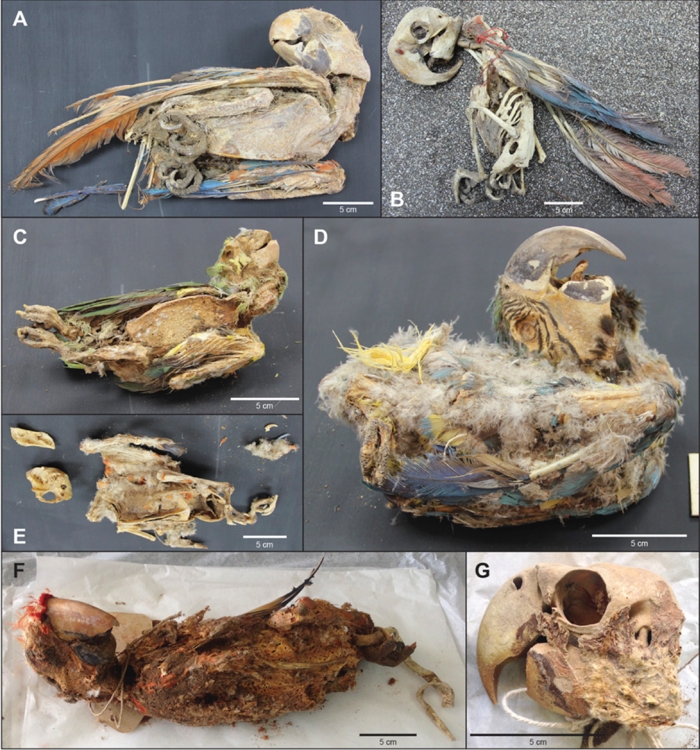
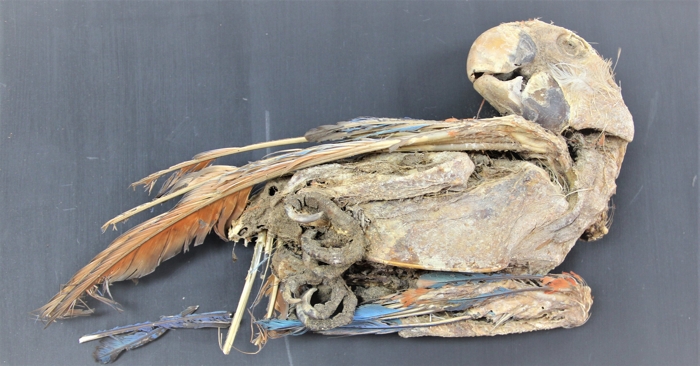
010 parrots 2Mummified scarlet macaw. (Calogero Santoro/José Capriles)

Capriles is something of a specialist when it comes to discovering the exotic oddities of pre-Columbian American culture.

This time, his mother – Eliana Flores Bedregal, an ornithologist by profession – came along for the ride, co-authoring a new study examining the life and death of over two-dozen mummified and partially mummified parrots found within the Atacama Desert.

In total, at least six species of parrots originally recovered from five of the desert's archaeological sites were studied in the research, with the remains variously dating from between 1100 to 1450 CE.

"The feathers of tropical birds were one of the most significant symbols of economic, social, and sacred status in the pre-Columbian Americas," the authors write in their study.


"In the Andes, finely produced clothing and textiles containing multicolored feathers of tropical parrots materialized power, prestige, and distinction and were particularly prized by political and religious elites."

Behind the folds of this marvelous drapery, the colorful birds likely lived a miserable existence in captivity, far from the Amazonian rainforests that were once their home.

010 parrots 2(Capriles et al., PNAS, 2021)

Sometimes, the feathers were plucked elsewhere and imported into the Andes in special containers, but the remains of the 27 parrots and macaws analyzed here suggest many other birds were specifically brought to the desert for their vibrant plumage.

The feather trade in the region dates back much longer than this, at least to the Chinchorro mummies of around 5050 BCE. Thousands of years later, feathers were still a cherished feature used in garments, hats, headdresses, and other ornaments.

Most of the mummified birds examined in the new study were originally recovered from an archaeological site called Pica 8, located close to an oasis community within the Atacama Desert that still exists today.

Once upon a time, though, the people here buried their birds alongside themselves.


"Most birds were placed in direct association with human burials," the researchers write, noting the parrots' tails were often removed.

Sometimes the animals were positioned in elaborate stances, with beaks opened and tongues sticking out, perhaps tied to ritualistic practices invoking parrots' ability to mimic human speech. Others had their wings spread, as if to forever soar in the afterlife.

During their life on Earth, it seems many had their wings broken and their feet strapped, although the researchers also observe care was taken with some of the animals, with evidence of clipping of their beaks and claws, in addition to healing processes for fractures sustained by the parrots.

"We have absolutely no idea why they were mummified like this," Capriles says. "They seem to be eviscerated through their cloaca (a common excretory and reproductive opening), which helped to preserve them. Many times, they were wrapped in textiles or bags."

What is certain is that it can't have been easy to get these grounded birds to the desert. Transported by llama caravans, it's likely the journey from the Amazon would have taken months, the researchers think, although it's possible some of the birds were procured from regions closer to the desert.

Once there, they were held as valuable pets, treasured for their wondrous palette of feathers, with each enticing shade certain to be stolen.

The findings are reported in PNAS.


#Humans | https://sciencespies.com/humans/mummified-birds-in-the-atacama-desert-reveal-a-dark-side-of-history/

Melting Ice Sheets 14,600 Years Ago Caused Seas to Rise 10 Times Faster Than Today

Ice sheet melting at the end of the last ice age may have caused sea levels to rise at 10 times the current rate, a study published Thursday by a team led by scientists from Britain's Durham University said.


Based on geological records, the researchers estimate that oceans worldwide rose 3.6 meters (11.8 feet) per century over a 500-year period some 14,600 years ago.

The findings raise a red flag about the potential today for rapid sea-level rise that could swamp coastal cities and densely populated deltas around the world.

The team found that the approximately 18-meter sea level rising event may have originated primarily from melting ice sheets in the northern hemisphere and not Antarctica as previously thought.

The scientists say their work could offer "vital clues" about future ice sheet melting and sea level rises due to climate change. 

"We found that most of the rapid sea-level rise was due to ice sheet melt across North America and Scandinavia, with a surprisingly small contribution from Antarctica," said the study's co-author Pippa Whitehouse, of Durham University's geography department.

"The next big question is to work out what triggered the ice melt, and what impact the massive influx of meltwater had on ocean currents in the North Atlantic. 

"This is very much on our minds today – any disruption to the Gulf Stream, for example, due to melting of the Greenland Ice Sheet, will have significant consequences for the UK climate."


Current models used by many climate scientists estimate global sea levels could rise by between 1 and 2 meters by the end of this century.

The Durham researchers used detailed geological sea-level data and state-of-the-art modeling techniques to reveal the sources of the dramatic five-century sea level rising event.

Comparable to melting an ice sheet twice the size of Greenland, it resulted in the flooding of vast areas of low-lying land and disrupted ocean circulation, with knock-on effects for global climate, they said.

"Our study includes novel information from lakes around the coast of Scotland that were isolated from the ocean due to land uplift following the retreat of the British Ice Sheet, allowing us to confidently identify the meltwater sources," added co-author Yucheng Lin, also of Durham's geography department.

Identifying the source of the meltwater will help improve the accuracy of climate models that are used to replicate the past and predict changes in the future, the team added.

They noted the findings were particularly timely with the Greenland ice sheet rapidly melting and contributing to a rise in sea levels and changes to global ocean circulation.

In 2019, Greenland cast off more than half-a-trillion tonnes of ice and meltwater, accounting for 40 percent of total sea-level rise that year.

© Agence France-Presse


#Environment | https://sciencespies.com/environment/melting-ice-sheets-14600-years-ago-caused-seas-to-rise-10-times-faster-than-today/

Thursday, April 1, 2021

Hubble's renewed image of the Veil Nebula will take your breath away

Stars die in fire and fury.

They tremble and shake, erupting their viscera out into space; when the star explodes and the violence is done, a gorgeously glowing cloud of star guts remains.


Such an event is what created the Veil Nebula, a gossamer shred of a larger supernova remnant called the Cygnus Loop created when a star 20 times the mass of the Sun went supernova, about 10,000 years ago.

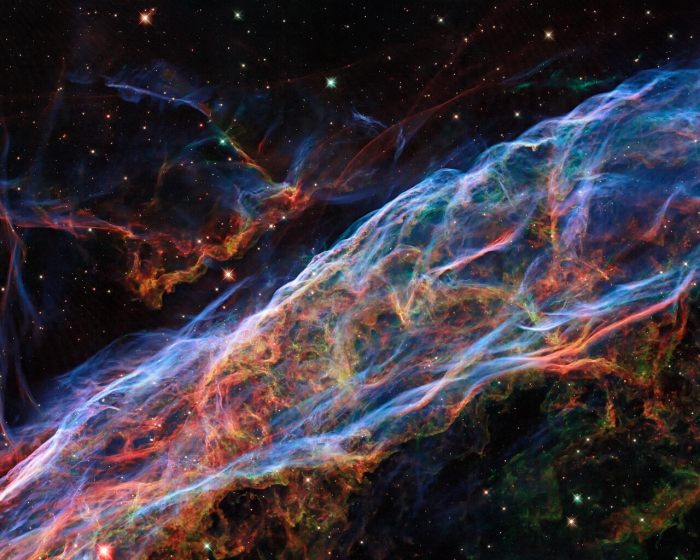
If you like space photos (and which science-lover doesn't?), you've probably seen it – the Hubble Space Telescope released a spectacular image in 2015, taken with its Wide Field Camera 3 instrument, a rainbow of filaments stretching across the darkness of space.

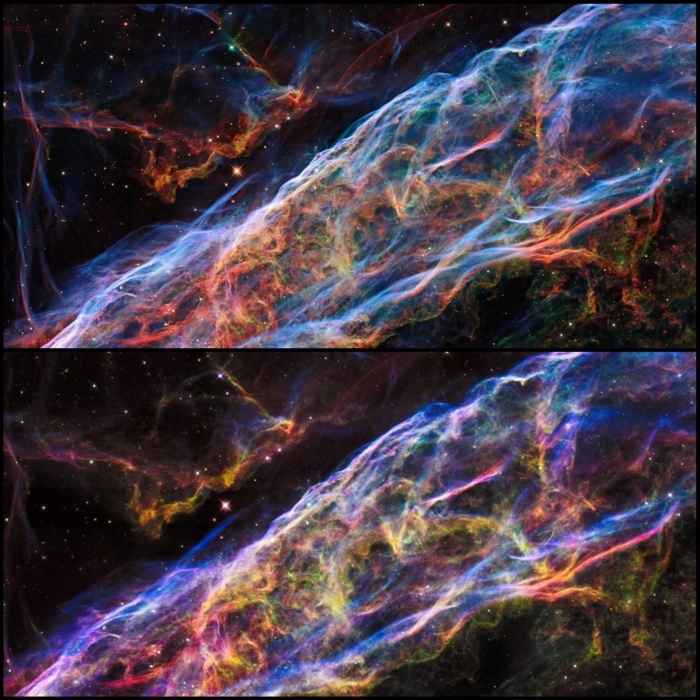
Now, researchers have reprocessed those data using new techniques, teasing out finer details in the threads of gas.

veil inset(ESA/Hubble & NASA, Z. Levay)

Located at a distance of around 2,100 light-years away, and spanning a length of around 110 light-years, the Veil Nebula is thought to have been shaped by a powerful stellar wind emitted before the star exploded.

The wind pushed into the gas that had already been ejected by the dying star, hollowing out cavities. When the supernova shock wave pushes into this region, it interacts with the cavity walls, shocking and energizing the gas therein, and creating the complex, filamentous structure of the Veil. 

veil comp vertThe new image (top) and the 2015 image (bottom). (ESA/Hubble & NASA, Z. Levay; NASA, ESA, Hubble Heritage Team)

Images like this aren't just a spectacle – they help astronomers understand these interstellar processes. Here, for instance, different gases emit slightly different wavelengths of light, which have been color-coded – blue for doubly ionized oxygen and red for ionized hydrogen and ionized nitrogen.

The green gases haven't been disturbed by shock waves as recently as the blue, so they have had time to cool and diffuse into their fluffier chaotic forms.

Because the nebula is still expanding, studying these filaments and their compositions can help us better understand the structure of the cloud, and how the shock wave from the supernova is interacting with it. Such images taken at different times can also be compared against each other to see how fast the shock wave is moving.

Hubble's 2015 observations were compared with images of the nebula taken in 1997 – see the video above – and scientists were able to calculate that it is expanding at a rate of 1.5 million kilometers (932,000 miles) per hour. Earth's diameter, for reference, is 12,742 kilometers.

Eventually, the remains of the young, hot star that died in such a dramatic fashion will be all blown away, scattered into the interstellar medium. Even for stars, all things must come to an end.

You can download a wallpaper-sized version of the reprocessed image on the ESA's Hubble website.


#Space | https://sciencespies.com/space/hubbles-renewed-image-of-the-veil-nebula-will-take-your-breath-away/

Scientists Make Big Step Towards Making Antimatter Stand Still

One of the biggest mysteries of modern physics is the question of why we don’t see as much antimatter in the universe as ordinary matter. A possible explanation is that antimatter is simply different from ordinary matter in an unknown, but important, way. To explore this possibility, scientists have trapped antimatter to study its properties. However, making precise measurements on antimatter require that it be nearly stationary and that has been hard to do until now. Scientists working at the CERN laboratory in Europe have just announced that they have used lasers to slow the motion of antimatter, resulting in unprecedented capabilities to its properties.


Antimatter is a subatomic cousin of ordinary matter. Its existence was predicted in 1928 by British theoretical physicist Paul Dirac, and it was discovered in 1932 by American physicist Carl Anderson. For every known subatomic particle, there is an antimatter equivalent. The electron’s counterpart is the positron, identical in every way to the electron, but with the opposite electric charge. The antiproton and antineutron also exist, and were discovered in the 1950s at a particle accelerator located on a hill, high above the University of California at Berkeley.


Matter and antimatter don’t get along all that well. If you combine them, they annihilate each other in a huge burst of energy. On the subatomic level, this energy is manageable, but if one were to combine a gram of antimatter with a gram of matter, the result is an energy release comparable to the atomic explosion at Hiroshima. A gram is equivalent to the weight of a paperclip.


It’s this antagonistic relationship with matter that makes antimatter difficult to study. If an antimatter particle comes into contact with its matter equivalent, the two disappear in a subatomic flash of energy.


Scientists have been able to trap antimatter particles using a combination of electric and magnetic fields. Antiprotons have been stored for over a year, while antimatter electrons have been stored for shorter periods of time, due to their lower mass. In 2011, researchers at CERN announced that they had stored antihydrogen for over 1,000 seconds.


While scientists have been able to store and manipulate small quantities of antimatter, they have not been able to answer why antimatter is so rare in the universe. According to Einstein’s famous equation E = mc2, energy should convert into matter and antimatter in equal quantities. And, immediately after the Big Bang, there was a lot of energy. Accordingly, we should see as much antimatter as matter in our universe, and yet we don’t. This is a pressing unsolved mystery of modern physics.


According to Einstein’s equations, as well as other modern theories of antimatter, antimatter should be exactly the same as ordinary matter, with only the electric charges reversed. Thus, antimatter hydrogen should emit light just like ordinary hydrogen does, and with exactly the same wavelengths. In fact, an experiment showing exactly this behavior was reported in early 2020. This was a triumph for current theories, but meant no explanation for the universe’s preference of matter was found.


Because of the difficulty of storing antimatter, the light emission spectrum of antihydrogen was not as precise as the equivalent measurement using ordinary hydrogen. One of the key reasons is that it has not been possible to slow antihydrogen atoms down. When they are produced, they continue to move at velocities that are large enough to affect the precision of measurements.


So researchers affiliated with the Alpha experiment at CERN set out to slow down antihydrogen atoms. They made antiprotons in their accelerator and combined them with antimatter electrons coming from the decay of sodium-22. They then used lasers to slow down the resultant antihydrogen.


The method is really quite clever. Ordinarily, if you hit an atom with a photon of enough energy to make the electron jump from a low energy state to a higher one, and then the atom decays back to the low energy state, the result is that the atom is in exactly the same state as it was before. Energy is conserved.


However, in laser cooling, researchers irradiate atoms with photons of an energy just below the amount required to make electrons jump from one state to another. If the atoms were stationary, no transitions would occur. However, if the atoms are moving, those atoms moving towards the light source will contribute some motion energy, so the energy of the atom and the energy photon is enough to make electrons jump between energy states. 


The atom eventually decays, emitting a photon, but emitted photon will be the full energy of that atomic transition, while the absorbed photon will be slightly lower energy. Because the emitted energy is a little higher than the absorbed energy, the result is that the atom will have slightly lower energy after this process. Consequently, it will slow down.


When Alpha scientists aimed such a laser at antihydrogen atoms for several hours, they found that the resulting average velocity of the atoms was about 10% what they were at the outset. The temperature of these antihydrogen atoms became about 0.012 degrees Kelvin, or nearly absolute zero.


When the researchers tested the precision of light emitted by these cooled atoms, they found a fourfold improvement over earlier measurements.


This first use of lasers to cool antimatter atoms will have very real consequences for studying antimatter. Already, they have an improved measurement of the properties of light emitted by antihydrogen. These techniques will also help a great deal in their main research program, which it to study the effects of gravity on antimatter. Conventional wisdom suggests that antimatter should be affected by gravity in a manner identical to matter, but this has not yet been tested. First results of this very interesting measurement could be available in 2022.


The cooling of antimatter by lasers is a tremendous technical achievement and its value will only become more apparent over time.


#News | https://sciencespies.com/news/scientists-make-big-step-towards-making-antimatter-stand-still/

Scientists finally know how an ancient reptile lived with such an absurdly long neck

Make a crocodile out of taffy. Take its head and tug on it until its neck extends a good few meters from its body. If you squint, this could be what one odd-looking Triassic reptile called Tanystropheus looked like. More or less.


This animal's assortment of ludicrously long fossilized neck bones has confused the heck out of paleontologists for nearly 170 years. By using CT scans to unpack the crushed skulls of the reptiles' remains, researchers finally resolved some nagging questions surrounding this strange animal in August last year.

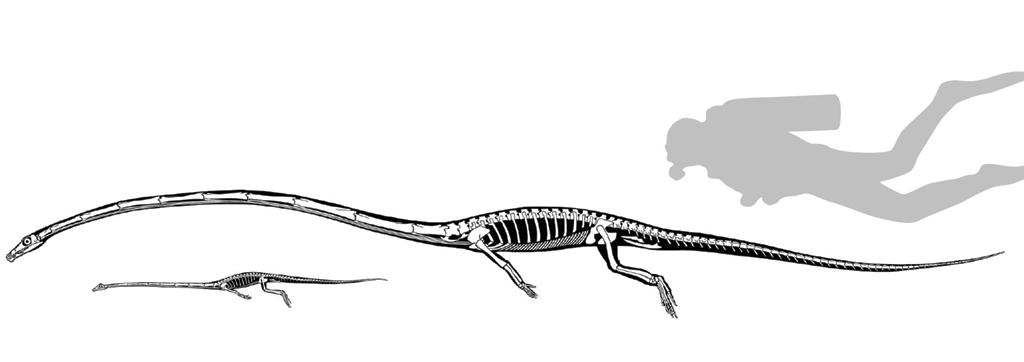
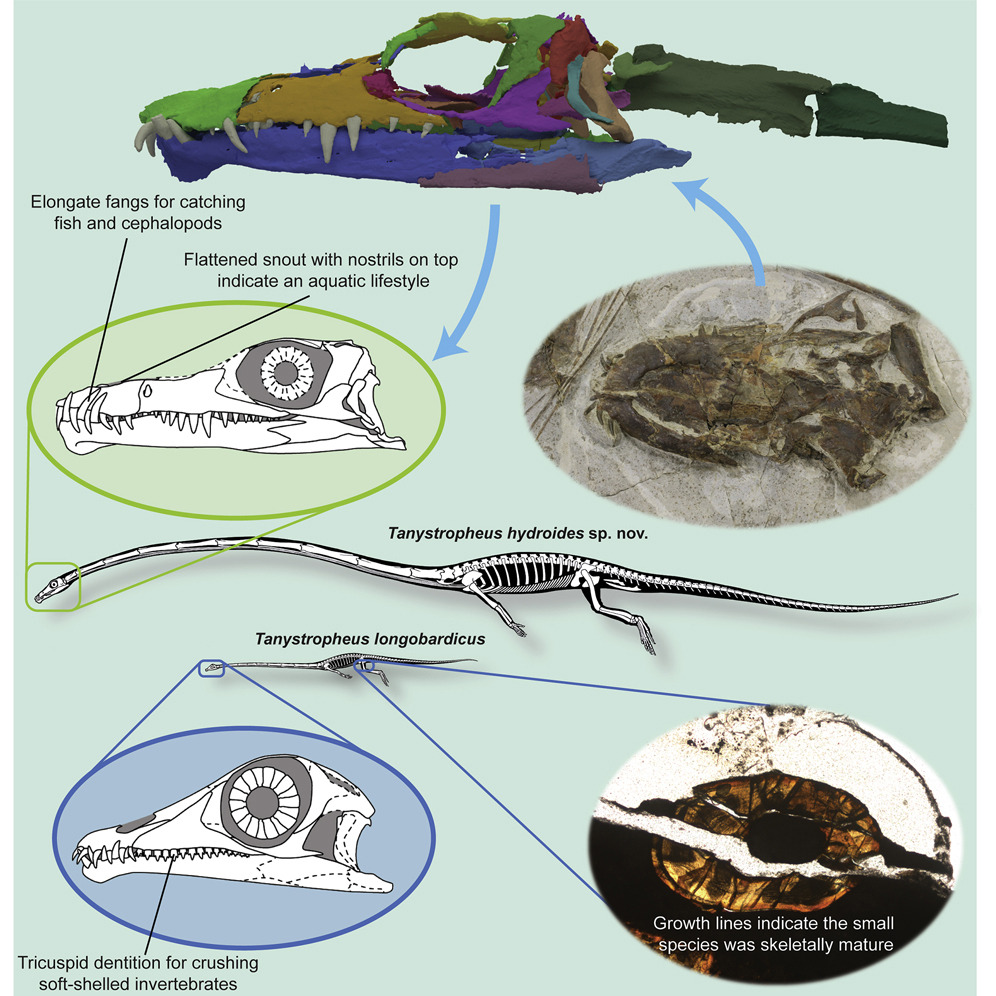
Specimens of Tanystropheus can reach more than 5 meters (16 feet) in length, with its tail making up roughly a third of its length, and its body maybe a quarter. The rest is all neck.

tanystropheus size compared to a humanTanystropheus sizes compared to a human. (Spiekman, et al., Current Biology, 2020)

"Tanystropheus looked like a stubby crocodile with a very, very long neck," said palaeontologist Olivier Rieppel from Chicago's Field Museum.

Why this reptile evolved such extended dimensions is a complete mystery. The fact nobody could figure out whether it preferred to be submerged in water or to lumber about on land only made it harder to settle on any conclusions.

Part of its oddness is the shape of the neck bones. Unlike those in a snake or lizard, the cervical vertebrae in Tanystropheus fossils are stretched out like a giraffe's. In fact, when its remains were first uncovered in 1852, the scattered bones were assumed to be the elongated wing bones of a flying pterosaur.


Not all of the individuals we've unearthed are crocodile-sized, either. A number are far smaller, prompting palaeontologists to question whether some of the specimens in their archives belong to juveniles, or represent a completely different species.

This is a common problem in palaeontology – the diminutive fossil of a dwarf species can be almost identical to the immature bones of a youngster. Separating them requires looking for clues on whether the skeleton has yet to reach full size or still has some growing to do.

Thankfully, such clues can be found deep inside the fossils. Just as the rings inside a tree's trunk present a record of their age, bones can do the same thing.

To find these, Rieppel and his colleagues used X-rays on an assortment of Tanystropheus skeletons, turning the scans into 3D models through high-resolution computerized tomography (CT) technology.

"The power of CT scanning allows us to see details that are otherwise impossible to observe in fossils," said lead author Stephan Spiekman, an expert in Triassic reptile evolution at the University of Zurich.


The growth rings revealed the smaller Tanystropheus bodies did indeed belong to adults, making it fairly clear that what the researchers had on their hands were two separate species.

To distinguish them, the team named the bigger one T. hydroides, after the hydra in Greek mythology. Its smaller cousin kept the original species name of T. longobardicus.

Transforming the scans into digital models also provided the researchers with a way to rearrange the squashed bones into a clearer configuration, making it far easier to get a good look at all of the creature's anatomy.

"From a strongly crushed skull we have been able to reconstruct an almost complete 3D skull, revealing crucial morphological details," said Spiekman.

With all of its bone fragments in their proper place, it looks like Tanystropheus would be well at home in the water after all.

The reptile's skull has its nostrils perched on top, much like a crocodile's snout – just the thing for an ambush predator to keep a lung full of air while waiting for a meal to pass by.

(Spiekman et al., Current Biology, 2020)(Spiekman et al., Current Biology, 2020)

What had been a jumbled pile of pointy teeth can also be seen forming a rather efficient trap for snatching a cephalopod, at least for the king-sized species.

"The small species likely fed on small shelled animals, like shrimp, in contrast to the fish and squid the large species ate," said Spiekman.

"This is really remarkable, because we expected the bizarre neck of Tanystropheus to be specialized for a single task, like the neck of a giraffe. But actually, it allowed for several lifestyles. This completely changes the way we look at this animal."

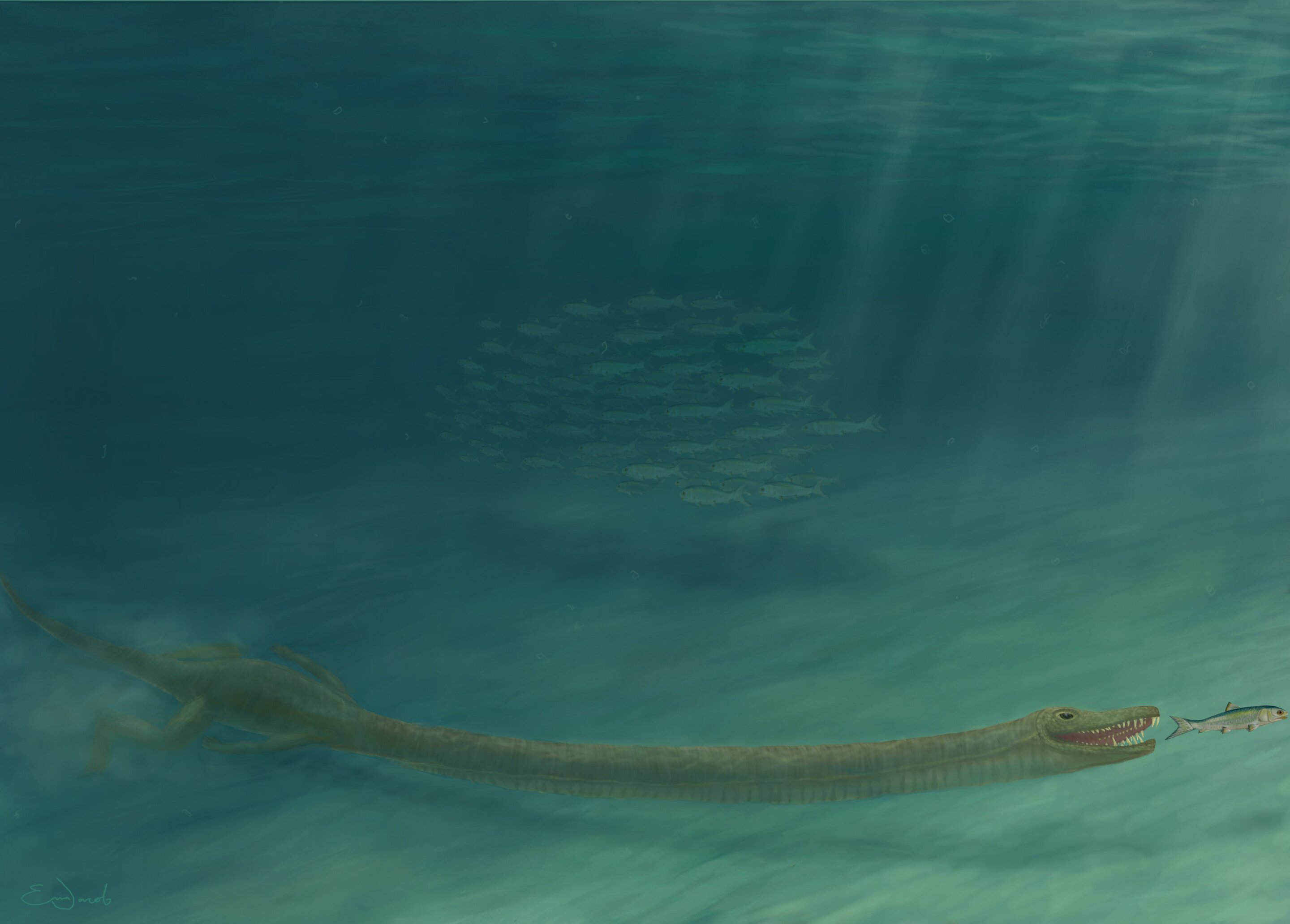
fossilmysterAn illustration showing T. hydroides hunting. (Emma Finley-Jacob)

The fact that the two, very similar species had such different ways of using their long bodies made it much easier for them to exist in the same habitats, sharing their environment without competing for the same food sources.

We can almost imagine the animal's squat, croc-like body lying against the floor of a shallow coastline some 242 million years ago, its head rising high up to the surface so its nostrils can siphon down air, its bristling mouth slightly agape in anticipation of a stray squid to stumble by.

As familiar as the scene feels, Tanystropheus is still one weird critter.

This research was published in Current Biology.

A version of this article was first published in August 2020.


#Nature | https://sciencespies.com/nature/scientists-finally-know-how-an-ancient-reptile-lived-with-such-an-absurdly-long-neck/

New reports highlight Russian, Chinese advances in space weapons

CSIS’ Space Threat Assessment and SWF’s Global Counterspace Capabilities are updated annually with open source information.


WASHINGTON — Russia over the past year has stepped up threats against satellites in orbit, a trend that is not likely to slow down. China, meanwhile, continues to display advances in space capabilities including the launch of an experimental spaceplane that may have deployed at least one small satellite on orbit. 


These are findings from new reports by the Center for Strategic and International Studies (CSIS) and the Secure World Foundation (SWF) released April 1. 


CSIS’ Space Threat Assessment and SWF’s Global Counterspace Capabilities are updated annually with open source information. They highlight global developments in anti-satellite weapons. 


The most significant change from a year ago has been Russia’s more aggressive behavior, said CSIS. 


“Russia was the most active in testing anti-satellite weapons over the past year, including tests of a space-based weapon that appears to be capable of firing projectiles at other satellites,” said the Space Threat Assessment. 


According to the SWF report, “there is strong evidence that Russia has embarked on a set of programs since 2010 to regain many of its Cold War-era counterspace capabilities. Since 2010, Russia has been testing technologies for rendezvous and proximity operations in both low Earth and geostationary orbits that could lead to or support a co-orbital anti-satellite capability.”


These technologies  can be used for non-aggressive applications such as surveillance and inspection of foreign satellites, the report says. “However, Russia has deployed two ‘sub-satellites’ at high-velocity, which suggests at least some of their rendezvous and proximity operations in low Earth orbit are of a weapons nature.”


CSIS noted that Russia tested a co-orbital anti-satellite weapon in July 2020, and tested a direct-ascent anti-satellite weapon in December 2020. “These activities are not new and reflect a pattern of behavior in which Russia has continued to develop and reconstitute its counterspace capabilities.”


Anti-satellite weapons can be kinetic systems like missiles or electronic weapons such as jammers. Of particular concern are kinetic weapons that produce orbital debris when they strike a target. “They pose a serious risk to the space environment and the ability of all nations to use the space domain for prosperity and security,” CSIS said. 


#Space | https://sciencespies.com/space/new-reports-highlight-russian-chinese-advances-in-space-weapons/