Featured Post

Tracking air pollution disparities -- daily -- from space

Studies have shown that pollution, whether from factories or traffic-snarled roads, disproportionately affects communities where economicall...

Thursday, April 1, 2021

Someone in the Kalahari collected crystals a whopping 105,000 years ago

A rockshelter in South Africa's Kalahari documents the innovative behaviors of early humans who lived there 105,000 years ago. We report the new evidence today in Nature.

The rockshelter site is at Ga-Mohana Hill - a striking feature that stands proudly above an expansive savanna landscape.


Many residents of nearby towns consider Ga-Mohana a spiritual place, linked to stories of a great water snake. Some community members use the area for prayer and ritual. The hill is associated with mystery, fear and secrecy.

Now, our findings reveal how important this place was even 105,000 years ago, documenting a long history of its spiritual significance. Our research also challenges a dominant narrative that the Kalahari region is peripheral in debates on the origins of humans.

We know our species, Homo sapiens, first emerged in Africa. Evidence for the complex behaviours that define us has mostly been found at coastal sites in South Africa, supporting the idea that our origins were linked to coastal resources.

This view now requires revision.

kalahari panorama(Author provided)

Above: The Ga-Mohana Hill North Rockshelter is located near the town of Kuruman in the Northern Cape province of South Africa.

A crystal-clear finding

We found 22 white and well-formed calcite crystals brought to the site 105,000 years ago. We determined this using a method called "optically stimulated luminescence", which dates sediments the crystals were excavated from.

Our analysis indicates the crystals were not introduced into the deposits via natural processes, but rather represent a small cache of deliberately collected objects.


Crystals found across the planet and from several time periods have previously been linked to humans' spiritual belief and ritual. This includes in southern Africa.

People at coastal sites similarity started to collect non-food seashells around the same time (but not earlier) - perhaps for similar reasons.
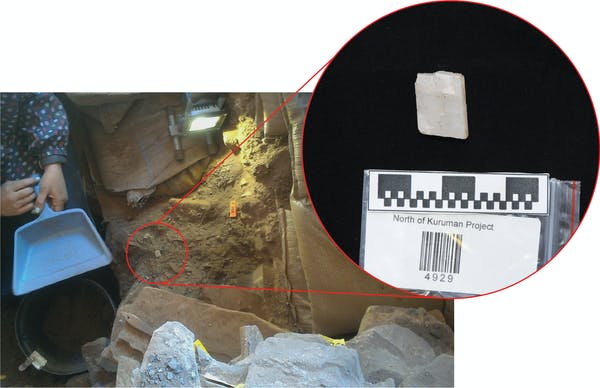
one of the crystals
One of 22 calcite crystals excavated from 105,000-year-old deposits. (Author provided)

Egg-citing technology

Ostrich eggshells can make excellent water storage containers and were used as such in southern Africa during the Pleistocene and Holocene. At coastal sites, the earliest evidence for this technology dates back about 105,000 years.

At Ga-Mohana Hill, we found ostrich eggshell fragments that show all the signs of being human-collected, based on their strong association with artefacts (including animal bones that are cut-marked from being butchered), and evidence of having been burned. These fragments may be the remains of early containers.
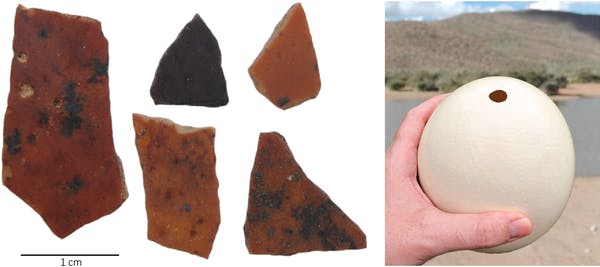
eggshell an modern canteen(Author provided)

Above: 105,000-year-old ostrich eggshell fragments (left). Modern day example of ostrich eggshell canteen (right).

This suggests early humans in the Kalahari were no less innovative than those living on the coast.

A global effort

International and interdisciplinary collaboration makes for the best research and our paper's authorship includes researchers from eight institutions across Australia, South Africa, Canada, Austria and the UK.

Local South African collaborators had an especially crucial role. For example, Robyn Pickering, Jessica von der Meden and Wendy Khumalo at the University of Cape Town provided important palaeoenvironmental context for the archaeology.

By dating tufa deposits around Ga-Mohana Hill, they showed water was more abundant 105,000 years ago when early humans were using the rockshelter.


Nnoga ya metsi

Many who visit Ga-Mohana Hill today for ritual practice see it as part of a network of places linked to the Great Water Snake (Nnoga ya metsi), a capricious and shape-shifting being. Many of these spiritual places are also associated with water.

Places such as Ga-Mohana Hill and their associated stories remain some of the most enduring intangible cultural artefacts from the past, linking modern indigenous South Africans to earlier communities.

These enduring beliefs establish an important sense of orientation in a country that has been spatially disorientated by colonial disruption.
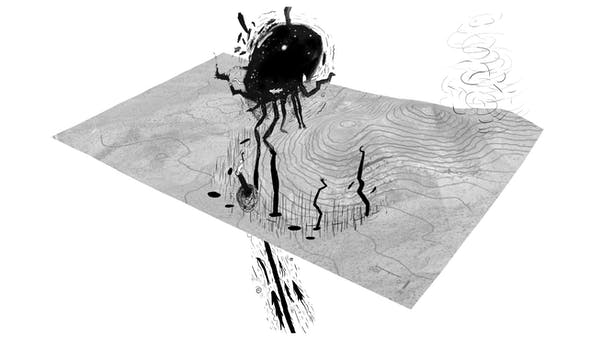
great water spiderAn illustrative representation of the Great Water Snake by Sechaba Maape. (Sechaba Maape)

Respectful research benefits all

Those who visit the site today for ritual purposes rely on its association with fear to launch them into their desired ritual states. The site's remoteness greatly contributes to this.

Recognising this significance, we've been adjusting our project methods to not undermine the practices held there. For example, following each excavation season, the areas we work from are completely back-filled and covered with sediment.


In this way, we can carefully recover our sections later, but leave almost no visible trace of our work. We haven't erected any signage or structures, or otherwise left any significant permanent modifications.

Community engagement continues as we consider ways to integrate the cultural and archaeological values of Ga-Mohana Hill. We are working to further develop an approach that has a positive impact on local communities, while also reflecting on what these communities teach us - particularly regarding respect and ritual.

From an archaeological perspective, we believe this approach will help ensure Ga-Mohana Hill can continue to offer new and valuable insights into the evolution of Homo sapiens in the Kalahari. The Conversation

Jayne Wilkins, ARC DECRA Research Fellow, Griffith University and Sechaba Maape, Senior Lecturer, University of the Witwatersrand.

This article is republished from The Conversation under a Creative Commons license. Read the original article.


#Humans | https://sciencespies.com/humans/someone-in-the-kalahari-collected-crystals-a-whopping-105000-years-ago/

We've found deep parts of the sea where the last ice age never actually ended

Some of the deepest parts of the Black Sea are still responding to climate changes prompted by the last ice age, scientists have discovered – a period which officially ended almost 12,000 years ago.


An analysis of gas hydrate deposits – in this case methane trapped by water molecules, in a solid substance that looks like ice – has revealed the lagging response in a northwestern area of the Black Sea known as the Danube fan.

Together with temperature measurements and other data, the drill cores of the gas hydrate deposits reveal something rather surprising: Levels of free methane gas under the seafloor have not yet adapted to the warmer conditions that have already prevailed on the surface for thousands of years.

"This shows that the gas hydrate system in the Danube deep sea fan is still responding to climate changes initiated at the end of the last glacial maximum," write the researchers in their paper.

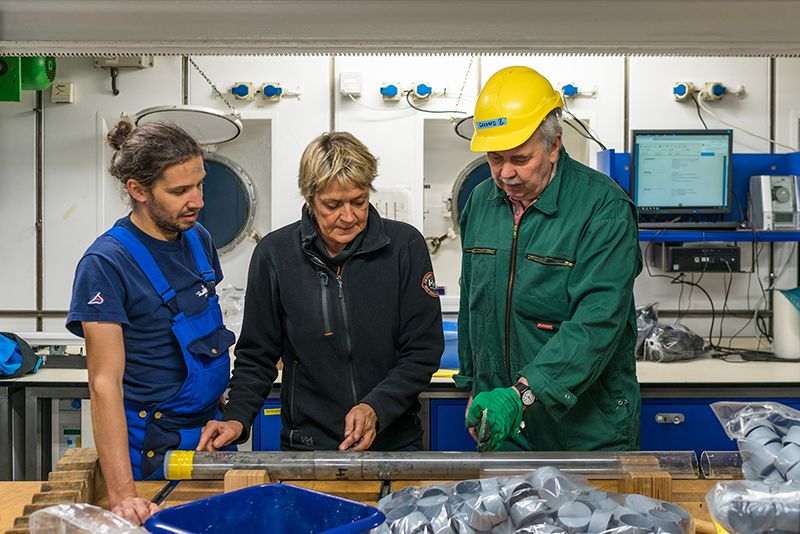
gas age 2Examining drill cores. (Christian Rohleder)

Central to the findings are scientists' attempts to determine the base of the gas hydrate stability zone (GHSZ) - the lowest point at which gas hydrates naturally form due to temperature, pressure, and a few other factors. Above and below that zone, you'll get 'free' methane gas not trapped in hydrates.

To find the base of this zone, researchers typically turn to a seismic reflection measure of the sediment known as the bottom-simulating reflector, or BSR for short. However, earlier work has found that in this part of the Black Sea, there's a curious depth discrepancy between the BSR and the base of the gas hydrate stability zone. 


By drilling down to the seafloor and taking temperature measurements, researchers have now concluded that the gas hydrate stability zone has adapted to the warmer conditions over the past millennia – as indicated by a rise to a higher level – but the free methane gas and the associated BSR are still playing catch up.

"From our point of view, the gas-hydrate stability boundary has already approached the warmer conditions in the subsurface, but the free methane gas, which is always found at this lower edge, has not yet managed to rise with it,"  says geophysicist Michael Riedel, from the GEOMAR Helmholtz-Center for Ocean Research in Germany.

That lagging response could be why the BSR isn't where it should be. Sediment permeability could also play a role, the team thinks, and their measurements show that methane has managed to rise in certain areas but not others.

"In summary, we have found a very dynamic situation in this region, which also appears to be related with the development of the Black Sea since the last ice age," says Riedel.

Around 20,000 years ago, the water level was around 100 meters (328 feet) lower in the Black Sea, meaning less pressure on the sea bed. The water was significantly cooler too. As far as the free methane gas is concerned, those conditions haven't yet changed.

As with any study of the effects of climate change, this research is going to help in future climate modeling. There's currently a huge volume of gas hydrate deposits underneath the Arctic, for instance, and it's important to know how they might react to increases in temperature in the years ahead.

The scientists emphasize that their findings should be interpreted cautiously, with many different factors in play and plenty more scope for study – but they also stress the importance of in-situ measurements and quality data for an analysis such as this.

"For our investigations we used our drilling device MARUM-MeBo200 and broke all previous depth records with a maximum depth reached of almost 145 meters [476 feet]," says geologist Gerhard Bohrmann, from the University of Bremen in Germany.

The research has been published in Earth and Planetary Science Letters.


#Nature | https://sciencespies.com/nature/weve-found-deep-parts-of-the-sea-where-the-last-ice-age-never-actually-ended/

Former NASA administrator Jim Bridenstine joins Viasat’s board

TAMPA, Fla. — Jim Bridenstine has joined satellite operator Viasat’s board of directors in his second corporate role since stepping down as NASA’s administrator.


U.S.-based Viasat is enlarging its board to eight members to add Bridenstine, who became a senior advisor for private equity firm Acorn Growth Companies soon after resigning from NASA Jan. 20 at the end of the Trump administration.


“I am very excited about the opportunity to get involved in a lot of the commercial capabilities of Viasat, increasing throughput and increasing bandwidth for humanity, connecting more of the world than ever before,” Bridenstine told SpaceNews in an interview.


Viasat has been investing heavily in a three-satellite ViaSat-3 terabit broadband constellation, which will transform the company into a global service provider.


The first Viasat-3 satellite will serve the Americas and will likely launch early next year, after pandemic-related supply chain disruption pushed it from the end of 2021.


“ViaSat-3 is going to be providing capacity that is going to compete against terrestrial networks,” Bridenstine said.


“We’re talking about a satellite constellation that can deliver per terabit second of throughput. We’re talking about constellations after that, that are going to deliver as much as five or even seven terabits per second of throughput.”


Bridenstine said Viasat’s ability to tackle the digital divide by driving down costs, in part by increasing the supply of bandwidth, is one of the reasons he approached the company about a month and a half ago.


“There’s a huge digital divide, not just in the United States of America but in the world, and that digital divide has consequences as it relates to the economy and education and healthcare — and all of the other things that we care about as a civilization,” he said.


It is an issue that the COVID-19 pandemic has helped push to the top of government agendas, as more activities were moved online to combat the spread of the virus. 


Analysts have said accelerated digitalization trends could result in permanent changes to workplace and other practices, although the extent of this remains unclear.


In a Feb. 4 letter to shareholders, Viasat said revenue for its satellite services division increased 4% year-on-year to $221 million for the three months to Dec. 31, after demand for U.S. fixed broadband helped offset a pandemic-driven decline in-flight connectivity.


Viasat said it will draw upon Bridenstine’s experience in space technology, innovation and safety as it plots future services for its consumer, enterprise and government customers.


Asked whether his appointment could result in tweaks to Viasat’s business strategy, Bridenstine said “right now I’m just looking forward to rolling up my sleeves, getting to work, learning more about the company and then seeing where the areas [are] that I can add the most value.”


One area on his radar concerns the threat of megaconstellations to space safety and the overall space access environment.


Viasat has warned that SpaceX’s Starlink broadband network, the world’s largest commercial satellite constellation that also seeks to compete with terrestrial telcos, poses environmental hazards in space and on Earth. 


In December 2020, Viasat petitioned the U.S. Federal Communications Commission to conduct an environmental review Starlink, before its grants SpaceX permission to operate nearly 3,000 more satellites in lower orbits.


“The bottom line is the direction we’re going right now in space as it relates to orbital debris and megaconstellations … in my view is not sustainable,” Bridenstine said.


“And it’s going to require the U.S. government to make decisions to make it sustainable for future generations. That’s not a Viasat issue, it’s an issue that’s important for the United States of America, and it’s an issue that’s important for humanity.”


Mark Dankberg, Viasat’s co-founder and executive chairman, said in a prepared statement: “[Bridenstine’s] insight into all aspects of advanced space programs can help ensure Viasat remains at the forefront of space system and network technology globally. 


“And, because of the pivotal role he’s played in expanding the U.S. manned space program, Jim is also an ardent proponent of preserving safe access to space via proactive measures to protect the space environment and contain orbital debris.”


NASA launched a new human lunar exploration mission through the Artemis program under Bridenstine’s leadership.


Bridenstine also led partnering efforts with U.S. companies under the Commercial Crew Program, which resupplied the International Space Station with American rockets for the first time since the end of the Shuttle program in 2011.


Before serving as NASA’s administrator between April 2018 and January 2021, Bridenstine was a member of Congress, representing Oklahoma’s First Congressional District in the U.S. House of Representatives.


He also served on the Armed Services Committee and the Science, Space and Technology Committee.


His career in federal service began as a pilot in the United States Navy in 1998.


US President Joe Biden March 19 nominated Bill Nelson, a former astronaut who represented Florida in the senate from 2001-2019, as NASA’s next administrator.


#Space | https://sciencespies.com/space/former-nasa-administrator-jim-bridenstine-joins-viasats-board/

Particles of a meteor explosion from 430,000 years ago found hidden in Antarctic ice

Approximately 430,000 years ago, a meteorite exploded over Antarctica.

The only reason we know about it now is because scientists have just found tiny, once-molten particles of space rock that have been hidden away in the ice ever since.


Based on an analysis of those particles, the event was an unusual one - not quite powerful enough to produce an impact crater, but nor was it a lightweight. The jet of melted and vaporized material that blasted from the mid-air explosion would have been more hazardous than the Tunguska event that flattened a Siberian forest in 1908.

Although crater-producing impacts are fairly rare, rocks entering and exploding in Earth's atmosphere are not. They're called bolides, and NASA has logged 861 of them since 1988 at time of writing. Superbolides - those like the Chelyabinsk meteor in 2013, or the Kamchatka meteor in 2018 - occur a few times a century.

Airburst events more powerful than Tunguska are rarer still, but they're still thought to have been more common than impact cratering events throughout Earth's history. This is sobering, according to a team led by cosmochemist Matthias van Ginneken of the University of Kent, UK.

"While touchdown events may not threaten human activity if occurring over Antarctica," he said, "if it was to take place above a densely populated area, it would result in millions of casualties and severe damages over distances of up to hundreds of kilometers."


The problem is that, because these events don't tend to leave a crater, we have a hard time identifying them (heck, sometimes we even have a hard time identifying craters), so it's unclear just how common they are.

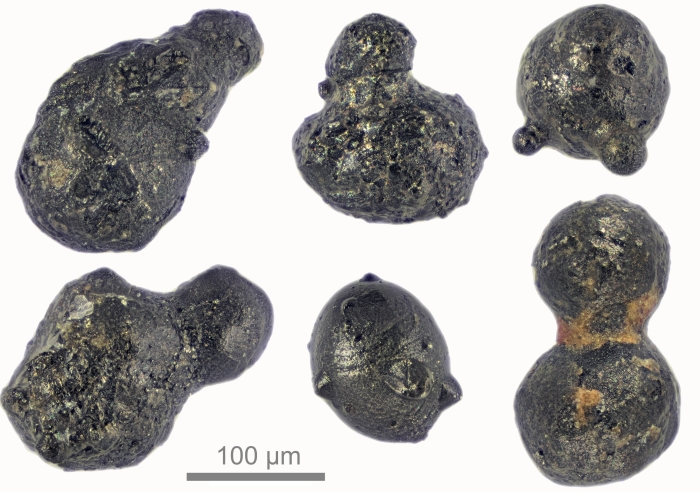
Cue 17 tiny particles, found on the summit of Walnumfjellet in the Sør Rondane Mountains of Queen Maud Land in East Antarctica. The largest of these bits is no bigger than half a millimeter across.

spherulesSome of the spherules. (Scott Peterson/micro-meteorites.com)

They might look like pretty ordinary grains of dirt to the naked eye, but van Ginneken and his team subjected them to scanning electron microscopy, revealing that they are a kind of bolide product called condensation spherules.

The team's study revealed that the blobby spherules are composed mostly of iron and olivine, with a high nickel content - exactly consistent with a kind of rare meteorite known as a pallasite, confirming that the globlets originated off-world.

They were also low in oxygen-18, an isotope of oxygen that is found in lower concentrations in colder conditions, such as polar ice and water. When compared to condensation spherules found in other regions of Antarctica, previously dated to 480,000 and 430,000 years ago, the researchers found them surprisingly similar.


This similar chemical profile suggests the spherules were all created from the same meteoritic event, 430,000 years ago. It also contains clues as to the explosion itself.

According to the researchers, condensation spherules from a simple airburst are rare; they're usually found associated with cratering events. But the team could find no crater associated with their grains. In addition to the wide area across which they were scattered, this suggests the event that produced the spherules had to be an airburst - but one much more powerful than we usually see.

We're not 100 percent sure how meteors explode in the air, but scientists believe that high-pressure air in front of the falling meteor seeps into cracks in the rock, increasing internal pressure and causing the rock to break apart.

The heat associated with this process would have vaporized material in the meteorite; the explosion sent it blasting towards the ground. There, the vaporized material condensed again, mixing with the Antarctic ice sheet as it did so: thus the oxygen-18 profile of the spherules.

Because this event would have been even more powerful than Tunguska - an explosion of at least 3 megatons - the findings hint that such 'intermediate' meteor events have the potential to be devastating; even without an impact, the Tunguska event flattened 2,150 square kilometers (830 square miles) of forest, felling an estimated 80 million trees.

It therefore behooves us, the researchers said, to try and fill in the gaps in the superbolide record.

"To complete Earth's asteroid impact record, we recommend that future studies should focus on the identification of similar events on different targets, such as rocky or shallow oceanic basements, as the Antarctic ice sheet only covers 9 percent of Earth's land surface," van Ginneken said.

"Our research may also prove useful for the identification of these events in deep sea sediment cores and, if plume expansion reaches landmasses, the sedimentary record."

As if we didn't have enough to worry about…

The team's research has been published in Science Advances.


#Space | https://sciencespies.com/space/particles-of-a-meteor-explosion-from-430000-years-ago-found-hidden-in-antarctic-ice/

There are two types of narcissist, and the difference is crucial, researchers say

In a time when flaunting your best self on social media has become a norm, narcissistic traits seem to be everywhere. 

In today's slang, off-putting behaviors like entitlement, superiority and self-congratulating are known as 'flexing'. Such traits might be more common these days, but being narcissistic is still seen as a pathological personality trait, akin to being sadistic, manipulative, or even psychopathic. 


However, a new study of 270 people with a median age of 20 lends more credit to the notion that narcissistic behaviors are not always driven by the same things as psychopathy.

"For a long time, it was unclear why narcissists engage in unpleasant behaviors, such as self-congratulation, as it actually makes others think less of them. Our work reveals that these narcissists are not grandiose, but rather insecure," said clinical psychologist Pascal Wallisch from New York University (NYU).

"More specifically, the results suggest that narcissism is better understood as a compensatory adaptation to overcome and cover up low self-worth," added clinical psychologist Mary Kowalchyk, also from NYU.

Psychologists do already distinguish between two rather different types of narcissists: 'vulnerable narcissists' who have low self-esteem, attachment anxiety, and are highly sensitive to criticism; and 'grandiose narcissists', who have high self-esteem and self-aggrandizement.

This latest research helps to further disentangle the two.

Kowalchyk and team used a series of measures to assess the levels of different traits including narcissism, self-esteem, and psychopathy for each of their participants, and found that flexing behavior is strongly associated with individuals who also have high insecurities and sense of guilt. Those exhibiting psychopathy showed relatively low levels of guilt.


"Narcissists are insecure, and they cope with these insecurities by flexing. This makes others like them less in the long run, thus further aggravating their insecurities, which then leads to a vicious cycle of flexing behaviors," said Kowalchyk.

This is in contrast to individuals that exhibit grandiose narcissism, who genuinely believe in their own self-importance and do not display signs of insecurity. To the researchers, the difference between the two goes further than just a category distinction.

"We posit that what was previously seen as grandiose narcissism is actually better understood as one behavioral manifestation of psychopathy," the team writes in their paper.

They acknowledge further research is needed in a more diverse population across larger time scales to validate their results. But these new findings align with a small study from 2017, in which narcissistic men's brain scans revealed emotional distress and conflict when they were shown a photo of themselves.

In fact, there have been conflicting studies around whether narcissists do or do not like themselves; by defining the two types of narcissism more precisely, we can arrive at a better understanding of their behaviors, since both types of narcissist may also cause real harm to the people around them in the form of narcissistic abuse.


Pathology aside, narcissistic traits - also thought to be fueled by an increased focus on individualism - can be seen reflected in our society through the ways we write with more "I" than "we", more self-focused lyrics in our songs, and a shift towards stories based around fame.

Researchers have measured these shifts, too. For instance, endorsement rates for the statement "I am an important person" have increased from 12 to 80 percent in adolescents between 1963 to 1992.

Furthermore, flaunting ourselves on social media is something many of us participate in, collectively forming and feeding insecurities about not fitting in. These behaviors are hardwired into us as an obligatorily social species.

While narcissists are notoriously great at using social media, whether social media can increase narcissism has been less conclusive, but the new paper suggests that "an increase in such behaviors – specifically self-elevation – makes sense within the framework we propose here, as engaging with social media inherently inflicts constant social comparison and appraisal, which could exacerbate insecurities about self-worth."

So, next time you're ready to dismiss someone's boastful behavior as self-importance, it might be worth considering they're just... insecure.

This research was published in Personality and Individual Differences.


#Humans | https://sciencespies.com/humans/there-are-two-types-of-narcissist-and-the-difference-is-crucial-researchers-say/

We just got closer to truly determining who were the world's first animals

The tree of animal life had to begin somewhere. Finding that original branch amongst such a tangled canopy is harder than it sounds, though.

A new analysis of genomic data suggests that one phylum in the running for the oldest branch has been deceiving us all along.


Since the 19th century, many scientists have presented the sponge - one of the simplest creatures in existence - as the world's first animal. 

Modern genomic studies, however, have pitted this muscle-less, nerve-less and organ-less blob against a far more complex creature.

Comb jellies comprise a small phylum known as Ctenophora, but unlike Porifera - the phylum sponges belong to - these orb-like creatures show much more advanced traits, including neurons and muscle cells to detect and eat prey, as well as a gut for digestion.

If these jellies actually came first, it means many of their traits were subsequently lost among Porifera, only to evolve again later on. While this might sound downright illogical, it's not entirely out of the question, although it does threaten to change our understanding of early animal evolution and the development of the nervous system itself.

"It may seem very unlikely that such complex traits could evolve twice, independently, but evolution doesn't always follow a simple path," explains geneticist Anthony Redmond from Trinity College Dublin in Ireland.

"For example, birds and bats are distantly related but have independently evolved wings for flight."


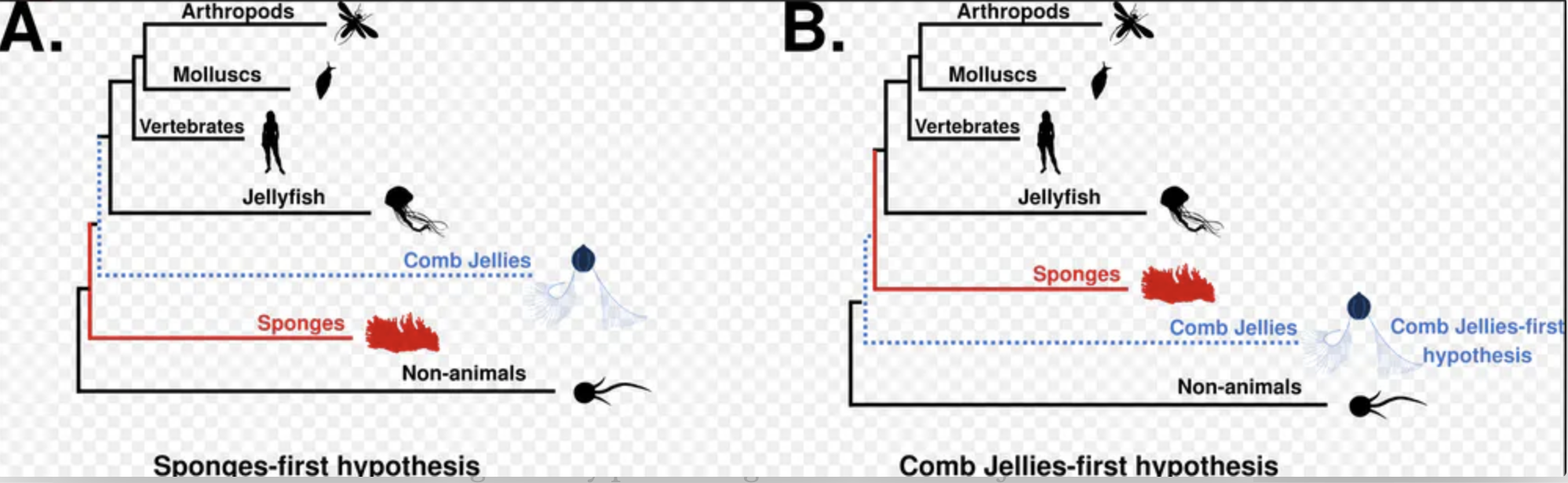
In recent years, some models that have split genes up into smaller groups for comparison have found comb jellies hold a greater phylogenetic signal than sponges, which suggests these animals evolved and existed first.

Using the same data, other models that do not partition genes but rely on a larger super-matrix have revealed the exact opposite timeline, with sponges arriving on the scene earlier than comb jellies.

Both of these approaches have their limitations, but examining them together helps alleviate some of our previous errors and biases when looking at the data.

A reanalysis using a more integrative model now suggests we were on the right track to begin with - namely, sponges were it.

"Our approach bridges the gap between two disagreeing methodologies, and provides strong evidence that sponges, and not comb jellies, are our most distant animal relatives," says Redmond.

"This means our last common animal ancestor was morphologically simple and suggests that repeated evolution and/or loss of complex features like a nervous system is less likely than if comb jellies were our most distant animal relatives."


In evolution, natural selection tends to maintain the function and shape of certain proteins by substituting specific amino acids with others that have similar biochemical properties. These properties, however, can differ from site to site, within and between genes.

Partitioned models, where genes are split up and substitution patterns among sites are compared in groups, often do not account for this diversity, which means they could be missing multiple 'hidden' substitutions, especially in species where new amino acids were selected for relatively quickly.

As such, most partitioned models point toward comb jellies as the original sister to other animals. But when models that do account for site differences are incorporated, researchers have found sponges instead take on that role.

This lines up with previous studies that have found partitioned and unpartitioned models can affect branch-lengths and nodes of change on the tree of life, "sometimes dramatically so."

In other words, researchers argue, it is our "poorly fitting" and "overly simplistic" models that are suppressing some evolutionary changes on the long branch of comb jellies. This makes the Ctenophora phylum look like it evolved before sponges, when, in fact, these jellies probably split from Porifera quite early on and then evolved incredibly fast.


The results support a previous study in 2020 that found the rapid evolution of comb jellies introduces a bias into our models that fools us into thinking they came first.

Both the Porifera and Ctenophora phyla have long branches, but when we compare the two using similar amino acid replacement models, the jellies look as though they must be older because of their rapid evolution. In reality, however, the gene sequences of comb jellies have occurred in a much tighter space of time, which makes them seem more closely related to sponges than they actually are.

Screen Shot 2021 04 01 at 12.38.44 pmTwo possible trees for the first phyla in existence. (Telford and Kapli/The Conversation)

Future models need to account for this bias, known as the 'long branch attraction', researchers say, otherwise these discrepancies will keep popping up again and again.

"Long-branched animal groups are often difficult to place," evolutionary biologist Detlev Arendt told Quanta Magazine in 2015.

"So far, the phylogenetic data is not really conclusive on where [comb jellies] belong."

Given how heated this debate has become, it's unlikely this new study will end the conversation for good. That said, the results of this updated model do join other recent advances in genomic research that suggest the genes of comb jellies are somehow throwing us off the scent.

"Consternation over which lineage is sister to other animals has had a major influence on development of novel approaches and reassessment of the quality of commonly applied phylogenetic methodologies," the authors write.

"This looks set to continue, with many avenues of research highlighted by this debate yet to be explored."

The study was published in Nature Communications. 


#Nature | https://sciencespies.com/nature/we-just-got-closer-to-truly-determining-who-were-the-worlds-first-animals/

How Middle East dust intensifies summer monsoons on Indian subcontinent

New research from the University of Kansas published in Earth-Science Reviews offers insight into one of the world's most powerful monsoon systems: the Indian summer monsoon. The study details how the monsoon, of vital social and economic importance to the people of the region, is supercharged by atmospheric dust particles swept up by winds from deserts in the Middle East.


"We know that dust coming from the desert, when lifted by strong winds into the atmosphere, can absorb solar radiation," said lead author Qinjian Jin, lecturer and academic program associate with KU's Department of Geography & Atmospheric Science. "The dust, after absorbing solar radiation, becomes very hot. These dust particles suspended in the atmosphere can heat the atmosphere enough that the air pressure will change -- and it can result in changes in the circulation patterns, like the winds."


This phenomenon, dubbed an "elevated heat pump," drives moisture onto the Indian subcontinent from the sea.


"The Indian summer monsoon is characterized by strong winds in the summer," Jin said. "So once the winds change, the moisture transport from ocean to land will change, and consequently they will increase the precipitation. The precipitation is very important for people living in South Asia, especially India, and important for agriculture and drinkable water."


While the dust from the Middle East boosts the power of the monsoons on the Indian subcontinent, there is also a reverse effect that results in a positive feedback loop where the monsoons can increase the winds in the Middle East to produce yet more dust aerosols.


"The monsoon can influence dust emission," Jin said. "When we have a stronger monsoon, we have heating in the upper atmosphere. The convection associated with the monsoon can go up to a very high elevation, as much as 10 kilometers. When this pattern of air over the monsoon is heated, you produce something like a wave. Across the area, you'll have high pressure, then low pressure, then high pressure. Those waves can transport air to the Middle East. The air comes upward over the Indian subcontinent, then goes to the Middle East and goes downward -- and when the downward air strikes the surface, it can pick up a lot of dust aerosols."


Jin's co-authors on the paper are Bing Pu, assistant professor of geography & atmospheric science at KU; Jiangfeng Wei of the Nanjing University of Information Science and Technology in Nanjing, Jiangsu, China; William K.M. Lau of the University of Maryland and Chien Wang of Laboratoire d'Aerologie, CNRS/UPS, Toulouse, France.


Their work encompassed a review of literature on the relationship between Middle East dust and the Indian summer monsoons, along with original research using supercomputers to better understand the phenomenon.


While it has been known that an "elevated heat pump" exists due to dust coming from the Arabian Peninsula, Jin and his colleagues argue for another source in South Asia fueling the effect of aerosolized dust upon the Indian summer monsoons: the Iranian Plateau.


"The Iranian Plateau is located between the Middle East and the Tibetan Plateau, and the Iranian Plateau is also very high," Jin said. "The land at high elevation, when solar radiation reaches the surface, will become very hot. Over this hot Iranian Plateau, we can expect changes to the monsoon circulation and at the same time the hot air over the Iranian Plateau can also strengthen the circulation over the deserts of the Arabian Peninsula. So, the Iranian Plateau can increase dust emission from the Middle East, as well as monsoon circulation and monsoon precipitation. The Iranian Plateau is another driver that can explain the relationship between Middle East dust and Indian summer monsoon."


Jin said the paper explores three other mechanisms influencing the Indian summer monsoon. One is the snow-darkening effect, where black carbon and dust reduce snow's reflectivity, warming the land and the troposphere above. Another is the solar-dimming effect, where aerosols in the atmosphere cause the land surface to cool. Lastly, the research considers how aerosolized dust can serve as ice-cloud nuclei, which can "alter the microphysical properties of ice clouds and consequently the Indian summer monsoon rainfall."


The KU researcher said understanding these mechanisms and climactic effects of dust will prove to be of increasing importance in the face of global climate change.


"This is especially true for Asia -- there are climate projections showing that in some areas of Asia, the land will become drier," Jin said. "So, we expect more dust emissions and dust will play a more important role for some time to come in Asia. We have a lot of anthropogenic emission, or air pollution, in eastern China, East Asia and India. But as people try to improve our air quality, the ratio between natural dust to anthropogenic aerosol will increase -- that means dust will play a more important role in the future."


#Environment | https://sciencespies.com/environment/how-middle-east-dust-intensifies-summer-monsoons-on-indian-subcontinent/