Featured Post

Tracking air pollution disparities -- daily -- from space

Studies have shown that pollution, whether from factories or traffic-snarled roads, disproportionately affects communities where economicall...

Tuesday, March 30, 2021

Amazon Web Services launches space accelerator program for startups

Startups at all stages of maturity working with space technology or space data are eligible to apply


WASHINGTON — Amazon Web Services is launching a space accelerator program for startups, the company announced March 30. 


AWS is teaming up with the U.K.-based venture investment firm Seraphim Capital to select the first 10 startups for the four-week mentoring program scheduled to begin in June. The program will be modeled after Seraphim’s “space camp” accelerator. 


The space accelerator is another step in AWS’s expansion into the space sector. Amazon Web Services in 2019 introduced AWS Ground Station, a cloud-based system for controlling satellites, and for downloading and analyzing data. The company in 2020 stood up the AWS Aerospace and Satellite business to work with government agencies and the space industry and figure out new ways to use the cloud. Startups have become a huge part of the AWS space business customer base.


Applications for the space accelerator program are due April 21.


“AWS and Seraphim will select a cohort of space startups to participate in an intensive, four-week program with AWS cloud and technical training to help them accelerate research, development and growth,” Sandy Carter, vice president of programs for AWS worldwide public sector, said in a blogpost. 


Startups at all stages of maturity working with space technology or space data are eligible to apply, Carter said. Selection criteria include: the innovative and unique nature of the project, the overall value the solution will bring to the industry, the creative application of AWS to solve problems and the team’s ability to deliver on an identified opportunity.


The 10 selected startups will receive mentoring and up to $100,000 in AWS technical services offered under the AWS Activate program.


#Space | https://sciencespies.com/space/amazon-web-services-launches-space-accelerator-program-for-startups/

A Spectacular ‘Super Pink Moon,’ ‘Shooting Stars’ And A Galaxy-Rise: Your Stargazing Guide To April 2021

April is here and finally it’s warm enough in the northern hemisphere to contemplate longer stargazing sessions in relative comfort. 


This month’s night skies are awash with constellations, with Leo, the Lion, and Ursa Major, the Great Bear, especially dominant. This month also sees our satellite, the Moon, go into conjunction with Jupiter and Saturn, a spectacular “Super Pink Moon” and—perhaps most impressively of all—the rise of the arc of the Milky Way. 


Here’s what happening above our heads in April 2021: 


1. Crescent Moon, Jupiter and Saturn


When: Just before sunrise on April 6 and 7, 2021


Where to look: southeastern sky


With Jupiter and Saturn having emerged in the pre-dawn skies, you can watch a 31%-lit crescent Moon pass the gas giants on successive mornings if you have a view low to the southeastern horizon.


It will pass 4° from Saturn on 6 April followed by 4.4° from Jupiter on 7 April, with the former close pass taking place in darker skies. 


2. Lyrid meteor shower


When: Just before sunrise on April 21/22, 2021


Where to look: all sky


Though active between April 16-25, 2021, the Lyrid meteor shower will this year take place under the watch of a 70%-lit waxing gibbous Moon. That’s not ideal, and means you’ll only see the very brightest “shooting stars” from the expected 10 to 15 meteors per hour.


However, since the chief attraction of the Lyrids is the possibility of a super-bright “fireball,” that’s perhaps not a killer blow. Go out stargazing when it’s really dark—around midnight—and you might see one. Besides, the best chance of seeing “shooting stars” is in the hour before dawn, when the Moon will have set in the west. 


3. Beehive Cluster


When: February to May


Where: highest around midnight  


An open cluster of stars about 520 light-years distant in the constellation of Cancer, the Beehive Cluster is one of the nearest and best-looking open clusters of stars to the Solar System.


Also known as both Praesepe and M44, it appears as around 60 stars in a pair of binoculars, though a dozen or so stand out. 


4. A ‘Super Pink Moon’ 


When: Moonrise on April 26, 2021


Where to look: low the eastern horizon


A full Moon that coincides (or thereabouts) with the Moon’s perigee—the closest point in the Moon’s monthly orbit that it comes to Earth—is often called a “supermoon.” It’s a result of the Moon’s orbit being slightly elliptical, which make the full Moon sometimes looks slightly larger.


That’s exactly what’s happening tonight, and it will be best viewed at moonrise where you are. 


5. Antares and the Moon


When: Just before sunrise on Thursday, April 1, 2021 and on Thursday, April 29, 2021


Where to look: southeastern sky


Look to the southeast horizon before sunrise on these two mornings and you’ll see a waning gibbous Moon about 5° Antares, the brightest star in the constellation of Scorpius, the Scorpion.


Antares is a red supergiant star that will one day explode as a supernova. It’s around 555 light-years distant. 


6. The core of the Milky Way


When: April-September


Where: southern night sky


The bright centre of our galaxy is a seasonal event and it helps to know when it's up. It emerges from the horizon in April, rising around midnight, by mid-June it rises right after sunset, and by July it’s already up after dark.


The further south you travel, the more of our galaxy’s bright core becomes visible. 


Times and dates given apply to mid-northern latitudes. For the most accurate location-specific information consult online planetariums like Stellarium and The Sky Live. Check planet-rise/planet-set, sunrise/sunset and moonrise/moonset times for where you are. 


Wishing you clear skies and wide eyes. 


#News | https://sciencespies.com/news/a-spectacular-super-pink-moon-shooting-stars-and-a-galaxy-rise-your-stargazing-guide-to-april-2021/

Guess what just happened to the latest SpaceX Starship prototype

SpaceX chief Elon Musk confirmed on Twitter Tuesday that the latest prototype of the company's Starship rocket series had crashed, after the video feed of its test flight cut out.


"At least the crater is in the right place!" he joked, in acknowledging the fourth failed test of the prototype.

"Something significant happened shortly after landing burn start. Should know what it was once we can examine the bits later today," he added.

The rocket, SN11, launched from the company's south Texas facility around 1300 GMT and began its ascent to 10 kilometers (six miles), experiencing some video glitches.

It was descending to the surface when the feed was lost once again.

"We lost the clock at T plus five minutes, 49 seconds," said announcer John Insprucker, meaning the amount of time that had passed after lift-off.

"Looks like we've had another exciting test of Starship Number 11," he added, dryly.

SN11 is the 11th prototype of Starship, which SpaceX hopes will one day be able to fly crewed missions to the Moon, Mars and beyond.

It was the fourth to conduct a test flight attempting to return to the ground for a soft vertical landing.

SN8 and SN9, which launched in December and February respectively, crash landed and exploded, while SN10 successfully landed then blew up a few minutes later during its test on March 3.

Despite the previous failures, analysts say SpaceX is gathering valuable data that will help it to accelerate its development timeline.

Eventually, SpaceX plans to combine the Starship spaceship with a Super Heavy rocket, creating a fully reusable system.

This final version will stand 394 feet (120 meters) tall and will be able to carry 100 metric tonnes into Earth orbit - the most powerful launch vehicle ever developed.

© Agence France-Presse


#Space | https://sciencespies.com/space/guess-what-just-happened-to-the-latest-spacex-starship-prototype/

Air pollution and physical exercise: When to do more or less

Physical activity is important in preventing heart and blood vessel disease in young people so long as they don't undertake very strenuous activity on days when air pollution levels are high, according to a nationwide study of nearly 1.5 million people published today (Tuesday) in the European Heart Journal.


Until now, little has been known about the trade-offs between the health benefits of physical activity taking place outdoors and the potentially harmful effects of air pollution. Previous research by the authors of the current study had investigated the question in middle-aged people at a single point in time, but this is the first time that it has been investigated in people aged between 20-39 years over a period of several years. In addition, the researchers wanted to see what happens when people increase or decrease their physical activity over time.


The researchers from Seoul National University College of Medicine (South Korea), led by Professor Sang Min Park, looked at information from the National Health Insurance Service (NHIS) in South Korea for 1,469,972 young Koreans living in cities, who underwent two consecutive health examinations during two screening periods: 2009-2010 and 2011-2012. They followed up the participants from January 2013 to December 2018.


At each health check-up the participants completed a questionnaire asking about their physical activity in the past seven days and this information was converted into units of metabolic equivalent task (MET) minutes per week (MET-mins/week). The participants were divided into four groups: 0, 1-499, 500-999 and 1000 or more MET-mins/week. European Society of Cardiology guidelines recommend people should try to do 500-999 MET-mins/week and this can be achieved by, for example, running, cycling or hiking for 15-30 minutes five times a week, or brisk walking, doubles tennis or slow cycling for 30-60 minutes five times a week. [1]


The researchers used data from the National Ambient Air Monitoring System in South Korea to calculate annual average levels of air pollution, in particular the levels of small particulate matter that are less than or equal to 10 or 2.5 microns in diameter, known as PM10 and PM2.5 [2]. The amount of exposure to air pollution was categorised at two levels: low to moderate (less than 49.92 and 26.43 micrograms per cubic metre, μm/m3, for PM10 and PM2.5 respectively), and high (49.92 and 26.46 μm/m3 or more, respectively). [2]


Dr Seong Rae Kim, first author of the paper, said: "We found that in young adults aged 20-39 years old, the risk of cardiovascular diseases, such as stroke and heart attack, increased as the amount of physical activity decreased between the two screening periods in the group with low levels of exposure to air pollution.


"However, in the group with high levels of exposure to air pollution, increasing the amount of physical activity to more than 1000 MET-min/week, which is more than internationally recommended levels for physical activity, could adversely affect cardiovascular health. This is an important result suggesting that, unlike middle-aged people over 40, excessive physical activity may not always be beneficial for cardiovascular health in younger adults when they are exposed to high concentrations of air pollution."


He continued: "Ultimately, it is imperative that air pollution is improved at the national level in order to maximise the health benefits of exercising in young adults. These are people who tend to engage in physical activity more than other age groups while their physical ability is at its best. If air quality is not improved, this could result in the incidence of cardiovascular diseases actually increasing despite the health benefits gained from exercise."


The researchers adjusted their results to take account of factors that could affect them, such as age, sex, household income, body mass index, smoking and alcohol consumption. During the follow-up period there were 8706 cardiovascular events. Among people exposed to high levels of PM2.5 air pollution, those who increased their exercise from 0 to 1000 MET-min/week or more between the two screening periods had a 33% increased risk of cardiovascular disease during the follow-up period compared to those who were physically inactive and did not increase their exercise, although this result was slightly weaker than that needed to achieve statistical significance. This means an extra 108 people per 10,000 might develop cardiovascular disease during the follow-up period.


Among people exposed to low to moderate levels of PM2.5, those who increased their physical activity from none to 1000 MET-min/week or more had a 27% reduced risk of developing cardiovascular disease compared to those who remained inactive, although this result was also not quite statistically significant. This means 49 fewer people per 10,000 might develop cardiovascular disease during the follow-up period.


Dr Kim said: "These results are very close to statistical significance. In fact, a further analysis ... of our paper shows that statistical significance was achieved for increasing and decreasing amounts of physical activity."


For low to moderate levels of PM10 air pollution, there was a statistically significant 38% or 22% increased risk of cardiovascular disease among people who started off doing 1000 MET-min/week or more and then reduced their activity to none or to 1-499 MET min/week, respectively, compared to people who maintained the same high level of activity. These results were statistically significant and mean that 74 and 66 extra people per 10,000 respectively would develop cardiovascular problems during the follow-up period.


Professor Sang Min Park, who led the research, said: "Overall, our results show that physical activity, particularly at the level recommended by European Society of Cardiology guidelines, is associated with a lower risk of developing heart and blood vessel disease among young adults. However, when air pollution levels are high, exercising beyond the recommended amount may offset or even reverse the beneficial effects."


The study cannot show that air pollution causes the increased cardiovascular risk, only that it is associated with it. Other limitations are that there was no information on whether or not the exercise took place indoors or outdoors; participants may not have remembered correctly the amount of exercise they took in the seven days before they attended their screening interview, although this is unlikely; PM2.5 data were only measured in three major cities; and the researchers did not investigate the short-term effects of exposure to air pollution.


Notes:


[1] Examples of activity for each of the MET-min/week categories: 0 MET-min/week: No physical activity at all; 1-499 MET-min/week: Running, bicycling, hiking etc. less than 15 minutes a day and less than 5 times a week / Brisk walking, doubles tennis, slow cycling, etc., less than 30 minutes a day and less than 5 times a week; 500-999 MET-min/week: Running, bicycling, hiking etc. 15-30 minutes a day and about 5 times a week / Brisk walking, doubles tennis, slow cycling, etc., 30-60 minutes a day and about 5 times a week; More than 1000 MET-min/week: Running, bicycling, hiking etc. more than 30 minutes a day and about 5 times a week / Brisk walking, doubles tennis, slow cycling, etc., more than 60 minutes a day and about 5 times a week


[2] A micron is one millionth of a metre.


#Environment | https://sciencespies.com/environment/air-pollution-and-physical-exercise-when-to-do-more-or-less/

Hanwha Systems to launch 2,000 LEO communications satellites by 2030

SEOUL, South Korea — Hanwha Systems, the South Korean conglomerate that added a bankrupt phased-array antenna maker to its growing portfolio last year, is planning to build and deploy a constellation of 2,000 satellites in low Earth orbit by 2030 to provide connectivity to urban cargo-delivery drones and passenger airplanes.  


To that end, the defense and information technology arm of Hanwha Group will invest 500 billion South Korean won ($440 million) by 2023 in developing LEO communications satellites, ultrathin electronically steerable antennas and satellite control systems.


The company unveiled this project March 29, while presenting a plan to raise 1.2 trillion won by issuing new stock for “preemptive investment” in its future businesses. 


“The global competition is heating up over LEO satellite-based communications market, which has huge growth potential,” Choi Jae-woo, a senior executive responsible for Hanwha’s satellite communications business, said during an online presentation. “With ample technology and expertise built upon 20 years of engagement in military communications business, we will try to become one of the leading players in the market.”


Under its business road map, Hanwha will invest:


  • 190 billion won in “developing communications technologies and satellite launch”

  • 120 billion won in “acquiring technological assets needed to launch satellite communications services” 

  • 110 billion won in “building manufacturing facilities” 

  • 80 billion won in “satellite communications technologies”


Choi said trial services will begin in 2023, shortly after the first batch of satellites is launched. Regular services will be available in 2025 with the goal of recording 5 trillion won in annual sales by 2030, according to the executive. 


“Between 2023 and 2025, the scope of communications will be limited to land and sea. It will be expanded to airplanes and Urban Air Mobility in 2025-2030, and to 6G internet by 2030,” he said.


A Hanwha spokesperson said while the company will rely on foreign launch vehicles to put its satellites into orbit, the development of satellites, antennas and supporting systems will be done mainly with internal resources.


Phased array antennas


Choi said Hanwha Phasor — a division created when Hanwha bought British antenna maker Phasor Solutions out of bankrupty in June 2020 — will play a leading role in developing ultrathin electronically steerable antennas that enable high-speed communications in-flight, at sea, or on land. Phasor’s proprietary technologies include flat-antenna-beam steering and semiconductor chip-design technology required for transmission and reception, accding to Hanwha.


Satrec Initiative (SI) is another Hanwha affiliate expected to play an important role in the project. SI — merged into Hanwha Aerospace in January — is the developer of South Korea’s first satellite, KITSAT-1, which launched in 1992. The company possesses core technologies needed to produce small and medium-size Earth-observation satellites, ground systems and electrooptical payloads.


U.S. satellite communications company Kymeta would be a key industry partner for pushing the project forward. In December, Hanwha Systems formed a strategic partnership with Kymeta that calls for investing $30 million to back the development of Kymeta’s next-generation solutions in return for gaining a foothold in the growing LEO antenna market.


“We are talking with other advanced players overseas to ensure the project’s smooth progress,” Choi said. 


Urban cargo-delivery drones


On top of this, Hanwha Systems said it will invest 450 billion won in the unmanned urban air cargo business — 250 billion won in companies with related technologies or services and 200 billion won in making flying vehicles, ground facilities and other infrastructure.


The company has two types of vehicles under consideration — an unmanned urban air cargo vehicle that can fly 150-650 kilometers carrying up to 500 kilograms of payload, and a smaller cargo drone that can fly up to 50 kilometers carrying up to 3 kilograms of payload. The main driver of this project would be Overair, a U.S. personal electric air vehicle developer owned 30 percent by Hanwha Systems. 


“LEO satellite communications system and cargo air vehicles are interconnected, creating synergy for each other,” Choi said. “That’s why we decided to make inroads into the two areas at the same time.”


#Space | https://sciencespies.com/space/hanwha-systems-to-launch-2000-leo-communications-satellites-by-2030/

This interstellar object could be the first truly pristine comet we've ever seen

In our limited experience, comet 2I/Borisov is one of a kind.

It was discovered in August 2019, on a trajectory that could only mean one thing - the object had come from outside of our Solar System. It was the first known comet to visit from interstellar space, and represented a unique opportunity to study exocomet formation.


New analyses have now proven that 2I/Borisov is even more special than we thought. Based on a close examination of the comet's dust, scientists have determined that it's likely the most pristine comet we've ever seen.

This suggests the comet has never been close to a star - the closest it's been was when it flew by our Sun in 2019 - which means it's essentially unchanged since it formed from the cloud of dust it was born in.

"2I/Borisov could represent the first truly pristine comet ever observed," said astronomer Stefano Bagnulo of the Armagh Observatory and Planetarium in Northern Ireland.

The new analyses are detailed in two papers that studied the comet's dust coma - the cloud of dust that appears around a comet when it draws close to the Sun. The proximity heats the comet, causing its ices to sublimate.

As the gases rise up from the comet (the gas coma), they bring dust particles with them, creating the dust coma. (Solar radiation pressure and solar wind then push the gas and dust away, forming the comet's tails - that's why a comet's tails always stream away from the Sun.)
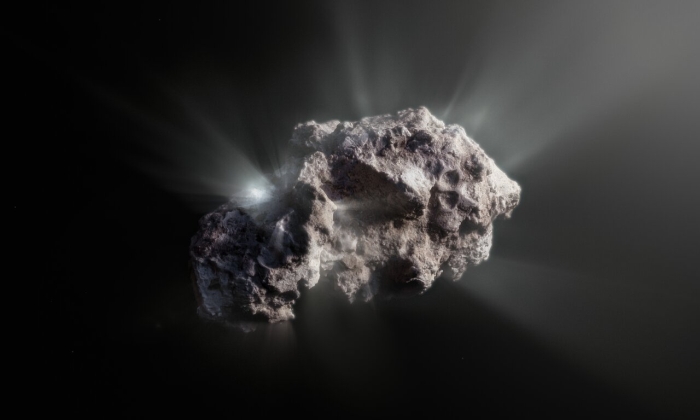
2iborisov artAn artist's impression of 2I/Borisov. (ESO/M. Kormesser)

In the first paper, Bagnulo and his colleagues made a careful study of the light scattered off the dust grains in the coma. In particular, they studied the polarization of this light.

As a particle of light travels through space, its oscillations are oriented in a certain direction. If it is scattered by, for example, dust in the interstellar medium, or rotated by a magnetic field, its orientation can change; we call that change polarization, and it can tell us about the environment that it came from. Recently, it revealed the shape of a magnetic field around a supermassive black hole. With comets, it reveals properties of the dust coma.


Many comets have been studied using polarimetry, and Bagnulo and his team were able to compare their 2I/Borisov data against Solar System comets. They found that the light from our interstellar interloper was significantly more highly polarized than the light scattered off Solar System comets.

This higher polarization, according to previous studies, is associated with more plentiful, and smaller, dust grains - suggesting, in turn, that the comet has not yet had its dust blown away by radiation pressure and the solar wind.

The only Solar System comet with a similar polarization profile to 2I/Borisov is Hale-Bopp, which is thought to only have passed the Sun once before its most recent close approach in 1997, and has therefore only been minimally affected by the wind and radiation. Still, 2I/Borisov is different - its polarized light is uniform, which means that it could be more pristine even than Hale-Bopp.

"The fact that the two comets are remarkably similar suggests that the environment in which 2I/Borisov originated is not so different in composition from the environment in the early Solar System," said astronomer Alberto Cellino of the National Institute for Astrophysics in Italy.


The second paper, led by astronomer Bin Yang of the European Southern Observatory, a team of scientists took a closer look at the dust grains themselves, as well as the gas coma.

The dust coma, they found, consists of compact "pebbles" with radii greater than 1 millimeter - quite different from the loose aggregates normally found around Solar System comets. The compaction, they said, seems to be the result of mutual impacts arising from collisions in the protoplanetary disc in which the comet formed - indicating that the comet was born from rocks colliding and sticking together.

The gases they detected as 2I/Borisov neared and sped away from the Sun, however, told a really interesting story. Both carbon monoxide and water were present in the gas coma - a lot of carbon monoxide, actually - but the relative proportions in the coma changed dramatically during and after its closest approach to the Sun.

This indicates that the distribution of materials in the cometary nucleus is uneven. According to the team, this could happen if the comet's distance to its home star changed as it was forming, perturbed by the gravitational influences of baby gas giants. Under these perturbations, the forming comet could have moved to different locations beyond the frost line (the point at which volatiles freeze into ice grains) with different chemical abundances.

This mixing, the team said, is similar to processes thought to have taken place in the early Solar System, too. But rather than ending up on a long orbit around its own star, 2I/Borisov got punted out into interstellar space. There, it finally had a close flyby of a different star - our Sun - offering astronomers an amazing opportunity to learn about the planetary formation conditions in another system, far from home.

"Imagine how lucky we were that a comet from a system light-years away simply took a trip to our doorstep by chance," Yang said.

The research has been published in Nature Communications and Nature Astronomy.


#Space | https://sciencespies.com/space/this-interstellar-object-could-be-the-first-truly-pristine-comet-weve-ever-seen/

Congress raises concerns about FAA’s handling of Starship launch license violation

WASHINGTON — As SpaceX gears up for another test flight of a Starship prototype, the Federal Aviation Administration is facing new scrutiny from Congress for how it handled SpaceX’s violation of its launch license on an earlier test flight.


SpaceX had planned to launch its SN11 Starship vehicle March 29 from its Boca Chica, Texas, test site. That flight will be similar to those of previous Starship prototypes, going to an altitude of 10 kilometers before landing on a nearby pad.


However, SpaceX called off the March 29 launch attempt because an FAA inspector could not arrive to observe the flight during a five-hour window. “FAA inspector unable to reach Starbase in time for launch today,” tweeted Elon Musk, chief executive of SpaceX, using the proposed new name for the Boca Chica site. “Postponed to no earlier than tomorrow.”


The requirement for an FAA presence on site at the test site is new for the SN11 launch. The latest version of SpaceX’s FAA launch license for the Starship suborbital test flight program, issued March 12, allows those test flights to take place “only when an FAA Safety Inspector is present at SpaceX’s Boca Chica launch and landing site.”


The change stemmed from an investigation into SpaceX’s violation of that launch license during the SN8 test flight in December. SpaceX proceeded with the flight despite the FAA determining that the flight profile exceeded the maximum allowed risk to the uninvolved public for “far field blast overpressure” in the event of an explosion. While the SN8 vehicle exploded upon landing, there were no reports of damage outside of the SpaceX test site.


FAA directed SpaceX to investigate the incident, delaying the flight of the next Starship prototype, SN9. That investigation included “a comprehensive review of the company’s safety culture, operational decision-making and process discipline,” the FAA said in a Feb. 2 statement.


The FAA cleared SpaceX to proceed with launches, with SN9 and SN10 launching and landing — and both exploding upon or shortly after landing — on Feb. 2 and March 3, respectively. Neither caused any damage outside of the SpaceX test site.


The FAA’s response to SpaceX’s launch license violation, including the lack of any penalties beyond the investigation, prompted criticism from two key members of Congress. In a March 25 letter to FAA Administrator Steve Dickson, Reps. Peter DeFazio (D-Ore.) and Rick Larsen (D-Wash.) sought to “register our concerns” with the incident. DeFazio is chair of the House Transportation Committee and Larsen the chair of its aviation subcommittee.


“Given the high-risk nature of the industry, we are disappointed that the FAA declined to conduct an independent review of the event and, to the best of our knowledge, has not pursued any form of enforcement action,” they wrote after summarizing the incident and investigation.


In the letter, DeFazio and Larsen called on the FAA to “resist any potential undue influence on launch safety decision-making” by taking “all the time and actions necessary” to evaluate proposed launches. They also urged the FAA to implement “a strict policy to deal with violations of FAA launch and reentry licenses” that includes civil penalties, and to evaluate its current approach to safety oversight and enforcement for commercial space activities.


“While the commercial space transportation sector is crucial to our Nation’s future, at no point should a commercial space launch jeopardize public safety,” they wrote.


The FAA, asked March 29 about the letter, said only that the agency “is in receipt of the letter and will respond directly to the committee.”


While the House Transportation Committee’s oversight includes the FAA, traditionally that has excluded the FAA’s Office of Commercial Space Transportation, which is in the jurisdiction of the House Science Committee. The transportation committee, though, has shown a growing interest in commercial space transportation, including several hearings in recent years that have examined the industry, including how the growing number of launches and spaceports affects commercial aviation.


In a speech at the March 23 meeting of the FAA’s Commercial Space Transportation Advisory Committee (COMSTAC), Dickson indirectly referred to the SN8 incident. “We can’t take all the dangers out of commercial space transportation, but I also know that we have to make it as safe as humanly possible,” he said. “Sometimes, that means we have to set the parking brake and make sure that we’re all aligned.”


Dickson said there have been six commercial launch mishaps since the beginning of the 2021 fiscal year. That includes the three Starship test flights that ended in explosion upon or shortly after landing, as well as a failed Falcon 9 landing at sea during an otherwise successful launch Feb. 15. The other two are the launch of Astra’s Rocket 3.2 in December that just missed reaching orbit and an aborted test flight of Virgin Galactic’s SpaceShipTwo suborbital spaceplane, also in December.


“When mishaps do happen, which is not uncommon in a fast-moving new field, they should be successful failures, meaning that the failure was consistent with, in this case, the FAA’s analysis that showed that the public would be kept safe,” Dickson said.


“So far, there have been six mishaps this fiscal year, some that ended in spectacular fireballs and went viral on social media,” he said, “but all six of these were successful failures, because we were able to protect public safety.”


#Space | https://sciencespies.com/space/congress-raises-concerns-about-faas-handling-of-starship-launch-license-violation/