Featured Post

Tracking air pollution disparities -- daily -- from space

Studies have shown that pollution, whether from factories or traffic-snarled roads, disproportionately affects communities where economicall...

Monday, March 1, 2021

Lake turbidity mitigates impact of warming on walleyes in upper Midwest lakes

Because walleyes are a cool-water fish species with a limited temperature tolerance, biologists expected them to act like the proverbial "canary in a coal mine" that would begin to suffer and signal when lakes influenced by climate change start to warm. But in a new study, a team of researchers discovered that it is not that simple.


"After analyzing walleye early-life growth rates in many lakes in the upper Midwest over the last three decades, we determined that water clarity affects how growth rates of walleyes change as lakes start to warm," said Tyler Wagner, Penn State adjunct professor of fisheries ecology. "In some lakes, warming actually led to increased walleye growth rates, in others there essentially was no change, and in others, growth rates declined. The different responses of growth rates to increasing water temperatures across lakes appear to be influenced by water turbidity."


The research is significant, Wagner explained, because walleye fisheries in the upper Midwest are important not just ecologically, but also from an economic and cultural perspective. Because walleye fishing is a valued social activity in Minnesota and Wisconsin and hundreds of thousands of walleye fingerlings are stocked there to bolster wild populations, the region is the ideal place to study the effect of warming conditions on the fish.


According to the U.S. Environmental Protection Agency, the Midwest has gotten warmer, with average annual temperatures increasing over the last several decades. Between 1900 and 2010, the average air temperature increased by more than 1.5 degrees Fahrenheit in the region.


"The rate of increase in air temperature has accelerated in recent decades, and this increase in air temperature will affect the thermal habitat for fishes across the region," Wagner said. "Temperatures are projected to continue increasing across the Midwest -- with the greatest increases in average temperature expected in northern areas -- so we wanted to know what was happening with walleye populations in the upper Midwest."


Using data provided by the Minnesota and Wisconsin departments of Natural Resources, researchers quantified annual walleye early-life growth rates from 1983 to 2015 in 61 lakes in the upper Midwest. Then they estimated the relationship between early-life growth rates and water growing degree days -- an indicator of the temperature the fish are exposed to -- over those 32 years. Importantly, they also examined how water turbidity influenced growth rates across the 61 lakes, correlated to an increased number of growing degree days.


Their findings, published Feb. 23 in the Canadian Journal of Fisheries and Aquatic Sciences, showed that, on average, early-life growth rates increased with increasing growing degree days in turbid lakes, remained more or less unchanged in moderately clear lakes, and decreased in very clear lakes. This suggests that a "one-size-fits-all" approach to managing walleye populations across a broad landscape may not be effective, according to Wagner.


"Rather, lake-specific characteristics likely will be important in determining how walleye populations respond to climate change," he said.


The analysis also indicated that walleye growth rates varied among lakes of different sizes, explained lead researcher Danielle Massie, who graduated from Penn State in 2020 with a master's degree in wildlife and fisheries science.


"Walleye early-life growth rates, on average, were significantly greater in larger lakes," she said. "Our results provide insights into the conservation of cool-water species in a changing environment and identify lake characteristics in which walleye growth may be at least somewhat resilient to climate change."


The results of the research were surprising, Wagner conceded, because researchers expected to see walleye growth rates in most lakes decrease with more growing degree days -- since walleyes prefer cool water. But that did not happen in most of the lakes they studied.


"It sounds counterintuitive at first, but if we think about fish growth, we can think about it as a performance curve, where growth increases with increasing temperature to a certain point," he said. "But as the lake warms past that optimum temperature, the curve descends, and we'll see declining growth as the temperature increases beyond that point."


Slightly higher water temperatures in some upper Midwest lakes have resulted in increased growth rates for walleyes, but if water temperatures continue to rise, influenced by a warming climate, walleye populations in the region will suffer, predicted Wagner, assistant leader of Penn State's Pennsylvania Cooperative Fish and Wildlife Research Unit, housed in the College of Agricultural Sciences.


"We're going to reach a water temperature tipping point where growth will decline, and then we'll see deleterious effects," he said. "This is why understanding what factors, such as turbidity and lake size, influence how fish populations respond to warming is critical for informing management and conservation efforts."


#Nature | https://sciencespies.com/nature/lake-turbidity-mitigates-impact-of-warming-on-walleyes-in-upper-midwest-lakes/

Newly Restored Pompeiian Frescoes Capture Hunting Scenes in Vivid Detail

The walls of Pompeii’s House of the Ceii are adorned with scenes of animals locked in battle, from a big cat on the verge of taking down a pair of rams to a deer looking back in terror as a wild boar gives chase. Nearby, African hunters standing in the shadow of Egyptian-style buildings prepare to hunt hippopotamuses and crocodiles on the banks of Nile.


More than 2,000 years after their creation, these stunning frescoes have finally been restored to their original glory. As the Archaeological Park of Pompeii, an autonomous Italian cultural body established to preserve and promote public usage of the razed Roman city, announced this week, experts used a laser to clean the paintings before carefully retouching their faded details. The “highly complex operation” also took steps to protect the artworks from rainwater and other potential threats, according to a statement.


Likely owned by magistrate Lucius Ceius Secundus, the House of the Ceii was first excavated between 1913 and 1914. Per Valentina Di Donato and Amy Woodyatt of CNN, the ancient domus, or single-family home, is one of the few surviving Pompeiian dwellings dated to the late Samnite period, during the second century B.C.


A close-up view of the House of the Ceii's central garden fresco

(Archaeological Park of Pompeii)


A close-up view of the House of the Ceii's central garden fresco

(Archaeological Park of Pompeii)


A close-up view of the House of the Ceii's central garden fresco

(Archaeological Park of Pompeii)


The uncovered frescoes, which may have been painted on the walls surrounding the house’s garden in order to create an illusion of increasing size, have deteriorated over the decades due to a lack of proper maintenance and poor restoration practices, the statement notes.


Despite this damage, wrote Julia Fiore for Artsy in 2018, Pompeii’s frescoes are actually better preserved than most: When Mount Vesuvius erupted in 79 A.D., burying the city in volcanic ash, it inadvertently shielded the light-sensitive artworks from the elements for centuries.


“What makes [the House of Ceii] fresco so special is that it is complete—something which is rare for such a large fresco at Pompeii,” Massimo Osanna, interim director of the park, tells Tom Kington of the London Times.


The newly restored central artwork highlights predator-prey conflicts in the natural world, including the aforementioned animals, as well as a lion hunting a bull, reports the Times. On the side walls of the garden, landscapes featuring Indigenous Africans and Nile Delta creatures suggest that the magistrate was interested in Egyptian culture.


Central fresco in the House of the Ceii prior to restoration

(Archaeological Park of Pompeii)


A close-up view of a fresco at the House of the Ceii

(Archaeological Park of Pompeii)


A close-up view of a fresco at the House of the Ceii

(Archaeological Park of Pompeii)


“In this case,” Osanna tells CNN, “in all probability, the exotic and religious theme of the paintings testified to a link and a specific interest that the owner of the domus had for the Egyptian world and for the cult of Isis, present in Pompeii in the last years of the city's life due to a very influential college in the city.”


The Romans took control of Pompeii, which had previously been an allied but independent city, during the Social War (91–88 B.C.). The seaside settlement served as a successful port and resort destination for affluent Romans but was devastated by an earthquake in 62 A.D. Residents were still in the process of rebuilding when Vesuvius erupted 17 years later; Pompeii only reemerged in the 18th century, when archaeologists first began exploring its well-preserved ruins.


Since the Great Pompeii Project, an ongoing conservation initiative funded largely by the European Union, launched in 2012, researchers have uncovered a stunning array of ancient treasures. Among other finds, the list includes a fresco of a bloody gladiator fight, a well-preserved horse still in its harness, and a snack bar that served snails and fish.


#History | https://sciencespies.com/history/newly-restored-pompeiian-frescoes-capture-hunting-scenes-in-vivid-detail/

Can you spot the Perseverance rover in this breathtaking satellite image of Mars?

A little over a week ago (18 February 2021), NASA's Perseverance rover landed in the Jezero crater on the surface of Mars.


In what was truly a media circus, people from all over the world tuned to watch the live coverage of the rover landing. When Perseverance touched down, it wasn't just the mission controllers at NASA who triumphantly jumped to their feet to cheer and applaud.


In the days that followed, the world was treated to all kinds of media that showed the surface of Mars and the descent.


The most recent comes from the Trace Gas Orbiter (TGO), which is part of the ESA-Roscosmos ExoMars program.


From its vantage point, high above the Martian skies, the TGO caught sight of Perseverance in the Jezero crater and acquired images that show the rover and other elements of its landing vehicle.


Since 2016, the TGO has orbited Mars and gathered vital data on the composition of its atmosphere. Specifically, TGO has been looking for traces of atmospheric methane and other gases that could be the result of geological or biological activity. These efforts are part of a larger effort to determine if life existed on Mars billions of years ago (and whether or not it still does).


In addition, the orbiter has conducted other important scientific operations, like relaying data from robotic missions on the surface and acquiring images of space.


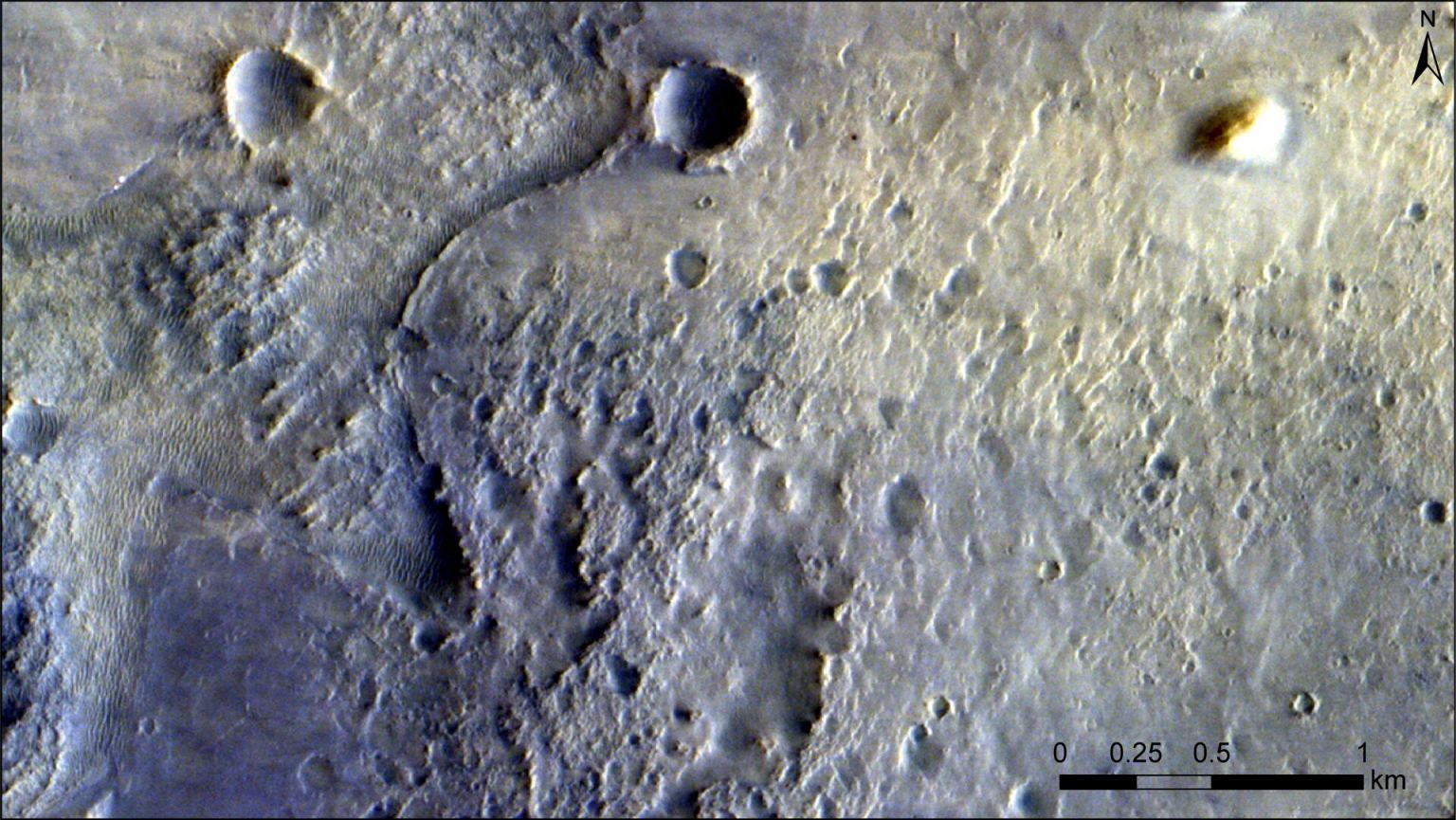
On February 23, the TGO took advantage of its orbit to snap pictures with its Colour and Stereo Surface Imaging System (CaSSIS) that showed the Perseverance rover – as well as its parachute, heat shield, and descent stage elements – within the Jezero crater.


ExoMars orbiter images Perseverance landing site pillars. (ESA)ExoMars orbiter images Perseverance landing site pillars. (ESA)


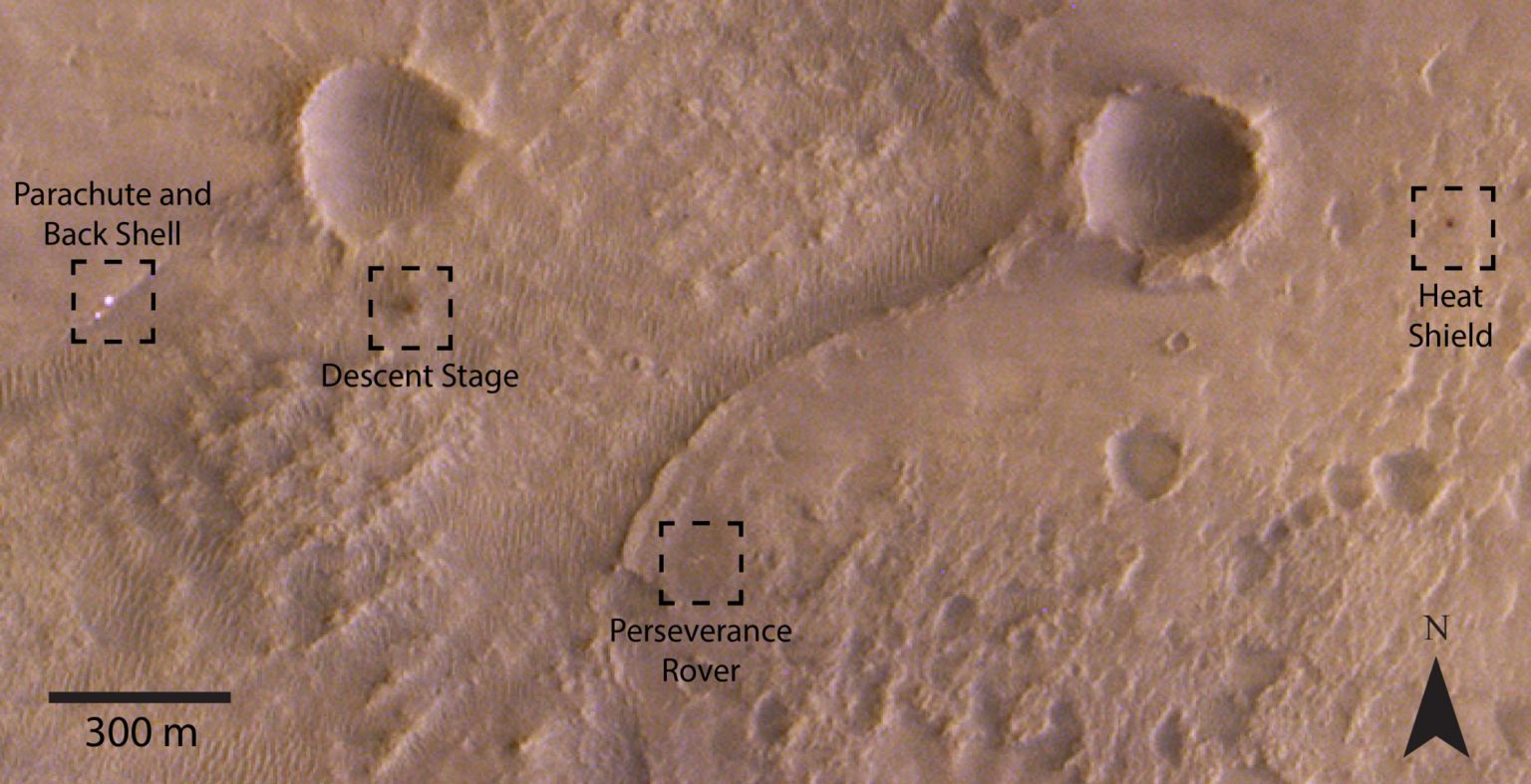
In the first image (above), the elements are discernible as a series of dark and bright pixels, which are indicated in the second image (below).


Close-up of Perseverance and mission elements in the Jezero crater. (ESA)Close-up of Perseverance and mission elements in the Jezero crater. (ESA)


As you can see, the descent stage and heatshield are dark spots spaced around two smaller craters while the parachute and backshell are visibly bright spots in close proximity to each other.


The Perseverance rover, near the bottom center, is a relatively faint spot by a small ridge leading from one crater.


It is here that Perseverance will spend the next two years (which will likely be extended) searching for signs of past microbial life.


Based on its features, which include a preserved river delta and clay-rich sedimentary deposits, the Jezero crater is known to have hosted a standing body of water billions of years ago. For this reason, it was selected as the landing site for the mission, since it is believed to be a good place to find evidence of past life.


Perseverance will also conduct an ambitious and unprecedented operation, where it will collect samples of Martian rocks and soil and set them aside in a cache.


These will be returned to Earth by a separate ESA-NASA Mars Sample Return mission that will consist of a lander, a rover (to retrieve the samples), and small launcher (for launching them to orbit). Once there, an orbiter will pick them up and bring them home for analysis.


The ExoMars TGO also provided a significant amount of assistance for the Perseverance rover during its landing, such as data relay services


Videos of the landing, as well as imagery and sound recordings, were captured by instruments aboard the rover's Entry, Descent, and Landing (EDL) vehicle.


These were sent back to Earth with the assistance of the TGO, as well as NASA's Mars Reconnaissance Orbiter (MRO).


The orbiter will continue to provide data relay support between Earth and Mars for future missions to the surface, particularly the the next ExoMars mission.


Known as ExoMars 2022, this mission will launch from the Baikonur Cosmodrome on 20 September 2022, and arrive at the Red Planet by 10 June 2023. It will consist of the Russian Kazachok surface platform and the Rosalind Franklin rover.


Meanwhile, the Trace Gas Orbiter will continue to orbit Mars and conduct its own science operations, focusing on the analysis of Mars' atmosphere and the search for gases that point the way towards past (or present) life.


Recently, the orbiter detected traces of hydrogen chloride gas leaving the planet's atmosphere, indicating that this salt exists on the surface which made it to orbit.


On Earth, this process has been observed with sodium chloride salts, where salt water evaporates from our oceans and is pushed into the upper atmosphere by strong winds. The TGO has also monitored water vapor leaving the Martian atmosphere and escaping to space.


Together, these findings have provided new clues as to where the abundant surface water Mars had billions of years ago escaped to.


This article was originally published by Universe Today. Read the original article.


#Space | https://sciencespies.com/space/can-you-spot-the-perseverance-rover-in-this-breathtaking-satellite-image-of-mars/

Your indifferent cat won't choose your friend over your enemy, research finds

There's an old stereotype about the difference between cats and dogs. Dogs are loving and fiercely loyal, they say, while cats are aloof and indifferent. Most cat people probably disagree – I certainly find it hard to believe, with my cat purring away in my lap, that she doesn't care about me.


Overall, cat cognition research suggests cats do form emotional bonds with their humans. Cats seem to experience separation anxiety, are more responsive to their owners' voices than to strangers' and look for reassurance from their owners in scary situations.


But a new study, by researchers in Japan, complicates the picture of our relationship with cats. Adapting a method previously used to study dogs, the researchers found cats – unlike dogs – don't avoid strangers who refuse to help their owners.


In the experiment, a cat watched as her owner tried to open a box to get at something inside. Two strangers sat on either side of the owner and the owner turned to one of them and asked for help. In "helper" trials, the stranger helped the owner to open the box. In "non-helper" trials, the stranger refused. The other stranger sat passively, doing nothing.


Then, both strangers offered the cat a treat, and the scientists watched to see which the cat approached first. Did she prefer to take food from a helper over a passive bystander? This would indicate a positivity bias, showing the helpful interaction made the cat feel more warmly towards the stranger. Or did she avoid taking food from the non-helper? This negativity bias might mean the cat felt distrustful.


When this method was used to test dogs, they showed a clear negativity bias. The dogs preferred not to take food from a stranger who refused help to their owner. In contrast, the cats in the new study were completely indifferent. They showed no preference for the helpful person and no avoidance of the unhelpful person. Apparently, as far as cats are concerned, food is food.


Social cues


What should we take from this? A tempting conclusion would be that cats are selfish and couldn't care less how their humans are treated. Although this might fit with our preconceptions about cats, it's an example of anthropomorphic bias. It involves interpreting cats' behaviour as though they were furry little humans, rather than creatures with their own distinctive ways of thinking.


To really understand cats, we have to get out of this human-centred mindset and think of them as cats. When we do, what seems most likely isn't that the cats in this study were selfish, but they weren't able to pick up on the social interactions between the humans. They weren't aware that some of the strangers were being unhelpful.


Although cats are able to pick up on some human social cues – they can follow human pointing and are sensitive to human emotions – they're probably less tuned in to our social relationships than dogs are.


Cats were domesticated more recently, and have been changed by domestication far less than dogs. While dogs are descended from social pack animals, cats' ancestors were largely solitary hunters.


Domestication has probably heightened dogs' existing social skills, but it may not have done the same for cats, who were less socially aware to begin with. So we shouldn't be too quick to conclude our cats don't care if people are mean to us. What's more likely is that they just can't tell.


Despite their popularity, we still know relatively little about how cats think. Future research might show cats' understanding of humans is even more limited than we currently realise. Alternatively, it might turn out that cats are better able to recognise human social dynamics in different contexts.


But whatever studies reveal, we should avoid letting preconceptions or anthropomorphism drive our interpretation of cats' behaviour. Before we judge our feline friends to be indifferent or selfish, we should first try to look at the world through their eyes.The Conversation


Ali Boyle, Research Fellow in Kinds of Intelligence (Philosophy), University of Cambridge.


This article is republished from The Conversation under a Creative Commons license. Read the original article


#Nature | https://sciencespies.com/nature/your-indifferent-cat-wont-choose-your-friend-over-your-enemy-research-finds/

Your indifferent cat won't choose your friend over your enemy, research finds

There's an old stereotype about the difference between cats and dogs. Dogs are loving and fiercely loyal, they say, while cats are aloof and indifferent. Most cat people probably disagree – I certainly find it hard to believe, with my cat purring away in my lap, that she doesn't care about me.


Overall, cat cognition research suggests cats do form emotional bonds with their humans. Cats seem to experience separation anxiety, are more responsive to their owners' voices than to strangers' and look for reassurance from their owners in scary situations.


But a new study, by researchers in Japan, complicates the picture of our relationship with cats. Adapting a method previously used to study dogs, the researchers found cats – unlike dogs – don't avoid strangers who refuse to help their owners.


In the experiment, a cat watched as her owner tried to open a box to get at something inside. Two strangers sat on either side of the owner and the owner turned to one of them and asked for help. In "helper" trials, the stranger helped the owner to open the box. In "non-helper" trials, the stranger refused. The other stranger sat passively, doing nothing.


Then, both strangers offered the cat a treat, and the scientists watched to see which the cat approached first. Did she prefer to take food from a helper over a passive bystander? This would indicate a positivity bias, showing the helpful interaction made the cat feel more warmly towards the stranger. Or did she avoid taking food from the non-helper? This negativity bias might mean the cat felt distrustful.


When this method was used to test dogs, they showed a clear negativity bias. The dogs preferred not to take food from a stranger who refused help to their owner. In contrast, the cats in the new study were completely indifferent. They showed no preference for the helpful person and no avoidance of the unhelpful person. Apparently, as far as cats are concerned, food is food.


Social cues


What should we take from this? A tempting conclusion would be that cats are selfish and couldn't care less how their humans are treated. Although this might fit with our preconceptions about cats, it's an example of anthropomorphic bias. It involves interpreting cats' behaviour as though they were furry little humans, rather than creatures with their own distinctive ways of thinking.


To really understand cats, we have to get out of this human-centred mindset and think of them as cats. When we do, what seems most likely isn't that the cats in this study were selfish, but they weren't able to pick up on the social interactions between the humans. They weren't aware that some of the strangers were being unhelpful.


Although cats are able to pick up on some human social cues – they can follow human pointing and are sensitive to human emotions – they're probably less tuned in to our social relationships than dogs are.


Cats were domesticated more recently, and have been changed by domestication far less than dogs. While dogs are descended from social pack animals, cats' ancestors were largely solitary hunters.


Domestication has probably heightened dogs' existing social skills, but it may not have done the same for cats, who were less socially aware to begin with. So we shouldn't be too quick to conclude our cats don't care if people are mean to us. What's more likely is that they just can't tell.


Despite their popularity, we still know relatively little about how cats think. Future research might show cats' understanding of humans is even more limited than we currently realise. Alternatively, it might turn out that cats are better able to recognise human social dynamics in different contexts.


But whatever studies reveal, we should avoid letting preconceptions or anthropomorphism drive our interpretation of cats' behaviour. Before we judge our feline friends to be indifferent or selfish, we should first try to look at the world through their eyes.The Conversation


Ali Boyle, Research Fellow in Kinds of Intelligence (Philosophy), University of Cambridge.


This article is republished from The Conversation under a Creative Commons license. Read the original article


#Nature | https://sciencespies.com/nature/your-indifferent-cat-wont-choose-your-friend-over-your-enemy-research-finds/

Curators Seek $25,000 to Repair Artworks Damaged in U.S. Capitol Attack

When a far-right insurrectionist mob stormed the United States Capitol on January 6, lawmakers abruptly ended their session and fled to secure locations, many in fear for their lives. Dozens were injured that day, and five people, including a police officer who was beaten by rioters, died as a result of the attack.


In the wake of the insurrection, stories both heroic and insidious have revealed new insights on how those six hours of chaos unfolded. Now, reports Cristina Marcos for the Hill, Farar Elliott, a curator in the House of Representative’s Office of History and Preservation, and Architect of the Capitol J. Brett Blanton are shedding light on another aspect of the attack: namely, its toll on the building’s artworks.


As Elliott said in prepared testimony earlier this week, 535 of the 13,000 artifacts housed in the House’s art collections were on display throughout the Capitol complex on January 6.


“During the riot,” the curator told a House subcommittee, “courageous staffers saved several important artifacts.”


One quick-thinking clerk saved an 1819 silver inkstand, the oldest object in the legislative chamber. Staff also rescued the House’s ceremonial silver mace, which was created in 1841 to replace one destroyed when the British burned the Capitol in 1814—one of the only other times that the seat of government has faced violence of this magnitude, as Sarah Cascone points out for Artnet News.


All told, Elliott said, eight artworks—six sculptures and two paintings—were vandalized in the attack. Chemicals present in fire extinguishers, pepper spray, bear repellants, tear gas and other irritants used by rioters caused the majority of the damage. (Per Blanton’s testimony, staffers raced to the roof of the building to reverse airflows and try to limit the damage inflicted by these chemicals.) House curators have requested $25,000 in emergency funding to cover the costs of restoration and repair.


Assessing the damage


The morning after the riot, Capitol staff arrived on the scene to take stock of the damage. Per Blanton’s testimony, they found graffiti, shattered glass and debris from broken furniture, and blue paint tracked through the hallways, among other remnants of the violence. Two of the fourteen historic Frederick Law Olmsted lamps that decorate the Capitol grounds were “ripped from the ground,” Blanton said.


As Elliott testified, the artifacts featured in an ongoing exhibition about Joseph Rainey, the U.S.’ first black congressman, sustained no damage. The four giant John Trumbull paintings that grace the Capitol Rotunda and the fresco that decorates its ceiling, Apotheosis of Washington, also escaped the violence unscathed, reported Sarah Bahr for the New York Times in January.


Curators noted that some objects in the corridors adjacent to the House chamber doors were covered in a fine powder residue. The team collected samples of this powder from a marble bust of Speaker James Beauchamp “Champ” Clark and sent them to the Smithsonian’s Museum Conservation Institute, which identified the material as discharge from a nearby fire extinguisher. The residue contains yellow dye, silicone oil and other chemicals that could wreak long-lasting damage on the fragile historic objects, according to Elliott’s testimony.


A list of 8 works with photos attached, including four white marble busts, a bronze bust of a Chippewa statesman Be shekee, a standing sculpture of Thomas Jefferson and two painted portraits of James Madison and John Quincy Adams

The eight artifacts damaged included a painting of President James Madison and a bust of House Speaker Joseph W. Martin.

(Office of the Clerk, U.S. House of Representatives)


The artworks and their history


In a strange twist of fate, one of the damaged marble busts depicts a man involved in another violent incident at the Capitol: Speaker of the House Joseph W. Martin. The Massachusetts politician was on the House floor on March 1, 1954, when four Puerto Rican nationalists opened fire from the public viewing galleries, wounding five people. Martin declared Congress in recess as he took cover behind a marble pillar on the rostrum.


“Bullets whistled through the chamber in the wildest scene in the entire history of Congress,” the speaker later recalled.


Other damaged works included marble busts of Speaker Joseph Gurney Cannon and Speaker Thomas Reed, a bronze bust of Chippewa statesman Be sheekee, and a statue of Thomas Jefferson. Chemical traces also left residue on two painted portraits of presidents James Madison and John Quincy Adams, who is depicted in 1848, toward the end of his life. Curators placed all of the affected works beneath museum-grade plastic to prevent further damage.


Cannon, a Republican representative from Illinois known as “Uncle Joe,” wielded unprecedented power in the early 20th century as both chair of the Rules Committee and speaker. His influence was such that representative George Norris actually led a “revolt,” convincing members of both parties to strip Cannon of much of his power in 1910.


Be sheekee, a powerful Chippewa chief also called Buffalo or the Great Buffalo, is known for negotiating a land cessation treaty with the U.S. government. In 1855, he and 15 other Native Americans, including Aysh-ke-bah-ke-ko-zhay (or Flat Mouth), traveled from present-day Minnesota and Wisconsin to Washington, D.C. There, the leaders sat for Francis Vincenti, a little-known Italian sculptor. (The original Vincenti work resides in the U.S. Senate collections; this bust is an 1858 copy by Joseph Lasalle.)


Records show that Vincenti paid Be sheekee $5 for the sitting. Montgomery C. Meigs, an engineer who played a key role in the building and design of the Capitol Rotunda in the late 19th century, likely commissioned the portraits of the Native American men to send overseas as models for Thomas Crawford, an American sculptor working in Rome. Meigs had previously commissioned Crawford to sculpt the pediment for the Senate wing, The Progress of Civilization.


The Be sheekee bust numbers among the few representations of identifiable Native American figures on display in the Capitol. It also speaks to a fraught, painful history: During the era of Manifest Destiny, European colonizers continued to take land from Native groups through treaties or by force. At the same time, many European artists created likenesses of Native people according to their own fixed, racist stereotypes.


“[S]culptors of this period idealized Native Americans in their work and asserted that they were symbolic of the U.S. because they were uniquely American,” says Karen Lemmey, curator of sculpture at the Smithsonian American Art Museum (SAAM), in an email. “Meigs likely arranged for this portrait not because he wanted to commemorate Be sheekee as a sovereign leader, one who traveled to Washington to negotiate important matters on behalf of his people, but rather for its supposed ethnographic value as a record of a ‘vanishing race.’”


Lemmey adds, “One might see the portrait of Be sheekee as satisfying Meigs’s penchant for decorating the Capitol with things he and others regarded as authentically American.”


In a dramatic shot, a worker walks across a strip of light from a door behind him as he cleans the floor; the lights appear to be off, and framed by the dark, the worker's shadow and an American flag are starkly visible in the center of the frame

A worker sweeps up the dust and debris left behind by a white supremacist mob in the Rotunda of the U.S. Capitol building on January 7, 2021.

(Samuel Corum / Getty Images)


The road to recovery


As Blanton testified before the subcommittee on Wednesday, the “damage to our precious artwork and statues will require expert cleaning and conservation.”


But while the physical damage wrought by rioters will be fixed over time, the agency head added that the emotional damage will likely remain.


Overall, report Emily Cochrane and Luke Broadwater for the New York Times, Blanton said that the costs of increased mental health services for staff, reinforced security and building restorations will exceed $30 million.


In addition to damaging works of art, rioters left behind broken glass, blood, debris and enduring trauma for all involved. As Elvina Nawaguna and Kayla Epstein noted for Business Insider in January, a custodial staff comprised mostly of people of color was tasked with cleaning up the mess left behind by the overwhelmingly white rioters.


“One of the images that I’m haunted by is the black custodial staff cleaning up the mess left by that violent White supremacist mob. … That is a metaphor for America,” Congresswoman Ayanna Pressley told CNN’s Jake Tapper in early February. “We have been cleaning up after violent, white supremacist mobs for generations and it must end.”


#History | https://sciencespies.com/history/curators-seek-25000-to-repair-artworks-damaged-in-u-s-capitol-attack/

NASA perplexed by strange geological stripes appearing in Russia

Near the Markha River in Arctic Siberia, the earth ripples in ways that scientists don't fully understand.


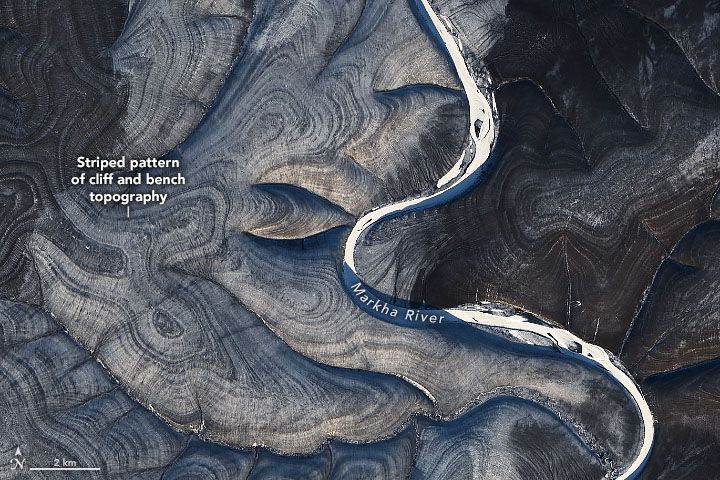
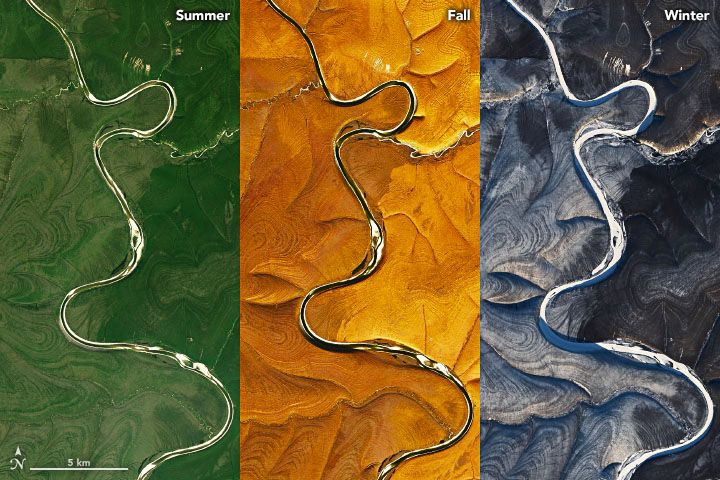
Earlier this week, NASA researchers posted a series of satellite images of the peculiar wrinkled landscape to the agency's Earth Observatory website. Taken with the Landsat 8 satellite over several years, the photos show the land on both sides of the Markha River rippling with alternating dark and light stripes.


The puzzling effect is visible in all four seasons, but it is most pronounced in winter, when white snow makes the contrasting pattern even more stark.


The striped swirls have scientists perplexed. (NASA Earth Observatory/ Landsat 8)The striped swirls have scientists perplexed. (NASA Earth Observatory/ Landsat 8)


Why is this particular section of Siberia so stripy? Scientists aren't totally sure, and several experts offered NASA conflicting explanations.


Related: Earth's 8 biggest mysteries


One possible explanation is written in the icy ground. This region of the Central Siberian Plateau spends about 9 percent of the year covered in permafrost, according to NASA, though it occasionally thaws for brief intervals.


Patches of land that continuously freeze, thaw and freeze again have been known to take on strange circular or stripy designs called patterned ground, scientists reported in a study published in January 2003 in the journal Science. The effect occurs when soils and stones naturally sort themselves during the freeze-thaw cycle.


The stripes of the Central Siberian Plateau vary by season. (NASA Earth Observatory)The stripes of the Central Siberian Plateau vary by season. (NASA Earth Observatory)


However, other examples of patterned ground - such as the stone circles of Svalbard, Norway - tend to be much smaller in scale than the stripes seen in Siberia.


Another possible explanation is erosion. Thomas Crafford, a geologist with the US Geological Survey, told NASA that the stripes resemble a pattern in sedimentary rocks known as layer cake geology.


These patterns occur when snowmelt or rain trickles downhill, chipping and flushing pieces of sedimentary rock into piles. The process can reveal slabs of sediment that look like slices of a layer cake, Crafford said, with the darker stripes representing steeper areas and the lighter stripes signifying flatter areas.


In accordance with the image above, this sort of sedimentary layering would stand out more in winter, when white snow rests on the flatter areas, making them appear even lighter. The pattern fades as it approaches the river, where sediment gathers into more uniform piles along the banks after millions of years of erosion, Crafford added.


This explanation seems to fit well, according to NASA. But until the region can be studied up close, it'll remain another one of those quintessentially Siberian curiosities.


Related Content:
The 11 biggest volcanic eruptions in history
The world's weirdest geological formations
7 ways Earth changes in the blink of an eye


This article was originally published by Live Science. Read the original article here.


#Environment | https://sciencespies.com/environment/nasa-perplexed-by-strange-geological-stripes-appearing-in-russia/