Featured Post

Tracking air pollution disparities -- daily -- from space

Studies have shown that pollution, whether from factories or traffic-snarled roads, disproportionately affects communities where economicall...

Thursday, December 31, 2020

See the Stunning Art Set to Welcome Travelers Back to Penn Station

Prior to the pandemic, the 650,000 commuters who passed through Penn Station every day were more likely to encounter dark, claustrophobic tunnels and rats scampering across subway tracks than world-class art. When travelers return to the New York City transit hub, however, they’ll find not only artistic masterpieces, but soaring skylights and a sleek, spacious waiting area reminiscent of the station’s demolished predecessor.


Dubbed the Moynihan Train Hall, the $1.6 billion, 255,000-square-foot space—located across the street from the main station in the historic James A. Farley Post Office—will serve as a central hub for Amtrak and Long Island Railroad passengers. Highlights of the venue, which is set to open January 1, include vaulted, 92-foot-high ceilings; art installations by Kehinde Wiley, Stan Douglas, and creative duo Michael Elmgreen and Ingar Dragset; a 6- by 12-foot suspended clock; and a one-acre sky-lit atrium.


“Is it grand? Yes. Is it bold? Yes, because that is the spirit of New York and that is the statement we want to make to our visitors, to our children and to future generations,” says Governor Andrew Cuomo, who unveiled the space Wednesday, in a statement. “As dark as 2020 has been, this new hall will bring the light, literally and figuratively, for everyone who visits this great city.”


Speaking with the New York Times’ Dionne Searcey, Wiley, who is perhaps best known for his presidential portrait of Barack Obama, describes the inspiration behind his contribution to the hall: Go, a hand-painted, stained-glass ceiling triptych that depicts young, black New Yorkers break dancing.


Kehinde Wiley, Go, 2020

Kehinde Wiley, Go, 2020

(© Kehinde Wiley / Photo by Nicholas Knight / Image courtesy of the artist, Sean Kelly, New York, Empire State Development and Public Art Fund, NY)


“So much of what goes on in ceiling frescoes are people expressing a type of levity and religious devotion and ascendancy,” the artist tells the Times. “For me the movement and space made so much more sense thinking about ways bodies twirl in break dancing.”


Another artwork installed in the space, The Hive by Elmgreen and Dragset, mounts 91 upside-down buildings “on the ceiling like glowing, [nine]-foot-tall stalactites,” as Shaye Weaver writes for Time Out. Featuring 72,000 LED lights and six color-changing segments, the sculpture’s title reflects the collaborative nature of city life.


“It’s about a huge collaboration in order to make everyone survive,” Dragset explains to the Times.


The hall’s third public art installation, Douglas’ Penn Station’s Half Century, consists of nine oversized photographic panels documenting overlooked but significant moments in the transit hub’s history. To capture these scenes, the Canadian artist combined photos of contemporary actors posing in period costumes with digital renderings of the now-defunct station’s interior.


“With a cinematic quality, each scene revives history in uncanny detail, revealing this architectural landmark as a grand theater for the millions of human dramas that animate civic spaces and endow them with meaning,” says the Public Art Fund, which oversaw the three installations, on its website.


The Moynihan Train Hall’s opening marks the culmination of a decades-long push to convert the Farley building into an extension of Penn Station, reports Christina Goldbaum in a separate article for the Times. Proponents of the plan cited the need to expand the station, which serves three times as many riders as its architects anticipated, and a desire to atone for the original building’s much-criticized demolition in the 1960s. But critics argued that the proposal ignored the needs of subway riders, as the post office is located a sizable walking distance from the station’s subway lines.


A grand structure outfitted with quarried travertine and a 138-foot-high ceiling, the original Penn Station opened in 1910. Locals lauded it as an architectural marvel, but after the Great Depression, the building fell into a state of disrepair. Railroad executives eventually decided to sell the rights to the property and move a downsized version of the station underground.


The building’s untimely demise had unexpected consequences: As Michael Kimmelman wrote for the Times in 2019, “The historic preservation movement, which rose from the vandalized station’s ashes, was born of a new pessimism.”


Like the razed Penn Station, the nearby Farley building’s 1912 Beaux-Arts edifice was designed by architecture firm McKim Mead & White. Senator Daniel P. Moynihan first introduced plans to transform the space into an extension of the station in the early 1990s; as Jim Dwyer reported for the Times in 2016, the then-president of the New York City Transit Authority responded to Moynihan’s proposal by arguing that resources should be allocated to more pressing concerns, like repairing 80-year-old track switches.


In 2016, after decades of delays, Cuomo announced plans to renovate the station and expand into the Farley building. Though the newly completed revamp won’t solve many of the city’s transit problems—including track congestion and decrepit train tunnels—officials say it will help improve overcrowding and pave the way for future infrastructure projects.


“[The hall] speaks to the brighter days ahead when we will be able to congregate, to pass one another and to share the same space free of fear,” Cuomo tells the Times Searcey. “It promises renewal and rebirth of civic life in New York, and points to the opportunity ahead.”


#History | https://sciencespies.com/history/see-the-stunning-art-set-to-welcome-travelers-back-to-penn-station/

Wind Turbines Generated More Than Half of Great Britain's Energy on Boxing Day


On December 26, Great Britain reached a new, green milestone when wind turbines generated more than half of its total electricity. The country has been making massive strides to produce more wind energy, and when Storm Bella swept through the region last week, its 100-mile-per-hour gusts kicked turbines into high gear. The boost helped set a record for the highest share of power ever generated by windfarms in the country, report Rob Davies and Jillian Ambrose for the Guardian.


The U.K. has been inching away from fossil fuels and towards renewable energy sources, like wind and solar power, after setting a goal in 2019 to reach net-zero greenhouse gas emissions by 2050, reports JP Casey for Power Technology. The U.K. has become a pioneer in wind energy, with the infrastructure to produce 10 gigawatts of electricity by the renewable source. The United States can only generate about 0.3 percent of what the U.K. can, reports Brian Kahn for Gizmodo.


The clean energy produced on Boxing Day is the latest renewable record for the U.K. Earlier in December, windfarms in Great Britain generated the most energy by turbines in one day—a smaller percentage than what the country recently experienced on Boxing Day. And earlier this year, the U.K. went two entire months—from April to June 2020—without using coal at all, reports Gizmodo.


This trend in declining fossil fuel energy use is partly a result of the Covid-19 pandemic, which has reduced the demand for electricity from 32.58 gigawatts in 2019 to 30.6 in 2020. As overall energy use has gone down, wind and solar power have been able to contribute a greater share, reports the Guardian.


“We saw the highest ever level of solar generation in April, the longest period of coal-free operation between April and June, and the greenest ever month in May," Rob Rome, the head of national control of the National Grid’s electricity system operator (NGEO), tells the Guardian.


Even with the promising news, experts warn that renewable energy sources like wind and solar power depend on the weather, reports Tony McDonough for Liverpool Business News. Without strong winds, the turbines don't spin enough; without ample sunlight, solar panels don't receive enough light to convert into electricitya relevant issue given the U.K.'s rainy, cloudy climate.


Steve Jennings, a partner at the consulting firm PwC, tells the Guardian that the key challenge to achieving a net-zero goal is finding alternatives for when the wind doesn't blow and the sun doesn't shine. He says the U.K. will retain nuclear and gas-fired power plants equipped with carbon capture technology, which will serve as back-ups as the country continues to embrace renewable energy.


"We expect to see many more records set in the years ahead, as the government has made wind energy one of the most important pillars of its energy strategy for reaching net-zero emissions as fast and as cheaply as possible," Melanie Onn, the deputy chief executive of Renewable UK, told Ambrose for the Guardian earlier in December.


Like this article?
SIGN UP for our newsletter


#News | https://sciencespies.com/news/wind-turbines-generated-more-than-half-of-great-britains-energy-on-boxing-day/

Look at all these mind-blowing photos of asteroid pieces retrieved from Ryugu

The best present this holiday season came in a small package, parachuted into the Australian desert from far within our Solar System on 5 December 2020.


Inside, astronomers were delighted to unwrap the first significant samples of a rocky asteroid which is currently 9 million kilometres (5.6 million miles) away, and returned to Earth in "perfect" shape. 


Photographs of the pristine pebbles have finally been released, and while the tiny, black-coloured grains inside may resemble nothing more than dirty coal, this galactic gift is hardly a rebuke. It's the culmination of a five-year-long journey, requiring careful planning and execution. 


The samples were originally collected by Japan's Hayabusa2 mission, which was sent to circle and sample the diamond-shaped asteroid called Ryugu, following the success of its first mission.


The initial Hayabusa spacecraft returned from the asteroid Itokawa in 2010 with the first direct sample of a near-Earth object. Altogether, the surface material weighed less than a milligram, and yet that was still enough to yield crucial information about the asteroid's age and geologic history


The new samples from Ryugu - scooped up last year - date back even further and contain more material than astronomers dared hope for, amounting to roughly 5.4 grams.


The name Ryugu refers to a magical underwater "dragon palace" in Japanese folklore, in which a fisherman finds himself being presented with a mysterious box to return home with - rather like Hayabusa's sealed capsules.


The treasure in this case is thought to be over 4.5 billion years old - a relic of our early Solar System, containing potentially ancient material that once formed our Sun and its orbiting planets.


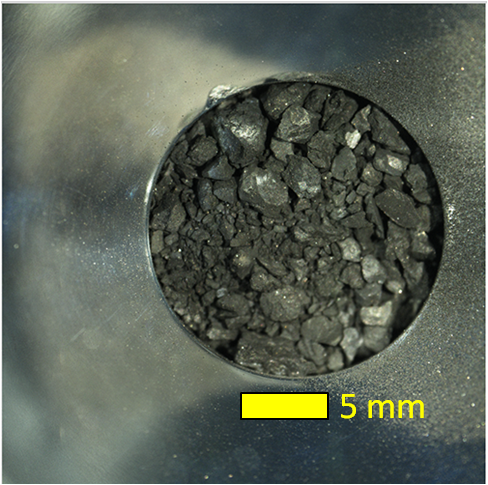
Opening the carefully sealed chambers, astronomers have found many particles larger than a millimetre. Those in chamber C were slightly bigger than the rest and were collected from the mission's second touchdown.


fig6Sample catcher chamber A, captured by an optical microscope. (JAXA)


Because this landing took place a little to the north of a crater intentionally created earlier in the mission, researchers expected the sample to contain chunks of subsurface material. That would be quite the achievement, since all other asteroid samples collected in space merely come from the surface.


Before these direct samples, most of our knowledge on the topic of asteroids came from meteorites, which are asteroids or comets that find themselves smashing into Earth's surface.


Unfortunately, without the protection of a human-made capsule, much of that material is destroyed or contaminated by our planet's atmosphere upon entry, not to mention all the weathering that occurs once these rocks come to rest on the ground.


Ryugu is a C-type asteroid which means its rock is highly porous and contains a lot of carbon and water. Astronomers suspect this particular pile of dark rubble was formed billions of years ago, when it broke off another large body of rock somewhere in the asteroid belt between Mars and Jupiter. 


Because Ryugu's surface appears unusually dry and shows red colouration, some experts think it once flew closer to the Sun.


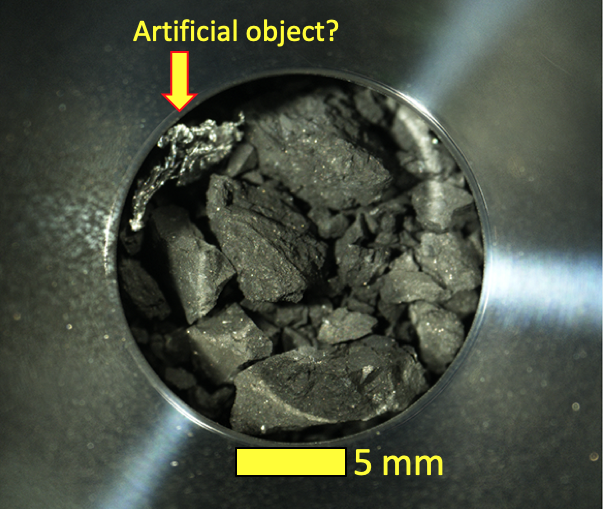
Still, not all the material collected in these containers is quite so primordial. One of the capsules does contain an obvious anachronism (pictured below).


fig7Sample catcher chamber C, captured by an optical microscope. (JAZA)


"Artificial material seems to be present in chamber C," reads a press release from the Hayabusa2 project. 


"The origin is under investigation, but a probable source is aluminium scraped off the spacecraft sampler horn as the projectile was fired to stir up material during touchdown."


Later, an update from Twitter said the object was still unconfirmed, but that it might have separated from the sampler horn used during collection. 


Scientists are already starting to analyse these new samples, including some gas trapped inside the capsules, which is thought to have been collected on the surface of Ryugu as well.


If researchers are correct, it will be the world's first gas sample returned from deep space.


Quite the present indeed.


#Space | https://sciencespies.com/space/look-at-all-these-mind-blowing-photos-of-asteroid-pieces-retrieved-from-ryugu/

A newly described Hawaiian flower is the only one of its kind in existence

Despite several cliff-scaling efforts to locate another of its kind, so far this native Hawaiian flower appears to be unique.


Found on one of the steep forested slopes of Helu that loom over Lahaina in West Maui, Hawaii, Cyanea heluensis was first discovered back in 2010 but it has only just been formally described.


Botanist Hank Oppenheimer and biologist Jennifer Higashino located it in a remote and deeply shady spot. Oppenheimer since used a specially developed paste to encourage new growth, from which they took a cutting in the hopes of propagating it at Olinda Rare Plant Facility.


After many attempts they managed to germinate a single seed from a fruit collected from the plant last year.


hawaii picture of people looking for plants(Hawaii Department of Land and Natural Resources/Facebook)


C. heluensis belongs to a group of plants called Cyanea, the most species-rich genus in Hawaii, that originated from a single introduction 8-10 million years ago. It has since diversified into 80 different species - some of which are found only on a single volcano.


"Dozens of native plants like this one are now only kept alive in nurseries," said Matthew Keir, Hawaii's Department of Land and Natural Resources Botanist on Facebook. "Just one natural disaster, like a hurricane, hitting a nursery could cause the extinction of many rare plants."


Oppenheimer recognised the leaves of C. heluensis were different to others of its genus when they first spied it from a distance through binoculars, and confirmed its uniqueness on closer inspection.


From mid-summer to October this tropical plant produces several hands' worth of finger-like white flowers, followed by fruits that start green and then mature into orange berries.


(Hawaii Department of Land and Natural Resources)(Oppenheimer, Phytokeys, 2020)


"Cyanea heluensis easily falls into the critically endangered category, which designates species facing a very high risk of extinction in the wild," Oppenheimer explains in his paper.


Plants like this one are also facing "probable loss and decline of most or all of its avian pollinators and dispersal agents, threats such as landslides and treefall, herbivory by alien slugs and rats, and competition with alien plants."


Conservation groups have been working hard to control some of the threats to this very lonely species, including weeding of invasive South American grass Cortaderia jubata, trapping rats and trying to control the goats and feral pigs that are encroaching on the area.


"Conservation of our ecosystems and the species that depend on them is vital to mankind's survival too," said botanist Steve Perlman from Plant Extinction Prevention Program.


"So few people study and know the flora and fauna well enough to recognize when a new species of plant, insect or bird lies in front of them... The age of discovery is not over!"


This research was published in Phytokeys.


#Nature | https://sciencespies.com/nature/a-newly-described-hawaiian-flower-is-the-only-one-of-its-kind-in-existence/

Fatal Skin Disease Outbreak in Dolphins Linked to Climate Change–Fueled Storm Surges


After Hurricane Katrina struck the Gulf Coast in 2005, scientists noticed bottlenose dolphins had developed ulcers and lesions all over their bodies after being caught in a brackish lake. Since Hurricane Katrina, reports of these gruesome sores on dolphins have increased in the United States, Australia and South America—and puzzled scientists have been working to identify the disease, Elle Hunt reports for the Guardian.


Fifteen years later, they finally have an answer. In a study published in Scientific Reports in December, the team of scientists named climate change as the root cause of this painful skin condition, reports the Miami Herald's Katie Camero.


Reports of the disease have increased in tandem with more frequent extreme weather events, like hurricanes and cyclones, study co-author Nahiid Stephens, a veterinary pathologist at Murdoch University in Perth, Australia, tells the Guardian. In extreme weather, storms dump freshwater into the ocean, decreasing the salinity and changing its chemistry. Dolphins can tolerate freshwater for short periods of time, but they developed painful lesions after the storms as a result of prolonged exposure to freshwater, which can last for months on end, reports the Miami Herald. In some cases, the team found that the lesions covered more than 70 percent of a dolphin's skin.


With open wounds, ions and proteins can ooze out of their skin as freshwater rushes in. Ultimately, the lesions cause electrolyte disruptions in the blood stream, leading to organ failure, Stephens tells Peter Dockrill for Science Alert. Plus, the open lesions provide an entryway for fungus, bacteria and algae to cause a further infection. The lesions are so devastating that they're on par with third-degree burns on humans, reports the Guardian.


"Their skin is just as sensitive as ours, and possibly even more so—it would be incredibly painful," Stephens tells the Guardian. "We couldn’t believe that such a severe, rapidly developing disease could be anything other than infectious … but ultimately, it is an environmentally caused disease."


Each region the scientists studied has experienced dips in ocean salinity as a result of more frequent and powerful storms. And as climate change continues to fuel more intense storms, the scientists expect prevalence of the disease to boom, too, reports the Miami Herald.


"We can only say there’s a pattern, a trend—but it’s gathering strength," Stephens tells the Guardian.


"This year was a record hurricane season, and who knows about next year," Pádraig Duignan, the chief pathologist at the Marine Mammal Center in California, tells Tiffany Duong for EcoWatch. "More Katrinas and more Harveys might be on their way, and each time, this will be happening to the dolphins. I think it will get worse."


Despite the grim news, the scientists are "pleased to finally define the problem," Pádraig says in a press release. The team can't cure climate change, but the findings will allow scientists and veterinarians to diagnose and treat the lesions now that they know what it is and how it's caused.


#News | https://sciencespies.com/news/fatal-skin-disease-outbreak-in-dolphins-linked-to-climate-change-fueled-storm-surges/

This epic space cloud is nicely summing up our farewell to 2020

Sometimes, the Universe provides just the perfect method for expressing our feelings.


A space cloud 7,500 light-years away has given us the most appropriate farewell we can think of for this whole dumpster fire of a year, 2020.


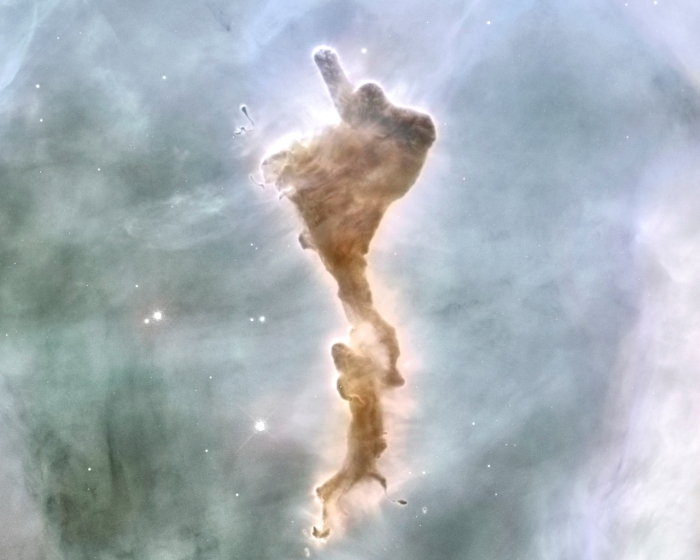
This small clump of material is part of a much larger cloud complex called the Carina Nebula, and under normal circumstances would not be given a nickname of its own. But its distinctive shape has led scientists to nickname it the Defiant Finger.


And that's exactly what it looks like - the age-old obscene gesture of "go do ghastly things to yourself", and "go away, but in much ruder words".


finger full(NASA, ESA, N. Smith/UC Berkeley, and The Hubble Heritage Team/STScI/AURA)


Actually, the Defiant Finger is what is known as a Bok Globule. These are small, dark, dense knots of dust and gas that are often the birthplaces of stars. As denser regions of the cloud condense further, they can collapse down under their own gravity, and start spinning into a star.


The Defiant Finger, comprising 6 solar masses worth of material, may have stars forming within it; because it's so dense, it's hard to see inside. The glow it appears to have is from external sources - the light of bright stars nearby.


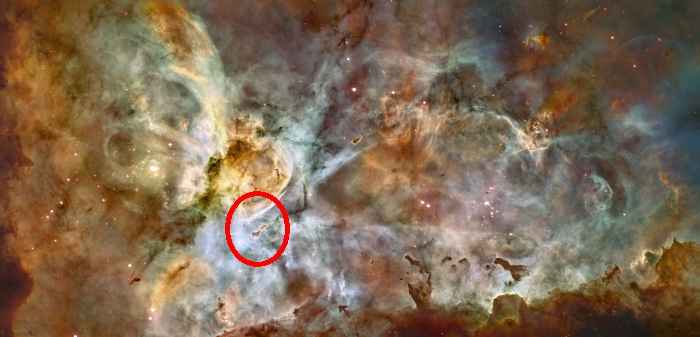
finger location(NASA, ESA, N. Smith/UC Berkeley, and The Hubble Heritage Team/STScI/AURA)


Because young stars are typically bright and hot, they blast their surroundings with radiation. The exterior of the Defiant Finger globule is likely being lit and ionised by either the Wolf-Rayet star WR 25, a very short-lived, massive star at the end of its lifespan; Tr16-244, a hot young supergiant; or a combination of both.


But while they illuminate, these stars also destroy: slowly but surely, they are evaporating the Defiant Finger. At the current estimated rate of mass loss, the cloud of dust has a projected lifespan of just 200,000 to 1 million years.


That's not very long in cosmic terms, not very long at all. But it's long enough to make a poetic statement: a scream into the void, a defiant gesture in the face of inevitability. And a really appropriate way to close the door on 2020.


Thanks, space. And bring on 2021.


#Space | https://sciencespies.com/space/this-epic-space-cloud-is-nicely-summing-up-our-farewell-to-2020/

Octopus and squid evolution is officially stranger than we could have ever imagined


Just when we thought octopuses couldn't be any weirder, it turns out that they and their cephalopod brethren evolve differently from nearly every other organism on the planet.


In a surprising twist, in April 2017 scientists discovered that octopuses, along with some squid and cuttlefish species, routinely edit their RNA (ribonucleic acid) sequences to adapt to their environment.


This is weird because that's really not how adaptations usually happen in multicellular animals. When an organism changes in some fundamental way, it typically starts with a genetic mutation - a change to the DNA.


Those genetic changes are then translated into action by DNA's molecular sidekick, RNA. You can think of DNA instructions as a recipe, while RNA is the chef that orchestrates the cooking in the kitchen of each cell, producing necessary proteins that keep the whole organism going.


But RNA doesn't just blindly execute instructions - occasionally it improvises with some of the ingredients, changing which proteins are produced in the cell in a rare process called RNA editing.


When such an edit happens, it can change how the proteins work, allowing the organism to fine-tune its genetic information without actually undergoing any genetic mutations. But most organisms don't really bother with this method, as it's messy and causes problems more often that solving them.


"The consensus among folks who study such things is Mother Nature gave RNA editing a try, found it wanting, and largely abandoned it," Anna Vlasits reported for Wired.


But it looks like cephalopods didn't get the memo.


In 2015, researchers discovered that the common squid has edited more than 60 percent of RNA in its nervous system. Those edits essentially changed its brain physiology, presumably to adapt to various temperature conditions in the ocean.


The team returned in 2017 with an even more startling finding - at least two species of octopus and one cuttlefish do the same thing on a regular basis. To draw evolutionary comparisons, they also looked at a nautilus and a gastropod slug, and found their RNA-editing prowess to be lacking.


"This shows that high levels of RNA editing is not generally a molluscan thing; it's an invention of the coleoid cephalopods," said co-lead researcher, Joshua Rosenthal of the US Marine Biological Laboratory.


The researchers analysed hundreds of thousands of RNA recording sites in these animals, who belong to the coleoid subclass of cephalopods. They found that clever RNA editing was especially common in the coleoid nervous system.


"I wonder if it has to do with their extremely developed brains," geneticist Kazuko Nishikura from the US Wistar Institute, who wasn't involved in the study, told Ed Yong at The Atlantic


It's true that coleoid cephalopods are exceptionally intelligent. There are countless riveting octopus escape artist stories out there, not to mention evidence of tool use, and that one eight-armed guy at a New Zealand aquarium who learned to photograph people. (Yes, really.)


So it's certainly a compelling hypothesis that octopus smarts might come from their unconventionally high reliance on RNA edits to keep the brain going.


"There is something fundamentally different going on in these cephalopods," said Rosenthal.


But it's not just that these animals are adept at fixing up their RNA as needed - the team found that this ability came with a distinct evolutionary tradeoff, which sets them apart from the rest of the animal world.


In terms of run-of-the-mill genomic evolution (the one that uses genetic mutations, as mentioned above), coleoids have been evolving really, really slowly. The researchers claimed that this has been a necessary sacrifice - if you find a mechanism that helps you survive, just keep using it.


"The conclusion here is that in order to maintain this flexibility to edit RNA, the coleoids have had to give up the ability to evolve in the surrounding regions - a lot," said Rosenthal.


As the next step, the team will be developing genetic models of cephalopods so they can trace how and when this RNA editing kicks in. 


"It could be something as simple as temperature changes or as complicated as experience, a form of memory," said Rosenthal.


The findings have been published in Cell.


A version of this story was originally published in April 2017.


#Nature | https://sciencespies.com/nature/octopus-and-squid-evolution-is-officially-stranger-than-we-could-have-ever-imagined/