Featured Post

Tracking air pollution disparities -- daily -- from space

Studies have shown that pollution, whether from factories or traffic-snarled roads, disproportionately affects communities where economicall...

Friday, May 1, 2020

Swiss soldiers pick up smartphones to fight COVID-19

CHAMBLON, Switzerland (Reuters) - In the battle against coronavirus, Swiss soldiers are using smartphones to test a new contact tracing application that could prevent infections while also protecting users’ privacy.


A Swiss soldier shows on a mobile device the contact tracking application created by the Swiss Federal Institute of Technology Lausanne (EPFL), using Bluetooth and a design called Decentralised Privacy-Preserving Proximity Tracing (DP-3T), which will be launched on May 11 by the Swiss Government for easing of the lockdown caused by the coronavirus disease (COVID-19) outbreak, at the Chamblon barracks, Switzerland April 30, 2020. REUTERS/Denis Balibouse


Switzerland hopes to launch the app on May 11 based on a standard, developed by researchers in Lausanne and Zurich, that uses Bluetooth communication between devices to assess the risk of catching COVID-19.


A hundred soldiers from the Chamblon army base near Lausanne volunteered to download the app and then go about their regular routines for 24 hours.


If they spend 15 minutes within two metres of each other, that information is logged on their devices and they must exchange a validation card given by researchers so the data can be checked.


The apps “do that in an encrypted way, and the records stay on the phone”, Marcel Salathe, director of the digital epidemiology lab at the Swiss Federal Institute of Technology Lausanne (EPFL), told Reuters Television.


“If a person eventually gets positively tested, they can upload their ID to the system and then all the other apps can check whether they have been close to that person and can then call the health authorities,” he added.


Speed is vital. COVID-19 can be spread by people without symptoms, making it important to react quickly when an individual tests positive and warn those they have contacted.


“The idea of this app is really to aid contact tracing,” said Salathe. “Usually this is done in a way that is person based, and with this app, we hope to support this process so that it is much faster.”


LIKE A SUBMARINE


EPFL project manager Alfredo Sanchez compared the app to “a submarine that sends sound markers and listens to the echoes that are coming back”.


Although early results with Bluetooth-based contact tracing in countries like Singapore have been modest, backers say it can help if large numbers participate.


Amid concerns about whether such technology can be used by governments to increase surveillance, the Swiss team has taken a privacy-first approach.


Records of Bluetooth exchanges between smartphones are kept on devices, not on a central server.


Salathe warned that, with a central server, “you start adding more and more things that, on their own, don’t look very problematic. But, actually, you are slowly building something that is very close to a really intrusive surveillance machinery.”


The Swiss app would be the first of its kind to have a decentralized design compatible with new standards from Apple and Google, whose operating systems run 99% of the world’s smartphones.


In Geneva, people’s views on the app are mixed.


Slideshow (11 Images)


Hamza Fawaz, a resident in his 30s, has doubts about data protection and will not use the app. But conference interpreter Beatrice Mallet, in her 60s, is “completely ready”.


“It can be useful and if it allows us to get out more quickly from this health crisis, this is a good thing”, she said.


The Swiss Parliament is expected to debate the app next week.


Additional reporting by Douglas Busvine; Editing by Giles Elgood


#News | https://sciencespies.com/news/swiss-soldiers-pick-up-smartphones-to-fight-covid-19/

UC Berkeley Lab to build NOAA space weather instrument

SAN FRANCISCO – The National Oceanic and Atmospheric Administration awarded a $7.5 million contract to the Space Sciences Laboratory at the University of California, Berkeley, to design, build and test an ion sensor for the Space Weather Follow-On (SWFO) Lagrange-1 mission.


Under the contract announced May 1, the Space Sciences Laboratory will build the Supra Thermal Ion Sensor and support launch and on-orbit checkout of the instrument.


SWFO, a high priority mission for NOAA’s Space Weather Prediction Center, is designed to gather solar wind data and coronal mass ejection imagery when the current generation of space weather instruments stops working.


SWFO is a scheduled to launch in 2024 as a rideshare on the NASA Interstellar Mapping and Acceleration Probe, a mission to observe the acceleration of energetic particles and the interaction of solar wind and the interstellar medium.


NASA’s Goddard Space Flight Center in Greenbelt, Maryland, serves as the flight system procurement agent for the SWFO program.


NOAA awarded a $12.9 million contract in April to the Southwest Research Institute to design and build the SWFO magnetometer.


Congress provided NOAA funding in the 2020 budget for SWFO, a mission intended to carry on work performed by NOAA’s Deep Space Climate Observatory launched in 2015 and the joint European Space Agency-NASA Solar and Heliophysics Observatory launched in 1995.


#Space | https://sciencespies.com/space/uc-berkeley-lab-to-build-noaa-space-weather-instrument/

France Is Slowly Bringing Back Its 'Forgotten Vegetables'


Ten ounces of bread per day, one egg per week and three ounces of butter per month. In 1944, after Paris was liberated from four years of Nazi occupation, food rationing remained severe, and didn’t entirely lift until 1949. A family was given three ounces of meat per person, but it was weighed with the bone still inside, so the actual portion of meat was even less.


Each weekend, Parisians would bike to the countryside in search of whatever vegetables their friends could spare. And what they found were not well-known staples, but leftovers usually grown for livestock. As Emily Monaco writes for Atlas Obscura, Nazi troops had taken over the majority of French food production. They redirected prime staples like potatoes and half of the country’s meat production.


The French, instead, worked with what was left: hardy root vegetables like rutabagas and Jerusalem artichokes. But after relying on them for nearly a decade, many of those who lived through rationing elected never to eat them again, earning the root veggies the name “forgotten vegetables.”


Lasting, negative associations with particular foods isn’t uncommon—memories involving food are often some of the strongest, Vassar College psychologist Hadley Bergstrom told Julie Thomson at the Huffington Post in 2017.


Owner of the Parisian culinary school Le Foodist Fred Pouillot grew up in central France, and tells Atlas Obscura that even today, his 86-year-old mother “despises rutabagas.” He adds, “She said that topinambours (Jerusalem artichokes) were the only thing she remembers eating during the war that was good. But she has never cooked them again.”


A Jerusalem artichoke is a tuber, like a potato. It comes from a plant with a bright yellow blossom, so its name in Italian is girasole, the word for sunflower. When the vegetable was picked up by English speakers, the Italian name morphed into “Jerusalem,” and “artichoke” was added to describe tuber’s flavor, Bon Appetit’s Andrew Knowlton reported in 2013.


In the last decade, chefs have been reviving interest in Jerusalem artichokes. Peeled, boiled and pureed, sliced and fried, or roasted whole, the vegetables have been rebounding as interest grows in locally grown produce. But chef and restaurant owner Rene Redzepi warned Bon Appetit against serving them raw. Unlike potatoes, that are rich in starch, Jerusalem artichokes are full of another carbohydrate called inulin. Our bodies are less equipped to break down inulin, so eating raw Jerusalem artichokes, or eating too many of them, can cause gastrointestinal distress.


Before the occupation, Jerusalem artichokes were mostly grown in France to feed livestock. Decades later, the vegetables are still associated with the hardship of the 1940s for those who lived through it. The same is true for rutabagas.


“There’s no French person who doesn’t have the memory of Grandma or Grandpa talking about how we had nothing to eat except horrible rutabagas in 1943,” Cornell University historian Steven Kaplan tells the Washington Post.


Rutabagas are like a cross between a turnip and a cabbage that came about hundreds of years ago. 17th-century Swiss botanist Gaspard Bauhin first described the odd vegetable in his 1620 book “Prologue to the Exposition of Plants,” according to the New Yorker’s Helen Rosner. Rutabaga leaves can be cooked like mustard greens, and their large, hairy roots can grow as big as a human head, which makes them perfect for turning into vegetable noodles, Rosner writes.


For families that experienced rationing, rutabagas and Jerusalem artichokes “just contributed to the idea of everything that was so horrible about the Occupation.” Université Paris Diderot culinary historian Patrick Rambourg tells Atlas Obscura. But as the veggies gain traction again, he says, “maybe we needed to wait for the second or third generation. We’re moving away from this history and this painful past of the Occupation. In time, you know. Not in our memories.”


#News | https://sciencespies.com/news/france-is-slowly-bringing-back-its-forgotten-vegetables/

Honey Bee Virus Tricks Hive Guards Into Admitting Sick Intruders


Honey bees are known for running a tight ship. Their hexagonal honeycombs make the most mathematically efficient use of space for storing honey, they keep diseases from spreading by minimizing touching or feeding of sick hive-mates, and guards stationed at the hive entrance act as bouncers to keep out intruders.


But new research suggests a deadly virus tricks those normally vigilant guards into letting infected invaders into their hives, reports Erik Stokstad for Science.


“Somehow, the infected bees are able to circumvent the guards of foreign colonies, which they shouldn’t be able to do,” says Adam Dolezal, an entomologist at the University of Illinois and leader of the new research, in a statement.


The virus, called Israeli acute paralysis virus (IAPV), has also been shown to make forager bees more likely to get lost on their way home—upping their chances of spreading the virus to a neighboring hive.


By enabling these wandering bees to slip past an unfamiliar colony’s defenses, the virus has evolved a way to spread despite the sophisticated tactics bees deploy inside their colonies to tamp down infections.


"This is an interesting study that demonstrates an arms-race between a honey bee host and its viral pathogen at the behavioral level," Eyal Maori, a virologist at Cambridge University who was not involved in the research, tells Rosie McCall of Newsweek.


IAPV infections have been linked to colony losses and are one of many environmental stresses—including parasitic mites, pesticides, pollution and loss of plant diversity—making life more difficult for some of the insect world's hardest working farmhands. Without honey bees, roughly a third of the food eaten by Americans would disappear. Bees’ contributions to pollinating crops including apples, melons, cranberries, pumpkins, squash, broccoli and almonds are valued at more than $15 billion.


This new research suggests that the practice of stacking multiple hives next to each other in commercial beekeeping may play right into the hands of IAPV. Left to their own devices, bees tend to spread out, with just one or two hives per square mile.


Dolezal and his team wanted to study how IAPV spreads and had a hunch that it might make some strategic alterations to the behavior and physiology of infected bees. To track the insects’ behavior, the team tagged bees with barcode-like labels that could then be recognized and tracked by cameras attached to an automated computer system.


The system, capable of tracking up to 900 bees at once, was programmed to spot a behavior called trophallaxis, in which two bees smush their faces together while sharing regurgitated food and transmitting hormones or other chemical messages.


“Trophallaxis is essential to the spread of information and nutrition throughout the hive, but unfortunately, a behavior performed with such close social contact also allows viral infections to be transmitted through a hive,” says Gene Robinson, an entomologist at the University of Illinois and study co-author, in a statement.


The researchers used the automated system to track the behaviors of 90 to 150 IAPV-infected bees released into an experimental hive. The study found that bees infected with IAPV, as well as bees with stimulated immune systems designed to mimic infection, were shunned by their hivemates when they went looking for trophallaxis, the researchers report this week in the journal Proceedings of the National Academy of Sciences.


But the bees’ brand of social distancing inside the hive wasn’t enough to protect them from the virus. When the team placed individuals infected with IAPV outside a hive, the guards gave them special treatment—letting them in more often and engaging in more trophallaxis with them than with healthy or immune-stimulated bees.


The researchers suspect the guards’ sweet spot for the sick bees may be because of their smell, which is used by the guards to discern friend from foe. The researchers found that smelly compounds called hydrocarbons were chemically altered in bees infected with the virus. But these sick bees may slip past the velvet rope by simply being nicer to the guards, reports Science. The researchers observed sick bees being more submissive and sharing more food when approached by hostile guards.


The findings suggest that IAPV is evolving to infect as many hosts as possible, says Dolezal in a statement.


Other researchers say IAPV’s ability to modify the bees’ behavior to get from hive to hive might also increase the spread of additional threats. IAPV could aid the transmission of pathogens and pests, such as the varroa mite, to new colonies, Maori tells Newsweek. The mite feeds on bees’ fat reserves and has devastated colonies across the world.


More research is needed to determine if IAPV plays a big role in the spread of mites and other viruses, Maori tells Newsweek, which would represent a significant vulnerability in commercial beekeeping operations that keep many hives close together.


#News | https://sciencespies.com/news/honey-bee-virus-tricks-hive-guards-into-admitting-sick-intruders/

NASA selects three companies for human landing system awards

WASHINGTON — NASA announced April 30 it has selected three companies to begin work on designs for human lunar landers, one of which the agency still hopes will be ready to land humans on the moon by the end of 2024.


NASA selected teams led by Blue Origin, Dynetics and SpaceX for 10-month study contracts for the Human Landing System (HLS) program. The combined value of the awards is $967 million.


“Let’s make no mistake about it: We are now on our way,” Doug Loverro, NASA associate administrator for human exploration and operations, said in a media teleconference to announce the awards, saying it completed NASA plans under the Artemis program to return humans to the moon. “There are no more puzzle pieces to add. We’ve got all the pieces we need.”


The largest award went to the team led by Blue Origin, which received $579 million. That so-called “national team,” announced in October, includes Draper, Lockheed Martin and Northrop Grumman. Blue Origin will develop the descent module, based on its Blue Moon lander design, while Lockheed provides the ascent module, Northrop builds the transfer stage, and Draper develops avionics and related systems.


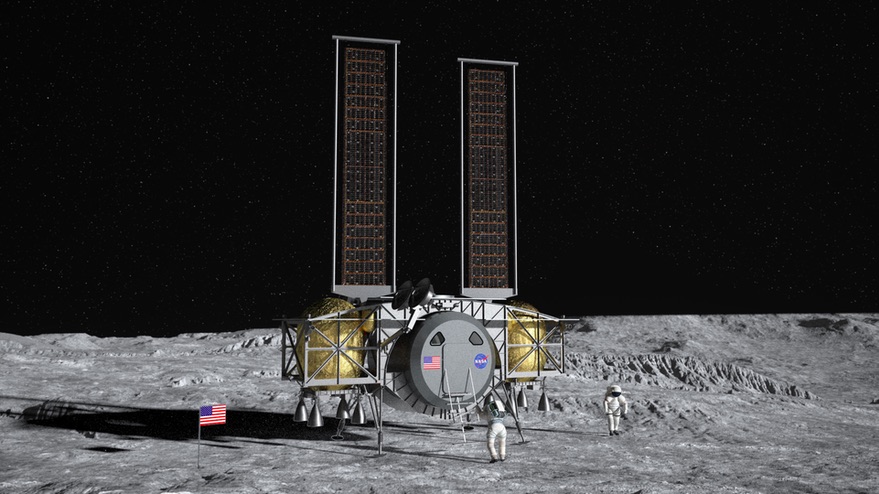
A team led by Dynetics with more than 25 subcontractors received $253 million. Dynetics announced in January it had bid on the HLS program, with Sierra Nevada Corporation as one of its partners. The Dynetics design features a single module capable of both descending to the surface and ascending back to orbit.


SpaceX received the third HLS award, valued at $135 million. SpaceX is offering its Starship vehicle for lunar landings, which would be launched on its Super Heavy booster and fueled in Earth orbit by other Starship vehicles before departing for the moon. SpaceX had not announced its intent to bid on the program, declining to answer questions about it in the past, although the company was widely rumored to have submitted a bid.


The three winning bidders will begin work with NASA to refine their concepts, including defining requirements for each lander. “We’re going to spend the first three months understanding the awardees’ designs,” said Lisa Watson-Morgan, NASA’s HLS program manager. “This is far more than just studies. It’s going to encompass deep design, development, long-lead procurements for each of the awardees.”


That work will lead to a level of maturity for each design equivalent to a preliminary design review. NASA plans to conduct a “continuation review” by the end of the 10-month studies, she said, “so we know, quickly, who we think has the best shot of making 2024.”


The lander most likely to be ready for a 2024 landing will go forward, but NASA suggested one or both of the other companies could be retained to develop landers better suited for later missions where NASA has emphasized sustainability.


NASA Administrator Jim Bridenstine said the lander selected for the 2024 mission likely will not make use of the lunar Gateway. “We believe that getting to the moon by 2024 does not require the Gateway,” he said when asked about previous comments by agency officials, like Loverro, that suggested the Gateway was not on the critical path. “The Gateway is not required for that 2024 mission, and, in fact, I would go as far to say that it’s not likely that we will use the Gateway for the 2024 mission.”


Bridenstine added that NASA was not formally taking the Gateway “off the table” for that initial 2024 mission, and that the Gateway is “critically important” for later phases of lunar exploration.


None of the three companies proposed using the Space Launch System for their lunar landers. Blue Origin said their lander can launch either on its own New Glenn vehicle or United Launch Alliance’s Vulcan, while Dynetics has baselined Vulcan and SpaceX its own Super Heavy booster for Starship. Bridenstine said SLS will still be used for launching the crewed Orion spacecraft to lunar orbit, where it will dock with the Gateway or directly with the selected lander.


NASA said its budget proposal released in February was sufficient to fund development of the HLS lander systems, along with the rest of the Artemis architecture needed for a 2024 landing. Bridenstine said he met with members of Congress of both parties in recent days about the upcoming HLS awards and found broad support for the effort.


“They have all been very supportive of the effort to get to the moon,” he said. “We have a budget request that reflects that budget priority and I have not heard anybody suggest that, because of the coronavirus pandemic, we’re going to have to cut NASA.”


It’s unclear, though, when and how Congress will act on that budget request, or if NASA will spend much or all of the 2021 fiscal year on a continuing resolution that would fund the agency at 2020 levels and deprive it of the additional funding needed for Artemis. Bridenstine did note that, if Congress does take up a new stimulus spending package focused on infrastructure as part of its response to the pandemic, he hopes that NASA will be a part of that bill.


Notably absent from the winners was Boeing, which announced in November it had proposed a lunar lander system that could be launched in one piece on the SLS. NASA officials on the call declined to state why Boeing was not selected, or if it had received other proposals, saying that would be included a source selection statement.


That source selection statement, posted on a procurement site April 30, confirmed Boeing submitted a proposal — along with another, previously unknown company, Vivace — but offered no explanation of why it was not selected.


“While Boeing is disappointed not to have been selected for HLS, we remain focused on delivering our elements of NASA’s Space Launch System, the rocket that will take Americans to the Moon and Mars,” Boeing spokesman Jerry Drelling said in a statement to SpaceNews.


#Space | https://sciencespies.com/space/nasa-selects-three-companies-for-human-landing-system-awards/

Framing Hope Through a Photographer's Lens


Framing Hope Through A Photographer's Lens


© Cristina Mittermeier


One of the most influential female photographers in the world is Cristina Mittermeier. But before she became one of the strongest voices in conservation photography, she worked in her native Mexico as a Marine Biologist. She discovered that visual storytelling, rather than data sets, allowed her to be a better advocate for the ocean.


Mittermeier was one of the speakers involved in the Smithsonian's 2020 Digital Earth Optimism Summit, during which she shared how she is able to capture optimism and shift the way we view conservation issues with her camera. Following the Summit, Earth Optimism's Cat Kutz asked Mittermeier to share a few of her inspiring photos and tell us how she sees Earth Optimism shaping the conservation narrative moving forward.


Cristina Mittermeier is one of the most influential female photographers in the world. (© Anna Heupel)

First of all, I want to thank you for being a part of the Earth Optimism Digital Summit last week. During your session, Telling the Story, you said, “A beautiful photograph is an open door into which people can enter this conversation.” How are you able to convey Earth Optimism in your photographs?


I learned storytelling by studying how some of the best storytellers in history frame their stories. Dr Martin Luther King didn’t start his famous speech by saying “I have a nightmare”.
​
Framing the issue at hand with a positive attitude has the wonderful effect of making the price of entry into the conversation accessible. We are currently engaged in the most important conversations of our lives; we need to make it accessible and democratic. Photography allows us to do that.


"I was really awakened by the commitment of young Titouan Bernicot, a young conservationist and artist, whom I met recently in French Polynesia. In his own words, Titouan says that he was, “born on a pearl farm lost in the middle of the Pacific Ocean.” At the age of 16 he realized that the coral reefs in French Polynesia were dying and resolved to do something to help. He founded The Coral Gardeners, a non-profit that educates the public about the importance of coral reefs. They believe, correctly, that the children are our future and that awareness should be brought to them as well as to adults. Now 20 years old, Titouan and the other coral Gardners work to restore the reef on the island that is also their home, Mo’orea." (Cristina Mittermeier)

Do you have a favorite photo of yours that has been particularly effective at portraying a sense of hope for our planet?


I love the images I have been able to make with young indigenous activists. Indigenous people are the last people on this planet that remain connected to the operating system of Earth; we need to empower those young indigenous people who are interested in downloading that knowledge from their elders.


"I first met Ta'kaiya Blaney, photographed here in her home waters in the Salish Sea, after hearing her speak for what she calls an "Earth Revolution. Ta'kaiya is an environmentalist and a First Nations activist from the Tla A'min Nation in British Columbia, Canada - and she lives not far from where I have made my home on Vancouver Island. She is an inspiring, passionate speaker; a force of nature in her own right, who first started expressing her concerns about the environment in songs when she was just ten years old. Today she is a singer, a drummer, and a speaker on behalf of the rights of indigenous people." (Cristina Mittermeier)

How do you see the idea of Earth Optimism continuing to shape the way we frame conservation?


Optimism is the key to our survival. If we can frame the challenges ahead with an air of positivity and hope, we will stand a chance of galvanizing action for our planet.


Can you tell us more about the mission of SeaLegacy and what inspired you to start this organization?


Our mission is simple; we are using the power of visual storytelling to change the story of our oceans. As we grow our following and galvanize action on key issues, we build a sense of community and positivity. In June, we are launching Only.One, one of the most exciting things Paul Nicklen and I have ever been a part of. We want everyone to join in our sense of optimism and hope, so come join us as www.only.one and let’s change the story.


"For most of us, it is hard to even know what a healthy coral looks like anymore. I was surprised to find one last survivor in this stretch of coastline off the island of Mo’orea. There is no question that both the ocean and the cryosphere (a fancy word to describe the frozen portions of our planet) are crucial for mitigating the climate crisis. For years, the ocean has absorbed massive amounts of heat created by human carbon emissions, keeping our earth cooler, but at a great cost. Carbon absorption has increased the acidity of our ocean, which not only makes it more difficult for our coral reefs to recover from bleaching events, but it also inhibits their ability to survive. This has dangerous implications for the future of marine diversity and coastal community protection. Healthy reefs act as a buffer between shorelines and storms, shielding communities and saving lives and property from damage of waves and floods." (Cristina Mittermeier)


Cat Kutz


#Nature | https://sciencespies.com/nature/framing-hope-through-a-photographers-lens/

Our Sun is surprisingly weak compared to other stars, study shows

We're pretty familiar with our Sun. We've even sent a probe to go study it; we haven't done that with any other star. Given how closely we study it, it would be tempting to think of it as a typical example of a G-type main-sequence star, or yellow dwarf.


New research suggests that this is not the case. After conducting a survey of stars similar to the Sun, scientists have discovered that our star is unusually subdued, at least at this stage of its life.


Compared to its peers, the Sun fluctuates in brightness much less, and has much lower sunspot activity, than the average. It's a curious result - and one that could have implications for the future of our life on this planet.


We know our Sun varies a little in brightness due to its 11-year cycles. The cycle starts at a quiet period, with the solar magnetic field neatly aligned between the poles. But because the equator spins faster than the poles, it pulls the magnetic field out of shape. This results in heightened activity, sunspots, and variable brightness. Eventually - after about 11 years - the magnetic field snaps back into alignment, the poles flip and it goes back into a quiet period.


Understanding how this activity changes is a powerful tool for predicting the Sun's future. And we actually have a really powerful tool at our disposal for understanding solar activity over the past. That's Earth itself. The concentration of various elements in tree rings, ice cores and the fossil record can be interpreted to understand how the Sun has changed over time.


From these records, we know that the Sun has been more or less as active as it is now for the last 9,000 years. But far back in the distant past, it's harder to gauge whether the Sun behaved differently, and whether its current activity level is temporary.


"Compared to the entire lifespan of the Sun, 9,000 years is like the blink of an eye," said astrophysicist Timo Reinhold of the Max Planck Institute for Solar System Research (MPS) in Germany.


"After all, our star is almost 4.6 billion years old. It is conceivable that the Sun has been going through a quiet phase for thousands of years and that we therefore have a distorted picture of our star."


This is where other stars come in. We can compare the Sun to others like it to determine whether its behaviour is typical. And thanks to the Kepler space telescope, we have really detailed data. It studied a patch of sky for four years, allowing astronomers to calculate the rotation rates of tens of thousands of stars in its field of view, recording the faint dips in brightness associated with a sunspot appearing and disappearing from view.


This is key - because the rotation rate of a star is thought to contribute to the strength of the magnetic field. "The magnetic field is the driving force responsible for all fluctuations in activity," said astrophysicist Sami Solanki of MPS.


From the Kepler data, the researchers selected stars with rotation periods between 20 and 30 days. (The Sun's rotation period is 24.5 days.) They cross-referenced those stars against the data from the Gaia satellite, and identified 369 stars that are comparable to the Sun in colour, mass, composition, age, temperature and rotation rate.


sun variation(MPS/hormesdesign.de)


Then, they compared the brightness variability of those stars as recorded by Kepler against the brightness variability of the Sun. The results were clear. The Sun's fluctuations were very weak compared to most of the other stars. Typically, other stars fluctuated by five times as much as the Sun.


"We were very surprised that most of the Sun-like stars are so much more active than the Sun," said astronomer Alexander Shapiro of MPS.


But not all stars have detectable sunspots, and their rotation rates cannot be recorded. For a broader comparison, the team measured the Sun against 2,500 stars with unknown rotation rates - and in this case, the Sun seemed much more normal.


It's difficult to know precisely what this means. It could be that there are fundamental differences between stars with known and stars with unknown rotation rates. As the researchers note, it's likely that the Sun would belong to the latter group if studied at a distance by a Kepler-like telescope.


"For example, it has been proposed that the solar dynamo is in transition to a lower activity regime because of a change in the differential rotation inside the Sun," they wrote in their paper.


"According to this interpretation, the periodic stars are in the high-activity regime, whereas the stars without known periods are either also in transition or are in the low-activity regime."


Another possibility is that stars can fluctuate between activity levels, and the Sun just hasn't exhibited rowdy behaviour recently. That suggests it could do so in the future; given that a rambunctious Sun can negatively impact communications, navigation, satellites and even power grids, that's a worrying thought.


However, since the star has been relatively quiet for at least 9,000 years, the timescales for such fluctuations are probably quite long in human terms.


There's no way, at present, to tell which of these scenarios is more likely. But future observations with even more sensitive instruments could help pony up some answers.


The research has been published in Science.


#Space | https://sciencespies.com/space/our-sun-is-surprisingly-weak-compared-to-other-stars-study-shows/