Featured Post

Tracking air pollution disparities -- daily -- from space

Studies have shown that pollution, whether from factories or traffic-snarled roads, disproportionately affects communities where economicall...

Thursday, April 30, 2020

Scientists report terrifying ice lumps that could be the largest hailstones recorded

The hailstone is so massive it even stunned meteorologists.


"It's incredible," said meteorologist Matthew Kumjian from Penn State University in the US. "This is the extreme upper end of what you'd expect from hail."


The hefty ice lump smashed down from a supercell thunderstorm in Argentina two years ago, in the heavily populated town Villa Carlos Paz. In a recently published study, Kumjian and colleagues have concluded the hailstone is possibly the largest ever recorded - estimated to be up to 23.7 centimetres (over 9 inches).


However, as its dimensions were only gleaned from video evidence (below, 11 seconds in), and not direct measurements, they can't conclusively say it's the largest to be recorded.


Another hailstone from the same storm, recorded by local Victoria Druetta, came in at 18 centimetres (7.1 inches), after she saw chunks of it smash off during the impact of its landing.
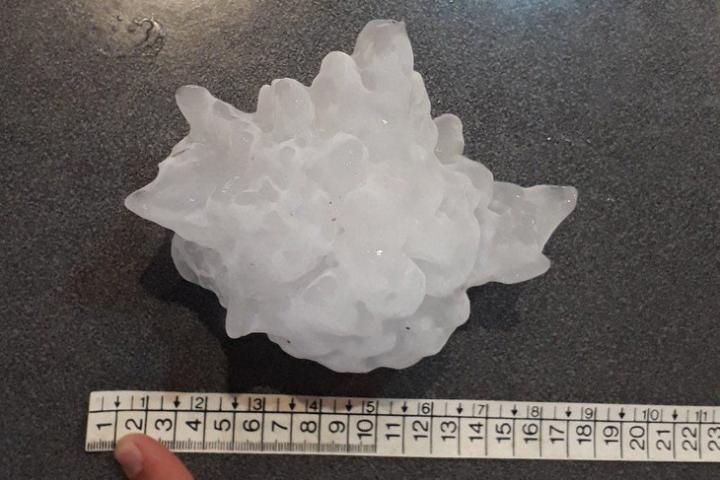

(Victoria Druetta)(Victoria Druetta)


Such horrific hailstones require special conditions - massive storms with powerful updrafts to keep them aloft long enough to pack on that weight. They start as raindrops sucked above freezing altitudes in a storm, and as they're tossed about up there, layers of supercool liquid water freeze onto them - the twists and turns moulding their lumpy lobed structures.


Such updrafts and windfields that twist and strengthen with height are promoted by warm and humid conditions, and radar information from this recent study showed this large hail fell close to where the main updraft occurred. 


The examined hail also showed substantial wet growth, which occurs in the lower part of hail growth zones within the storms, suggesting the updraft there must be particularly strong for these giants to obtain their size.


As fascinating as this may be from a safe distance, hail of course is also extraordinarily dangerous, and more so the larger it gets. 


"Hail can cause significant damage to property and agriculture, as well as injuries or even deaths," the researchers wrote in their paper.


They proposed officially classifying hailstones larger than 15 centimetres (6 inches) as "gargantuan", to help warn us all of their damaging potential.


"Anything larger than about a quarter in size can start putting dents into your car," Kumjian said. "In some rare cases, 6-inch hail has actually gone through roofs and multiple floors in houses. We'd like to help mitigate the impacts on life and property, to help anticipate these kinds of events."


The team searched for warning signs leading up to the hailstorm but found a "lack of indications of an extreme event in the pre-storm environment, numerical model forecasts, or radar imagery collectively," and pointed out we need a lot more research in this area.


With predicted increases in the severity of thunderstorms in the future, understanding the dynamics of these giant stones of ice may soon become more critical. So far, research on future hailstorms suggests some areas may see increases in hail frequency while others a decrease, but that there will likely be a shift from small to large hailstones occurring with increasing global temperatures.


Penn State meteorologist Rachel Gutierrez explains volunteers can help scientists better understand the risks of hailstorms by reporting and providing accurate recordings of gargantuan hailstones, including the time and location of its fall and its weight.


This research has been published in the Bulletin of the American Meteorological Society.


#Nature | https://sciencespies.com/nature/scientists-report-terrifying-ice-lumps-that-could-be-the-largest-hailstones-recorded/

Space agencies working on a ‘unified message’ on industry stimulus

The Space Acquisition Council is collecting data on the state of the defense supply chain.


WASHINGTON — The Space Acquisition Council, which includes senior leaders from the Pentagon and the National Reconnaissance Office, has made it a priority to assist space industry suppliers that are financially stressed by the coronavirus crisis.


But exactly what type of assistance will be offered is still to be determined, said the Department of the Air Force’s top procurement official Will Roper.


Roper told reporters April 29 during a video conference that he has asked DoD organizations that work with space companies to get as much data as possible on suppliers that might be on the brink of collapse.


“When we get the results back, it’ll help us put out a unified message to Congress, to the Office of the Secretary of Defense and others about where to take actions,” Roper said.


The Pentagon has already identified small launch vehicles and microelectronics as sectors that support national security space programs and have been weakened by the crisis. Roper suspects there are other fragile points in the supply chain such as providers of specialized materials used in satellites.


“These are critical supplies,” he said. “You can’t just make a satellite out of anything, you have to have materials that meet tolerances that you just don’t get anywhere,” said Roper. “It’s not an area that you can just snap your fingers and find a company that does that type of work.”


During an emergency meeting April 27, “we reached the decision to put out a survey,” Roper said. The council also discussed “specific queries” that were sent from particular companies but Roper said he could not mention them by name.


“What we wanted to do with this emergency session is to put our thoughts on the table about what we’re seeing in the space industrial base,” he said.


Roper has seen investors become more conservative “and I think they’re looking for the government to take a leading role in saying what’s going to be important in the long term.”


Space is viewed as a “booming part of the future economy” and now needs help, said Roper. “Before COVID-19 most of the large investment firms were predicting at least a trillion dollar space economy by 2040.”


Congress might not support stimulus for DoD


Giving more money to the Pentagon to help stressed suppliers will be a hard sell, according to the chairman of the House Armed Services Committee Adam Smith (D-Wash.).


“I don’t think we should put money for DoD in a stimulus package,” Smith said April 29 during a Defense Writers Group video conference.


Smith said the Pentagon has plenty of money it can reallocate to fund industry stimulus efforts. Fuel costs, for example, have plummeted so there is extra funds in those accounts.


“Any future supplementals should be to fight the virus” not to buy military equipment, Smith said.


“I have not seen an argument that makes sense to me that we should put more money into defense to manufacture things,” he said.


With regard to helping suppliers in space or other sectors, “I don’t think DoD necessarily should turn into a bank on this one.”


Lots of businesses need help right now, said Smith. “Some have seen 100% of their revenue disappear.” A question for DoD is “how do you distribute resources? How do you make sure that it gets to the people that most desperately need it? We’re going to need to constantly reevaluate what’s working and what’s not working, and who needs the help.”


#Space | https://sciencespies.com/space/space-agencies-working-on-a-unified-message-on-industry-stimulus/

Here's why news on the 'insect apocalypse' has been so confusing


News of an insect apocalypse has become a familiar headline in recent years, with study after study pointing to an alarming loss in invertebrate numbers. As consistent as the message seems, the results don't always agree with one another.


A new study led by ecologists from the German Centre for Integrative Biodiversity Research suggests the decline in global populations might not be as steep as we thought, and could actually be improving in some areas.


That conclusion might appear to be in stark contrast to claims we heard last year that 40 percent of all insect species face extinction, with some claiming an annual decline of 2.5 percent in their numbers worldwide, or even higher in some corners of the globe.


But taken in context, the new study builds a picture that shows how important it is to protect our environment and pay close attention to this vital part of the biosphere.


By compiling more than 160 surveys monitoring the weight of insect and arachnid populations around the globe, the researchers were able to get a good sense of the biomass and distributions of creepy crawlies dating as far back as 1925.


Their figures suggest there's a marked difference in trends for invertebrates in different ecosystems in different parts of the world.


For those that live on land – which is most insects and spiders – the news still isn't terrific, with an estimated yearly drop of just under one percent.


Seeing nearly one tenth of the invertebrate biomass shrink away every decade isn't exactly cause to celebrate, but it's a slope that we could optimistically interpret as giving us more time to act.


Oddly, other results in the study do provide us with a ray of hope. Insects that live in aquatic environments might have had a bit of a hey-day over the past century, growing by a similar amount year by year.


With so many numbers hinting at such different scenarios, it's easy to feel confused. Are things terrible? Just bad? Or is the science simply unsettled?


Manu Saunders is an ecologist from the University of New England with plenty of experience in interpreting data on insects. While she was not involved in this study, her advice is to not miss the wood for the trees.


"The overall trend is not the important message here," Saunders explained to ScienceAlert.


"The key take-home for me is the variation in insect population trends across space and time, between species groups, and between types of habitats or climate zones. These trends can be more informative about where we can most effectively address conservation initiatives."


It's all well and good to be shocked by the numbers. But hidden inside the statistics are important details we'll need to understand if we're to make decisions on how to best focus our efforts.


The surveys used in the study were all at least a decade or two in length, and focussed largely on protected environments across more than 40 countries covering five continents.


The details revealed the decline was worst in North America. Even putting those numbers aside, a weak global drop was still evident, indicating there's plenty of reason for all of us to pay attention.


The reason behind the decline is also a topic still in need of more research. Bees have suffered greatly from pesticides, parasites, and potentially changes in climate, but the sheer diversity of insects means it's unlikely any one explanation will be sufficient for all.


Just why there is a rise in freshwater insects is a bit of surprising mystery, and could be evidence that ongoing efforts to improve water quality are succeeding.


As encouraging as it is to think governments can turn things around with adequate environmental protections, the sheer complexity of insect ecology means solutions will probably need to be diverse. 


"This study is great because it really highlights how complex and varied insect population trends are," says Saunders.


"Although some people are again focusing on the simplified average trend mentioned in the abstract, the authors themselves take pains to note that there is more nuance here."


Given the study was light on data covering managed environments like crops, and included few sites from the Southern Hemisphere, there's plenty of room for further research to contribute to that nuanced description.


We're going to need all the information we can get, and with luck, the picture it all paints won't be a simple one, but one rich in ideas that can inform our decisions. 


It shouldn't take threats of an insect apocalypse to motivate us into putting pressure on governments to protect such an important part of nature. Just solid data.


This research was published in Science.


#Environment | https://sciencespies.com/environment/heres-why-news-on-the-insect-apocalypse-has-been-so-confusing/

Wednesday, April 29, 2020

'River monster': Huge African dinosaur Spinosaurus thrived in the water

WASHINGTON (Reuters) - The huge African predator ​Spinosaurus spent much of its life in the water, propelled by a paddle-like tail while hunting large fish - a “river monster,” according to scientists, that showed that some dinosaurs invaded the aquatic realm.


Tools lie at the excavation site of Spinosauru in the Kem Kem region of the Sahara Desert in southeastern Morocco, from the excavation site of Spinosaurus in an undated photograph provided April 29, 2020. Diego Mattarelli/Handout via REUTERS.


Scientists on Wednesday announced the discovery of fossil bones from the tail of ​Spinosaurus in southeastern Morocco that provided a deeper understanding of the appearance, lifestyle and capabilities of the longest meat-eating dinosaur on record.


“Spinosaurus had a highly specialized tail - a propulsive structure that would have allowed this river monster to actively pursue prey in the water column,” said University of Detroit Mercy paleontologist and anatomist Nizar Ibrahim, lead author of the study published in the journal Nature.


Spinosaurus, which lived 95 million years ago during the Cretaceous Period, was a highly unusual dinosaur, and not just because of its staggering dimensions - up to 50 feet (15 meters) long and seven tons.


The anatomy of Spinosaurus had remained mysterious for decades after crucial fossils were destroyed during World War Two until the 2008 discovery of the Morocco skeleton, with the additional tail bones dug up since 2015.


Its tail was flexible with a large surface area thanks to a series of tall neural spines - different from the stiff and tapering tails of other carnivorous dinosaurs like Tyrannosaurus rex - indicating Spinosaurus and its close relatives engaged in tail-propelled locomotion unlike any other dinosaurs.


Laboratory experiments in which a plastic model of the Spinosaurus tail was attached to a robotic swimming device showed that the tail could move laterally to create thrust and power the animal through water like a crocodile, said Harvard University fish biologist and biomechanist George Lauder, a study co-author.


This indicates Spinosaurus terrorized rivers and river banks as a semi-aquatic animal, not merely wading into the water waiting for fish to swim by. It may have eaten huge fish, including sharks.


“This discovery overturns decades-old ideas that non-bird dinosaurs were restricted to terrestrial environments,” said Harvard University vertebrate paleontologist and biomechanist Stephanie Pierce, a study co-author. “So, yes, we believe that this discovery does indeed revolutionize our understanding of dinosaur biology.”


Spinosaurus still was able to move on land and lay eggs there, perhaps walking on four legs rather than two like other meat-eating dinosaurs.


“But it had so many adaptations to an aquatic existence - nostrils high on the skull and further back from the tip, flat bottomed-toe bones and claws, dense and thickened bone for buoyancy control, and this newly discovered tail form - that it would have been at least as aquatic as Nile Crocodiles,” University of Portsmouth paleontologist and study co-author David Martill said.


“It just might topple T. rex,” Pierce said, “as the most famous and exciting meat-eating dinosaur.”


Reporting by Will Dunham; Editing by Sandra Maler


#News | https://sciencespies.com/news/river-monster-huge-african-dinosaur-spinosaurus-thrived-in-the-water/

Look at the adorable derpy face of this newly discovered mata mata turtle

The mata mata turtle of South America is known for its camouflage, blending in effortlessly with the plant detritus, rocks and algae of its freshwater homes. But little did we realise that it was also hiding an entire species.


Yep - what we thought was a single species of turtle in the Chelus genus has now turned out to be at least two, discovered through rigorous genomic analysis.


No wonder it looks so delightfully smug.


"Although these turtles are widely known due to their bizarre looks and their unusual feeding behaviour, surprisingly little is known about their variability and genetics," said herpetologist Uwe Fritz of the Senckenberg Natural History Collections in Germany.


"Until now, we assumed that there is only one species of this armoured reptile that ranges widely across South America."


It is possible for a wide variety of physical differences within a species group - take giant squids, for example. But scientists had noticed that how mata mata turtles look seems to vary according to region. This prompted speculation that the genus has been harbouring a second species.


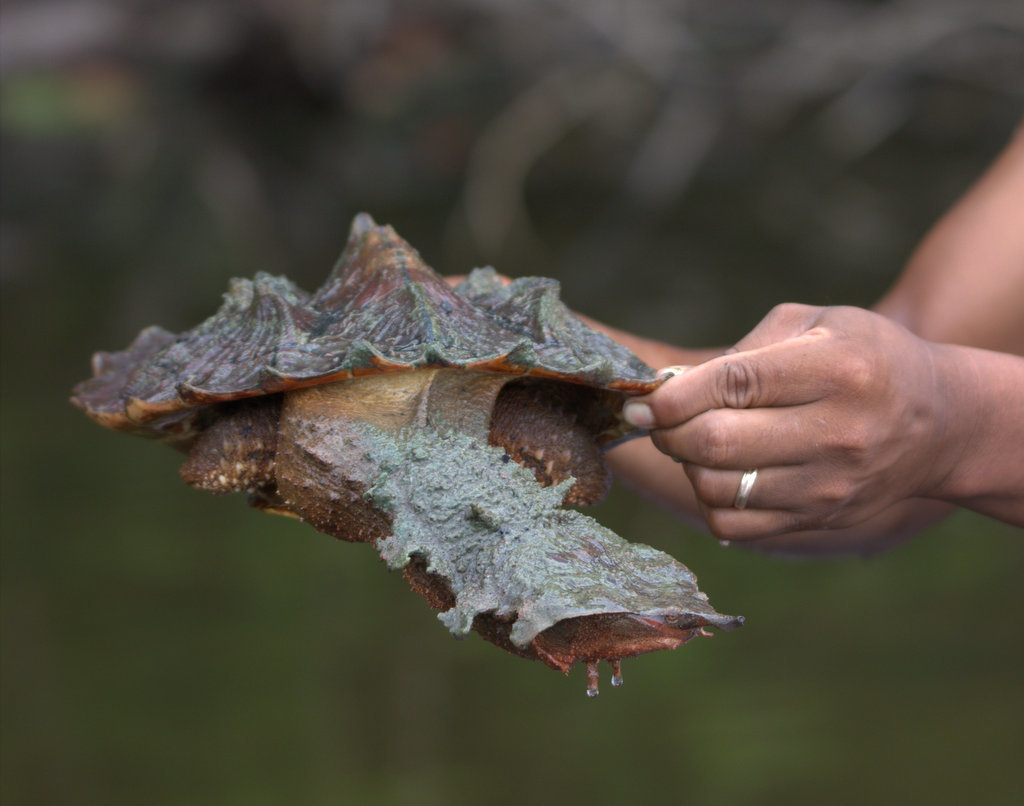
They're very charismatic little reptiles with wedge-shaped heads, wide mouths, tiny eyes, bark-like knobby shells often coated in algae, and tubercles and skin flaps all over the head and neck.


mata mata turtle inaturalist observation ccA mata mata turtle found in Guyana in 2015. (bruceebennett/iNaturalist/CC BY-NC 2.0)


These characteristics aid the turtle's peculiar hunting strategy. They lurk at the bottom of a body of water, neatly camouflaged, waiting for fish to swim a bit too close. Then, the head snaps out, and that large mouth opens wide, sucking the prey in like a vacuum.


But the mata mata turtles from the Amazon Basin and the drainage region of the Mahury River have some colour variations on the skin and shell, as well as some morphological differences from the mata mata turtles of the Orinoco and Río Negro basins.


So, the researchers collected 75 DNA samples from mata mata turtles across the entire distribution range, and ran them through mitochondrial analyses. They also conducted a survey of the turtles' morphological characteristics, and compared it to their DNA findings.


Not only did the DNA results show two distinct lineages, these matched up with the morphological differences.


The old species, Chelus fimbriata, lives in the Amazon and Mahury regions. It has a dark underside, and a more rectangular shell.


The new species has been named C. orinocensis, and it inhabits the Orinoco and Río Negro basins. The underside of its shell is unpigmented, and the overall shape of the shell is more oval.


According to the team's analysis, the two species started to diverge about 12.7 million years ago, during the late Miocene. This was around the same time that the combined Amazon-Orinoco Basin split into two.


As well as revealing a previously unknown diversity in this turtle species, the finding has implications for conservation. Previously, the mata mata turtle population was considered homogeneous, widespread and healthy. Now, we have to rethink that.


"To date, this species was not considered endangered, based on its widespread distribution. However, our results show that, due to the split into two species, the population size of each species is smaller than previously assumed," said biologist Mario Vargas-Ramírez, formerly at Senckenberg and now at the National University of Colombia.


"In addition, every year, thousands of these bizarre-looking animals end up in the illegal animal trade and are confiscated by the authorities. We must protect these fascinating animals before it is too late."


The research has been published in Molecular Phylogenetics and Evolution.


#Nature | https://sciencespies.com/nature/look-at-the-adorable-derpy-face-of-this-newly-discovered-mata-mata-turtle/

Small Business Administration rule disqualifies many space startups from coronavirus relief loans

The Commercial Spaceflight Federation and the SmallSat Alliance have asked the SBA to change how it defines a small business.


WASHINGTON — Industry groups representing space and other technology sectors are asking the U.S. government to change rules that make many startups ineligible to receive Small Business Administration loans to help pay workers during the coronavirus crisis.


The issue was raised in an April 29 letter sent to Treasury Secretary Steven Mnuchin, Office of Management and Budget acting director Russell Vought and the head of the Small Business Administration Jovita Carranza.


The letter was signed by two space industry groups — the Commercial Spaceflight Federation and the SmallSat Alliance — along with the App Association, Dcode and Financial Executives International.


The groups claim that hundreds of U.S. startups have been disqualified from loan programs — created under the Coronavirus Aid, Relief, and Economic Security (CARES) Act and the Paycheck Protection Program — because of the way the SBA defines “small business.”


Many startups are funded by venture capital firms that typically invest in a portfolio of companies. To be eligible for the SBA loan program a business has to have fewer than 500 employees. When defining a small business, the SBA applies an “affiliation rule,” requiring companies to include in their worker count all the employees of companies with which they are “affiliated.”


That rule requires venture-backed startups to aggregate the employees of all the unrelated companies in which their investors have equity positions, pushing many beyond the 500-employee threshold.


According to the industry groups, 98 percent of U.S. startups have fewer than 100 employees.


The letter warns that until the SBA issues a waiver to the “affiliation rule,” thousands of workers nationwide will be laid off from startups. “Many of these companies support elements of our nation’s critical infrastructure and need to be protected.”


An industry source said the April 29 letter from the five trade groups follows several other letters sent by congressional leaders to the SBA and to Treasury over the past month on the same issue.


#Space | https://sciencespies.com/space/small-business-administration-rule-disqualifies-many-space-startups-from-coronavirus-relief-loans/

This Hungarian village welcomed skull-shaping immigrants as the Roman Empire crumbled

As the Roman Empire drew to a dramatic collapse towards the end of the 5th century, ripples were felt across its former territories. Balances shifted as new powers rushed to fill the vacuums Rome's retreats left behind.


The changes to the everyday lives of the people are far less well documented, but a cemetery in Pannonia Valeria - in what is now Hungary - is shedding light on the cultural upheaval. And it seems that the founders of that community welcomed newcomers - and even adopted their customs, including modifying the shape of their skulls.


During this time, "the population decreased and the settlement structure changed drastically. Communities fled to the western provinces with the promise of safety, while others sought refuge in forts and cities looking for protection," the researchers wrote in their paper.


"The newly arriving groups also founded rural settlements often in connection to the former Roman infrastructure, such as roads and fortified places."


Until around 470 CE, a site now called Mözs-Icsei dűlő was the burial ground of just such a settlement. Its 96 graves have been well documented, with work going back decades.


But archaeologists in Germany and Hungary have now closely examined the remains of 87 individuals, analysing the strontium isotopes in the bones to figure out how the community came together.


That's because some stable isotopes - like strontium - are taken up by plants from the soil. When humans eat these plants, the isotopes can replace some of the calcium in teeth and bones, which can then be dated and matched to geological regions known to have particular isotope ratios.


Using this technique, the team was able to identify three distinct populations across two or three generations buried in the Mözs-Icsei dűlő cemetery.


The first population is a small founder population. They were buried in Roman-style brick graves, with Roman and Hun style grave goods, and the strontium isotope ratios in their bones indicated a largely local diet.


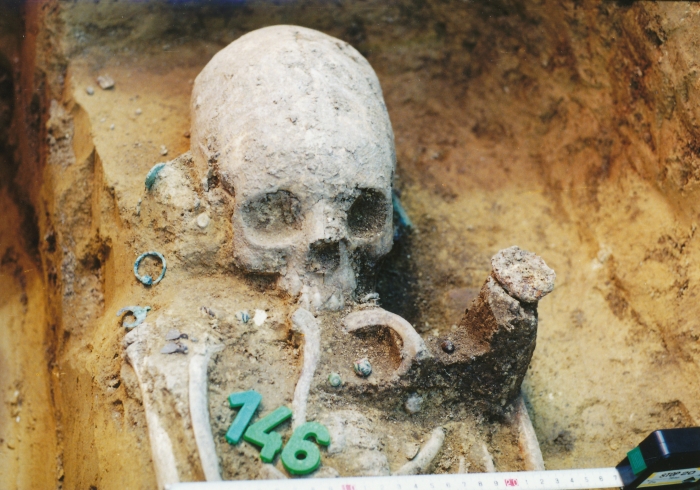
The second is a foreign group of 12 individuals who seem to have arrived at the community around a decade after the founders. They all had similar strontium isotope ratios, indicating that they had a shared origin. Ten of them also had modified skulls, suggesting they practised head shaping - the use of tight cloth bindings in infancy to elongate the still-hardening skull.


We still don't know why ancient cultures practised cranial modification. Although it's dying out today, it's an ancient practice, and there's evidence for it dating back thousands of years all around the world - and, interestingly, it seems to have no effect on cognitive function.


The third, slightly later group suggests that the customs of both earlier populations seem to blend together in the following generation. Not only were there founder-style grave goods included in later burials, head shaping seems to have exploded in popularity.


burial(Wosinsky Mór Museum, Szekszárd, Hungary)


In all, the 96 graves contained 51 individuals with deliberately modified skulls, marking the site as one of the biggest concentrations of artificial cranial deformation in the region.


As we have previously reported, reasons for the practice seem varied globally throughout history - from a marker of social status, to a side-effect of binding a baby's soft head to protect it while it grows. Or maybe some people just thought it looked really cool.


Whatever the reasons for it, the practice here is a beautiful example of how a community can grow and thrive under regional strife, joining their differences to build something new together.


"The community .. accepted and integrated men, women, and children of different geographical and cultural backgrounds during the two to three generations of its existence. The isotope data indicate that residential changes played a remarkable role and occurred not only on an individual basis, but also in groups of a shared cultural background and lifestyle," the researchers wrote in their paper.


"Placed into the historical narrative, this could be understood as the emergence of a Roman-'Barbarian' Mischkultur (mixed culture), in which Romanised 'Barbarians' and 'barbarised' late Roman population groups were indistinguishable."


The research has been published in PLOS One.


#Humans | https://sciencespies.com/humans/this-hungarian-village-welcomed-skull-shaping-immigrants-as-the-roman-empire-crumbled/