Featured Post

Tracking air pollution disparities -- daily -- from space

Studies have shown that pollution, whether from factories or traffic-snarled roads, disproportionately affects communities where economicall...

Wednesday, April 29, 2020

A piece of the moon for sale: just $2.5 million

LONDON (Reuters) - One of the world’s largest lunar meteorites goes on private sale at Christie’s on Thursday, valued at 2 million pounds ($2.49 million).


The moon rock, weighing over 13.5 kg, was probably struck off the surface of the moon by a collision with an asteroid or comet and then showered down on the Sahara desert.


Known as NWA 12691, it is thought to be the fifth largest piece of the moon ever found on earth. There is just 650 kg of moon rock known to be on earth.


“The experience of holding a piece of another world in your hands is something you never forget,” said James Hyslop, Christie’s head of science and natural history.


“It is an actual piece of the moon. It is about the size of a football, a bit more oblong than that, larger than your head.”


Like many meteorites that are discovered, it was found in the Sahara by an anonymous finder after travelling some 240,000 miles to earth from the moon. It then changed hands and was carefully studied.


Scientists can be certain of its origin after comparing it with rock samples brought back by the United States’ Apollo space missions to the moon.


“In the 1960s and 1970s the Apollo programme brought back about 400 kilograms of moon rock with them and scientists have been able to analyse the chemical and isotopic compositions of those rocks and they have determined that they match certain meteorites,” said Hyslop.


Meteorites are incredibly rare and only about one in a thousand comes from the moon, making this a very special object, he added.


Slideshow (7 Images)


“We are expecting huge international interest in it from natural history museums... it is a wonderful trophy for anyone who is interested in  space history or lunar exploration.”


The moon has fascinated man since the dawn of human history as a symbol of power, love, time and prosperity, and is the earth’s only natural satellite. It is thought to have been formed 4.5 billion years ago when a Mars-sized body collided with earth.


Christie’s will also offer for private sale a group of 13 aesthetic iron meteorites. That collection is estimated to be worth 1.4 million pounds.


Reporting by Guy Faulconbridge, Mike Davidson and Sarah Mills; Editing by Alexandra Hudson


#News | https://sciencespies.com/news/a-piece-of-the-moon-for-sale-just-2-5-million/

Guiana Space Center to reopen May 11

MT LAUREL, New Jersey — Europe’s spaceport will resume launch activity May 11 when France lifts a nation-wide lockdown that included the Guiana Space Center. 


Located in the South American territory of French Guiana, the spaceport has been closed since March 16 in an effort to slow the spread of COVID-19, the disease caused by the coronavirus. 


The French space agency CNES said April 29 that launch activity and construction of the Ariane 6 launch pad were resuming with protective measures to prevent the spread of the coronavirus.


Those measures include “strict social distancing” before leaving mainland Europe, medical screenings for people flying into French Guiana’s Cayenne airport, and a 14-day quarantine in Kourou, French Guiana, after landing. 


CNES said 100 people will travel from Europe to the Guiana Space Center on May 11, and will start preparations May 25 for a Vega rocket launch previously scheduled for March. 


In an interview, CNES President Jean-Yves Le Gall said the spaceport’s first missions would be the Vega launch in June followed by an Ariane 5 launch in July. 


“We should be back to routine operations one month from now,” Le Gall said. 


European launch provider Arianespace had 14 missions planned from the Guiana Space Center this year, two of which were completed prior to the spaceport’s closure.


The March bankruptcy of Arianespace-customer OneWeb left eight Soyuz launches in limbo, but only two of those would have launched from the Guiana Space Center. The other six were to launch from Russia and Kazakhstan. Le Gall said the Guiana Space Center should be able to accommodate all eight of Arianespace’s other 2020 missions without issue, despite the coronavirus delay. 


“We had some margins between the launches, so if everything is going well we will probably complete the launch program as it was planned early this year,” he said. 


Le Gall said launches at the Guiana Space Center shouldn’t require more time than in the past because of the coronavirus, but cautioned it will take time to know that fully. 


Spaceport personnel will be required to wear face masks while working, he said. Masks, spacing out workers and other safety steps should enable CNES to keep the spaceport running without a second interruption, he said. 


Le Gall said the coronavirus has had a limited impact on completing the Ariane 6 launch pad, known as ELA4, because some of that work resumed April 21 with local staff. Launch pad work will return to normal after more people arrive in May, he said. 


Le Gall said ELA4 should be completed in the second half of 2020. The biggest difference between ELA4 and the Ariane 5 launch pad is the introduction of a mobile gantry that will allow access to Ariane 6 up to the final minutes before liftoff, Le Gall said. 


#Space | https://sciencespies.com/space/guiana-space-center-to-reopen-may-11/

Becoming a parent makes you 25% less environmentally friendly, new research finds


It's not unusual for parents to worry about the next generation and the future planet they'll inherit, but new research suggests having children doesn't necessarily make you any 'greener' as a person - quite the opposite, in fact.


A new study in Sweden has found that even those who really care about the environment often end up having their deck of priorities re-shuffled by the realities of parenthood.


After all, there's only so much time and energy available in a single day, and children have a way of sapping up a lot of those limited resources.


Comparing adult parents to adult non-parents in Sweden, researchers found households made up of the former tend to emit more carbon dioxide from transportation, food, heating, and electricity.


Ultimately, the team found two-adult households with children were responsible for over 25 percent more carbon emissions than two-adult households without children.


"Our findings suggest that having children might increase CO2 emissions both by adding to the population and by increasing CO2 emissions from those choosing to have children," the authors write.


While adding another human to the planet in this day and age will inevitably increase carbon emissions, especially in wealthier nations, by how much exactly is still up for debate, and currently, only a small fraction of adults choose not to have children because of environmental reasons.


This means there are many parents out there who consider themselves quite 'green' and who list the environment as a top priority, even though their behaviour isn't quite matching up.


"Becoming a parent can transform a person – he or she thinks more about the future and worries about future risks imposed on their children and progeny," explains economist Jason Shogren from the University of Wyoming (UW). 


"But, while having children might be transformational, our results suggest that parents' concerns about climate change do not cause them to be 'greener' than non-parent adults."


This is one of the first rigorous studies on whether parents behave 'greener' than other adults. But it's still an open question, and the current findings will need to be verified in other nations and in larger sample sizes.


Previous research has provided mixed evidence on whether parenthood changes environmental attitudes, preferences, and behaviours, but the new study reevaluates the subject with a unique dataset, including an impressive 4,000 Swedish households.


Across all major household expenditures, the findings reveal a "substantial gap" in carbon emissions between parents and non-parents, especially in regards to transportation and food.


The results might be surprising, given how accepted climate change is in Sweden – the nation has a sizeable carbon tax that many people are happy to pay – but it's a good reminder that even with the best of intentions, parents can sometimes overlook the bigger impact of their actions for more immediate concerns.


This isn't to say it's entirely their fault, either. It may simply be about time and energy, although this is currently just one theory.


Reports on time usage in Swedish households reveal that out of all people, parents with small children have the least leisure time, and that's true even in a nation with generous parental leave. That could be making a big difference.


Carbon-intensive goods are usually convenient and cheap, the authors explain, which makes them particularly tempting to parents. When you're juggling the demands of a family, driving to the grocery store might be simpler than taking public transport or biking. Whereas pre-prepared food containing red meat might be convenient, and in some cases even cheaper.


Figuring out what's driving this emissions gap between adults is essential. The world isn't about to stop having children, so policies that alleviate some of the stress parents with young children are facing could allow families the time and money to better reduce their carbon footprint in the future.


For instance, if food really is an environmental issue in these households, then perhaps government subsidies for meat substitutes will go a longer way towards reducing emissions. Just as government policies for breastfeeding may reduce our reliance on formula milk, which produces a shocking amount of carbon emissions.


Still, there are other explanations, other than time and convenience. It may be stemming from the children themselves.


"Altruistic parents' consumption may also be impacted by the child's immediate preferences for carbon-intense consumption, such as a taste for red meat, flights to family-friendly resorts, and so on," the authors write.


"Children may of course also be concerned about the environment, which in turn may affect household consumption. Even though children in the Nordic countries have been found to be more environmentally concerned than their parents, there is a substantial gap between their attitudes and actions."


While the research took place in just one country, the authors think their findings are relevant to many other nations around the world.


"If we're finding these results in Sweden, it's pretty safe to assume that the disparity in carbon footprints between parents and non-parents is even bigger in most other Western countries," argues UW economist Linda Thunstrom.


The study was published in PLOS ONE.


#Humans | https://sciencespies.com/humans/becoming-a-parent-makes-you-25-less-environmentally-friendly-new-research-finds/

New tests suggest a fundamental constant of physics isn't the same across the Universe


Scientists have found evidence that a fundamental physical constant used to measure electromagnetism between charged particles can in fact be rather inconstant, according to measurements taken from a quasar some 13 billion light-years away.


Electromagnetism is one of the four fundamental forces that knit everything in our Universe together, alongside gravity, weak nuclear force, and strong nuclear force. The strength of electromagnetic interaction between elementary particles is calculated with the help of what's known as the fine-structure constant.


However, the new readings – taken together with other readings from separate studies – point to tiny variations in this constant, which could have huge implications for how we understand everything around us.


The latest data also show the Universe may have previously hidden 'north' and 'south' bearings, a definitive direction upon which these variations in electromagnetism can be mapped.


"[The new study] seems to be supporting this idea that there could be a directionality in the Universe, which is very weird indeed," says astrophysicist John Webb, from the University of New South Wales (UNSW) in Australia. "So the Universe may not be isotropic in its laws of physics – one that is the same, statistically, in all directions."


"But in fact, there could be some direction or preferred direction in the Universe where the laws of physics change, but not in the perpendicular direction. In other words, the Universe in some sense, has a dipole structure to it."


The electromagnetic force that surrounds us has a crucial role in tying electrons to nuclei inside atoms – without it, matter would simply disintegrate. It provides us with visible light, and is the main reason electricity works as it does.


Using images and data captured by the Very Large Telescope (VLT) in Chile, the research team was able to measure this force as it would've appeared in the Universe when it was much younger and closer to its beginnings.


The data require further testing and verification, but the team says that the current results raise a curious question: whether the idea of there being a 'Goldilocks' balance of fundamental forces – just perfect for life to be able to exist – actually applies throughout our Universe.


"Putting all the data together, electromagnetism seems to gradually increase the further we look, while towards the opposite direction, it gradually decreases," says Webb.


"In other directions in the cosmos, the fine structure constant remains just that – constant. These new very distant measurements have pushed our observations further than has ever been reached before."


That idea of directionality in the Universe has been backed by researchers working independently in the US, who have been busy looking at the nature of X-rays. They've also found a cosmic alignment that happens to point in the same way as the one the UNSW team has discovered.


As for what this means for physics on a broader scale, it's too early to say. The findings are absolutely worth further research at least, and mean the Grand Unified Theory - the search for one unifying force that can tie electromagnetism, weak and strong nuclear forces together - may even have to be shelved for a while.


Indeed, research published last year suggests there might be a fifth fundamental force to take into consideration. The further we look out into the Universe and the more we discover, the more complex and strange everything seems to get.


"Our standard model of cosmology is based on an isotropic universe, one that is the same, statistically, in all directions," says Webb. "That standard model itself is built upon Einstein's theory of gravity, which itself explicitly assumes constancy of the laws of nature."


"If such fundamental principles turn out to be only good approximations, the doors are open to some very exciting, new ideas in physics."


The research has been published in Science Advances.


#Physics | https://sciencespies.com/physics/new-tests-suggest-a-fundamental-constant-of-physics-isnt-the-same-across-the-universe/

Smallsat launch delays prompt push for greater standardization

WASHINGTON — A study that found that every small satellite launched commercially in the last five years suffered delays is evidence of the need of greater standardization in payload accommodations so that smallsats can easily switch vehicles, one company argues.


The study, conducted by Bryce Space and Technology and released April 22, found that all 1,078 smallsats — defined as weighing less than 600 kilograms — launched commercially in the last five years suffered delays ranging from days to years for a variety of reasons.


The median launch delay for the smallsats included in the study is 128 days. A little more than 150 smallsats had delays of no more than two weeks, but a similar number suffered delays of at least one and a half years.


The fact that so many smallsats have suffered launch delays is not surprising. “We’ve always known anecdotally that launch moves to the right,” said Grant Bonin, vice president of business development at Spaceflight, which arranges launches of smallsats on a variety of rockets, in an April 28 interview. “What we hadn’t really done yet is attempt to quantify just how likely delays are.”


Spaceflight commissioned the Bryce study to both quantify the delays and identify their causes. “I think some of that data was eye-opening as well, because it reflects a different distribution of launch delay causes than what a lot of people might assume,” he said.


The survey found that 40% of delays were due to payloads, including those of the primary payload on launches where smallsats were flying as secondary payloads. Issues related to launch vehicles accounted for 34% of delays, but most of those were caused by launch vehicle development and manufacturing delays, rather that delays caused by vehicle anomalies. Most of the rest of the delays were due to administrative or programmatic issues, or changes in the International Space Station manifest for those smallsats being launched from the station.


Whatever the reason, delays can cause serious problems for many of Spaceflight’s customers. “The facts of life have always been that launches are delayed, and that can be extremely punishing on businesses who need satellites in space,” Bonin said. “A day of slip in launch is a day they’re not making money off the asset because it’s not in space.”


He argued that the fact that many delays are caused by primary payload or launch vehicles issues underscores the importance of having more standardized approaches to accommodating smallsats, so that they can be easily remanifested from one launch vehicle to another. “That’s something we can do months before launch, but we’re committed to the idea, with standardization, of decreasing that time significantly, to a matter of weeks,” he said.


Such standardization already exists for cubesats, most of which use deployers that can be easily moved from one launch vehicle to another. Spaceflight wants to try to extend standardization to larger smallsats. “Locking in the electrical interfaces, standardizing the mechanical interfaces, and standardizing how a spacecraft needs to be processed is really key,” he said.


One reason for delays that emerged since the Bryce report is linked to the ongoing coronavirus pandemic. Bonin said that several launch providers it works with, including Arianespace, the Indian Space Research Organisation and Rocket Lab, are encountering delays because of lockdowns that have halted launch activities.


It’s not clear when those launches will resume, although the New Zealand government backed down from its highest coronavirus alert level this week, allowing some increased business activity. He predicted a surge in launch activity once those providers can resume launches and address their backlog.


Demand for future launches, though, may be depressed. “With the customer base right now, we’re seeing a lot of people taking a deep breath and putting themselves on pause,” he said. Startups in particular are concerned about access to capital needed to expand their businesses, including developing and launching satellites.


“I think a lot of companies are just stopping and saying to themselves, ‘Survival is victory, so we’re going to try to ride this out and extend our runway as much as possible,’” he said. There will remain demand from companies in the midst of satellite deployment plans, as well as government customers in the U.S. and elsewhere. “You might see a shift in our customer portfolio a little bit.”


There will also likely be a shakeout not only among customers but also launch providers, given the large number of companies working on small launch vehicles. “But overall, we are bullish and optimistic about the industry bouncing back in a strong way,” he concluded.


#Space | https://sciencespies.com/space/smallsat-launch-delays-prompt-push-for-greater-standardization/

Palaeontologists think they have found 'the most dangerous place' in Earth's history

A long-known but under-studied deposit of Cretaceous rock on the edge of the Sahara desert was more than just an ancient stomping ground for dinosaurs, according to a comprehensive new paper.


The Kem Kem Group in eastern Morocco might also represent a prime candidate for the most dangerous time and place to have been alive in Earth's prehistoric past, based on its fearsome preponderance of large-bodied carnivores, as evidenced in the fossil record.


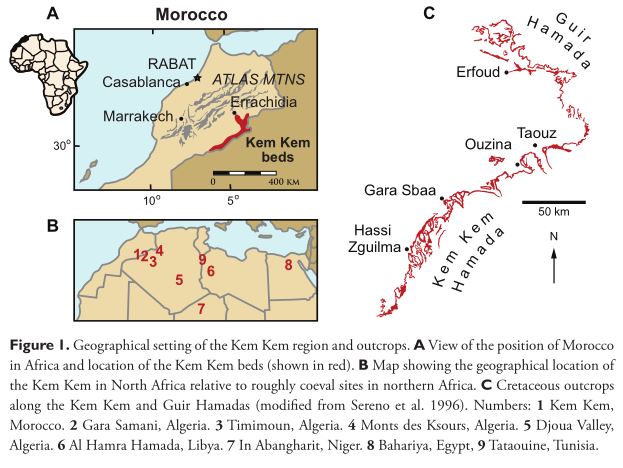
geographical setting of kem kem group(Ibrahim et al., ZooKeys, 2020)


That prevalence – in contrast to the relative scarcity of herbivore remains – constitutes a bias towards giant flesh-eaters that can't be found in any comparable modern terrestrial ecosystem, researchers say.


"This was arguably the most dangerous place in the history of planet Earth, a place where a human time-traveller would not last very long," says palaeontologist Nizar Ibrahim from the University of Detroit Mercy.


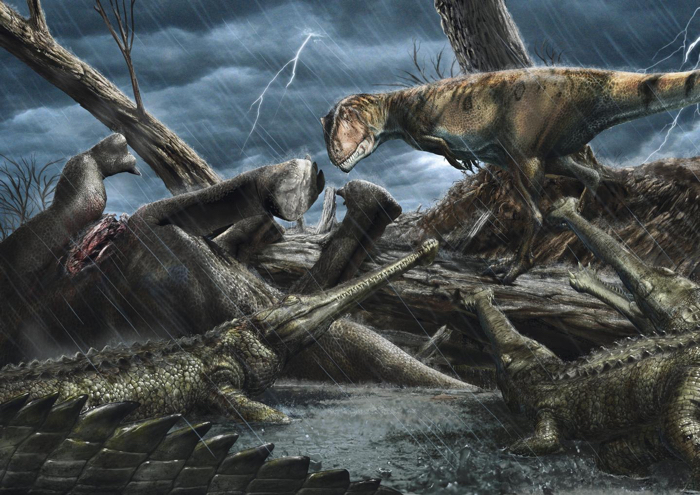
010 kem kem group 4A Carcharodontosaurus eyes a group of crocodile-like hunters called Elosuchus. (Davide Bonadonna)


In a new study, Ibrahim and his team reviewed the abundance of fossil evidence sourced from what has previously been termed the 'Kem Kem beds' – a fossil-rich deposit of ancient strata situated near the Moroccan-Algerian border and dating back to the Late Cretaceous period.


The site's existence has long been known, and not only to palaeontologists, but also to commercial fossil hunters, meaning the plundered remains of many of these ancient dinosaurs, reptiles, and other creatures are now scattered far and wide across the globe in private collections.


That distribution of isolated fossils means we've been missing out on a consolidated overview of what the Kem Kem Group's fossil haul truly represents; something Ibrahim and fellow researchers have attempted to rectify with their new analysis, which involved visits being made to collections held on several continents.


"This is the most comprehensive piece of work on fossil vertebrates from the Sahara in almost a century, since the famous German palaeontologist Ernst Freiherr Stromer von Reichenbach published his last major work in 1936," explains one of the team, palaeobiologist David Martill from the University of Portsmouth in the UK.


The review provides "a window into Africa's age of dinosaurs", Ibrahim says, and suggests the Kem Kem Group actually encompasses two distinct fossil-rich sites, called the lower Gara Sbaa and upper Douira formations.


Both formations exhibit a range of dinosaurs and pterosaurs, in addition to ancient crocodyliforms, turtles, fish remains, plus various invertebrate, plant, and trace fossils.


010 kem kem group 4The fish-eating, sail-backed Spinosaurus. (Davide Bonadonna)


Perhaps the most remarkable feature of the Kem Kem palaeoecosystem is what has since become known as 'Stromer's riddle': the overabundance of predatory versus herbivorous dinosaurs, seen in both the Kem Kem Group, and also the Bahariya Formation of Egypt.


With regard to the Kem Kem Group, this is indicated by the presence of four different kinds of theropods (an abelisaurid, Spinosaurus aegyptiacus, Carcharodontosaurus saharicus, and Deltadromeus agilis), whereas in most Mesozoic formations like this, only one or two large-bodied predators like this would be found, the researchers say.


But there is more that sets Kem Kem apart, the team found.


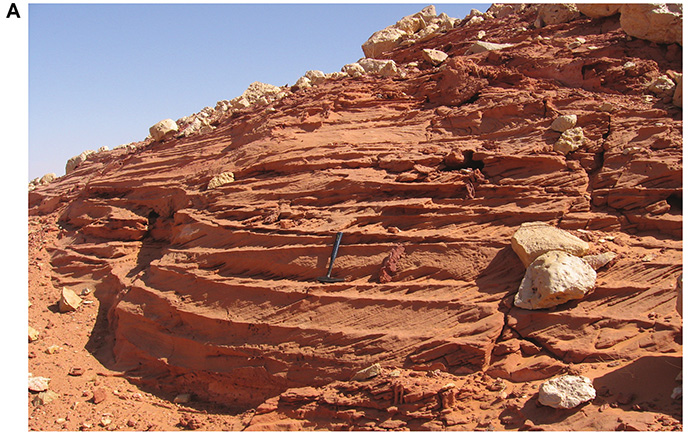
Tabular cross-bedding in the Gara Sbaa FormationTabular cross-bedding in the Gara Sbaa formation. (Ibrahim et al., ZooKeys, 2020)


"In addition to the overabundance of large-bodied dinosaurian predators," the authors write, "at least three of the four large-bodied predators present in both the Kem Kem and Bahariya assemblages are among the largest (top 10 percent) dinosaurian predators on record."


At the same time, large-bodied herbivores are neither diverse nor abundant in the fossil record, the team says, although they likely did dwell alongside the large meat-eaters, but are "not as diverse as in many other Cretaceous formations nor particularly common as fossils".


010 kem kem group 4(University of Detroit Mercy)


Nonetheless, there was plenty else to eat. At the time these dinosaurs roamed, roughly 100 million years ago (but dating up to 115 million years back for some of the fossils), the area was the headland of a vast river system, and a bountiful supply of fish and other marine animals would have easily sustained the theropod population.


"This place was filled with absolutely enormous fish, including giant coelacanths and lungfish," Martill says.


"There is an enormous freshwater saw shark called Onchopristis with the most fearsome of rostral teeth, they are like barbed daggers, but beautifully shiny."


The findings are reported in ZooKeys.


#Nature | https://sciencespies.com/nature/palaeontologists-think-they-have-found-the-most-dangerous-place-in-earths-history/

Tuesday, April 28, 2020

Creator of Wolfram Alpha has a bold plan to find a new fundamental theory of physics

Stephen Wolfram is a cult figure in programming and mathematics. He is the brains behind Wolfram Alpha, a website that tries to answer questions by using algorithms to sift through a massive database of information. He is also responsible for Mathematica, a computer system used by scientists the world over.


Last week, Wolfram launched a new venture: the Wolfram Physics Project, an ambitious attempt to develop a new physics of our Universe.


The new physics, he declares, is computational. The guiding idea is that everything can be boiled down to the application of simple rules to fundamental building blocks.


What's the point of the 'new physics'?


Why do we need such a theory? After all, we already have two extraordinarily successful physical theories.


These are general relativity – a theory of gravity and the large-scale structure of the Universe – and quantum mechanics – a theory of the basic constituents of matter, sub-atomic particles, and their interactions. Haven't we got physics licked?


Not quite. While we have an excellent theory of how gravity works for large objects, such as stars and planets and even people, we don't understand gravity at extremely high energies or for extremely small things.


General relativity "breaks down" when we try to extend it into the miniature realm where quantum mechanics rules. This has led to a quest for the holy grail of physics: a theory of quantum gravity, which would combine what we know from general relativity with what we know from quantum mechanics to produce an entirely new physical theory.


The current best approach we have to quantum gravity is string theory. This theory has been a work in progress for 50 years or so, and while it has achieved some success there is a growing dissatisfaction with it as an approach.


How is Wolfram's approach different?


Wolfram is attempting to provide an alternative to string theory. He does so via a branch of mathematics called graph theory, which studies groups of points or nodes connected by lines or edges.


Think of a social networking platform. Start with one person: Betty. Next, add a simple rule: every person adds three friends. Apply the rule to Betty: now she has three friends. Apply the rule again to every person (including the one you started with, namely: Betty). Keep applying the rule and, pretty soon, the network of friends forms a complex graph.


Dots connected by lines in networks.A simple rule multiple times creates a complex network of points and connections. (Author provided)


Wolfram's proposal is that the universe can be modelled in much the same way. The goal of physics, he suggests, is to work out the rules that the universal graph obeys.


Key to his suggestion is that a suitably complicated graph looks like a geometry. For instance, imagine a cube and a graph that resembles it.


A shaded cube and a line drawing of one. (Author provided)


Above: In the same way that a collection of points and lines can approximate a solid cube, Wolfram argues that space itself may be a mesh that knits together a series of nodes.


Wolfram argues that extremely complex graphs resemble surfaces and volumes: add enough nodes and connect them with enough lines and you form a kind of mesh. He maintains that space itself can be thought of as a mesh that knits together a series of nodes in this fashion.


What does this have to do with physics?


How can complicated meshes of nodes help with the project of reconciling general relativity and quantum mechanics? Well, quantum theory deals with discrete objects with discrete properties. General relativity, on the other hand, treats the universe as a continuum and gravity as a continuous force.


If we can build a theory that can do what general relativity does but that starts from discrete structures like graphs, then the prospects for reconciling general relativity and quantum mechanics start to look more promising.


If we can build a geometry that resembles the one given to us by general relativity using a discrete structure, then the prospects look even better.


Complex diagrams depicting graphing of space.Space may be a complex mesh of points connected by a simple rule that is iterated many times. (Wolfram Physics Project)


So is it time to get excited?


While Wolfram's project is promising, it does contain more than a hint of hubris. Wolfram is going up against the Einsteins and Hawkings of the world, and he's doing it without a life spent publishing in physics journals.


(He did publish several physics papers as a teenage prodigy, but that was 40 years ago, as well as a book A New Kind of Science, which is the spiritual predecessor of the Wolfram Physics Project.)


Moreover, his approach is not wholly original. It is similar to two existing approaches to quantum gravity: causal set theory and loop quantum gravity, neither of which get much of a mention in Wolfram's grand designs.


Nonetheless, the project is notable for three reasons.


First, Wolfram has a broad audience and he will do a lot to popularise the approach that he advocates. Proponents of loop quantum gravity in particular lament the predominance of string theory within the physics community. Wolfram may help to underwrite a paradigm shift in physics.


Second, Wolfram provides a very careful overview of the project from the basic principles of graph theory up to general relativity. This will make it easier for individuals to get up to speed with the general approach and potentially make contributions of their own.


Third, the project is "open source", inviting contributions from citizen scientists.


If nothing else, this gives us all something to do at the moment – in between baking sourdough and playing Animal Crossing, that is. The Conversation


Sam Baron, Associate professor, Australian Catholic University.


This article is republished from The Conversation under a Creative Commons license. Read the original article.


#Physics | https://sciencespies.com/physics/creator-of-wolfram-alpha-has-a-bold-plan-to-find-a-new-fundamental-theory-of-physics/