Featured Post

Tracking air pollution disparities -- daily -- from space

Studies have shown that pollution, whether from factories or traffic-snarled roads, disproportionately affects communities where economicall...

Thursday, October 31, 2019

Air Force claims accomplishments in Space C2 program in wake of critical report

The Air Force has submitted an acquisition strategy for the Space C2 program which is now being reviewed by the Pentagon


WASHINGTON — Following the release of a critical congressional report on the Space Command and Control program, the Air Force says it has been working with the Pentagon to address the concerns raised by the Government Accountability Office.


GAO in an Oct. 30 report criticized the program known as Space C2 for lacking an acquisition strategy and called for greater Pentagon oversight. The Air Force launched the program just over a year ago to replace the long-troubled Joint Space Operations Center Mission System, or JMS.


Col. Jennifer Krolikowski, senior materiel leader for Space C2 at the Air Force Space and Missile Systems Center, told SpaceNews Oct. 31 that she did not disagree with the GAO assessment but insisted that the Air Force already has moved to fix the problems highlighted in the report.


Under the Space C2 program, the Air Force is developing software applications used by military commanders and analysts to monitor and understand what is happening in space. JMS failed because it was managed like a traditional monolithic DoD software development program, and was chronically late and over budget. Space C2 uses commercial agile software development methods where engineers make rapid changes, ask for user feedback and adjust the software for the next increment.


Krolikowski, who has been in charge of Space C2 since August 2018, said new software applications are being delivered every few months to commanders and analysts at military space command centers at Schriever Air Force Base, Colorado, and at Vandenberg Air Force Base, California.


She said GAO had no issues with the actual software or the agile development methods but questioned the lack of a formal acquisition strategy, which is required for every DoD program.


“We have an acquisition strategy already written and in coordination with the Air Force and the Office of the Secretary of Defense,” Krolikowski said. Air Force officials will be meeting Nov. 26 with Undersecretary of Defense for Acquisition and Sustainment Ellen Lord to discuss the strategy, she said.


Lord has been a proponent of agile software development and had led a DoD-wide review of software acquisition practices. “My program is a pathfinder for them to help other programs and identify problems,” said Krolikowski.


An acquisition strategy lays out procedures for contracting, testing and setting program requirements. Although agile software development has been commonplace in the private sector for years, it is a relatively new practice in DoD. The acquisition strategy for Space C2 has to explain how those practices will be implemented.


Krolikowski highlighted some new products delivered by Space C2:


• A High-Interest Event Tracker that allows operators to monitor, track, and display information regarding potential satellite conjunctions, space launches, satellite de-orbits, re-entries, and other high interest space events. The tracker was be pursued by JMS but it was too complex and had hardly any users. Krolikowski said that after the release of the new version, 600 users signed up.


• A Radio Frequency Deconfliction tool that provides a consolidated workflow that reduces the time it takes to process radio frequency deconfliction requests.


• A software tool for intelligence analysts that helps them manage data collection taskings for ground based radars and other sensors. Krolikowski called this a “dynamic sensor planning tool” designed to produce better intelligence about the space environment.


#Space | https://sciencespies.com/space/air-force-claims-accomplishments-in-space-c2-program-in-wake-of-critical-report/

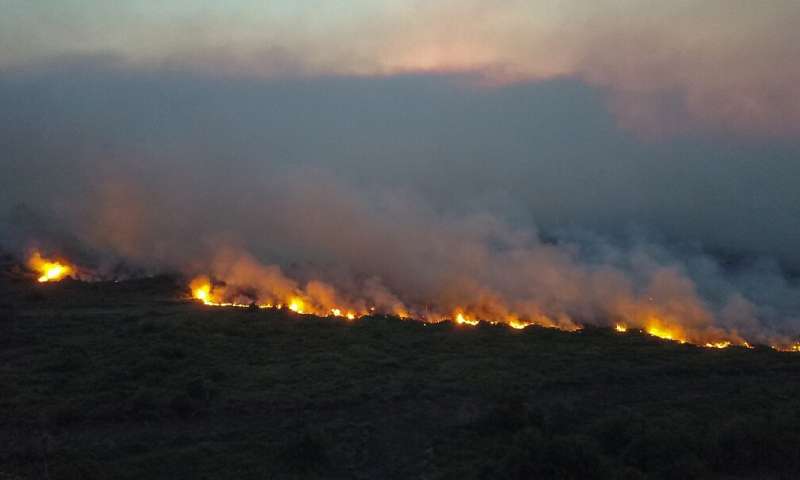
Massive wildfires hit southern Brazil's Pantanal


Fires have ravaged the Pantanal marshland area in Brazil's Mato Grosso do Sul state

Fires have ravaged the Pantanal marshland area in Brazil's Mato Grosso do Sul state
More

Wildfires are raging across the Pantanal tropical wetlands in southern Brazil, one of the most biodiverse areas in the world and a major tourist destination, regional authorities said Thursday.


The governor's office in the state of Mato Grosso do Sul said the fires were "bigger than anything seen before" in the region.


So far, more than 50,000 hectares (nearly 125,000 acres) have been affected.


The blazes follow other wildfires that say ravaged millions of hectares in the Amazon rainforest in August.


The statement from the governor's office said the situation was "critical," with blazes ravaging three towns in the Pantanal, a popular eco-tourism spot.


"Intense flames and reddish smoke have disrupted traffic" on the highways, the statement said.


The coordinator of the National Risk Management Center, Paulo Barbosa de Souza, said the blaze—fed by wind and dry vegetation—was causing "logistical difficulties."


Satellite images from the INPE space institute showed there were nearly 8,500 fires in the Pantanal area between January and October this year.


That was the worst record since 2007.


The fires were threatening three towns in Brazil's Pantanal

The fires were threatening three towns in Brazil's Pantanal
More


Explore further


As global leaders meet, the Amazon rainforest burns


© 2019 AFP


Citation:
Massive wildfires hit southern Brazil's Pantanal (2019, October 31)
retrieved 31 October 2019
from https://phys.org/news/2019-10-massive-wildfires-southern-brazil-pantanal.html


This document is subject to copyright. Apart from any fair dealing for the purpose of private study or research, no
part may be reproduced without the written permission. The content is provided for information purposes only.


#Environment | https://sciencespies.com/environment/massive-wildfires-hit-southern-brazils-pantanal/

Czech lab grows mustard plants for Mars


More

Scientists check plants inside of an aeroponic growing chamber system as an experiment called Marsonaut at Prague University of Life Sciences in Prague, Czech Republic, October 30, 2019. REUTERS/David W Cerny


PRAGUE (Reuters) - Czech scientists have opened a lab to experiment growing food for environments with extreme conditions and lack of water, such as Mars.


The “Marsonaut” experiment by scientist Jan Lukacevic, 29, and his team at the Prague University of Life Sciences is based on aeroponics - growing plants in the air, without soil, and limiting water use to a minimum.


The plants grow horizontally from a vertical unit and are stacked one above the other to minimize space. Researchers experiment with light and temperature changes, Lukacevic said.


The team has already succeeded in growing mustard plants, salad leaves, radishes and herbs like basil and mint.


Scientists ate their first harvest last week. 


“They taste wonderful, because they grow in a controlled environment and we supply them with bespoke nutrients,” said Lukacevic.


Strawberries are the next crop planned.


The main benefit of the growing method is that it uses 95 percent less water than normal plant cultivation and also saves space, which could boost agricultural yields in areas hit by urbanization and climate change.


Reporting by Jiri Skacel; Writing by Jan Lopatka; Editing by Alexandra Hudson and Dan Grebler


#News | https://sciencespies.com/news/czech-lab-grows-mustard-plants-for-mars/

Boeing and SpaceX preparing for commercial crew abort tests

WASHINGTON — Boeing and SpaceX are on schedule to perform two critical tests of their commercial crew vehicles in the next week with hopes that both vehicles will be ready to carry astronauts by early next year.


In an Oct. 30 presentation to the NASA Advisory Council’s Human Exploration and Operations committee, Kathy Lueders, manager of NASA’s commercial crew program, said that Boeing was still working towards a Nov. 4 pad abort test of its CST-100 Starliner spacecraft that the company announced three weeks earlier.


In that test, at the White Sands Missile Range (WSMR) in New Mexico, the Starliner will fire the abort engines in its service module to simulate escaping a launch vehicle on the pad. The Starliner will fly about 1.5 kilometers high, landing 1.5 kilometers downrange 90 seconds later.


“The vehicle is stacked up on the stand, getting ready to go,” Lueders said. “We, right now, are on the range at WSMR for next Monday morning to do this check-out. It’s a huge, huge test for us.”


Besides testing the abort motors themselves, she said key areas of interest for the test will be the separation of the Starliner’s crew module from its service module after the motors shut down, as well as the deployment of parachutes for the crew module.


The Starliner that will fly an uncrewed orbital test flight, called the Orbital Flight Test (OFT) by Boeing, doesn’t have an abort system, but Lueders said the pad abort test was critical for it nonetheless. “The way the system separates will reflect on our OFT progress,” she said. “It’s critical for us to get this test going, and that we understand it prior to us doing rollout of the spacecraft” for the orbital test flight.


That OFT mission is scheduled for launch Dec. 17 on a United Launch Alliance Atlas 5 from Cape Canaveral. That rollout of the Starliner from a Boeing facility at the Kennedy Space Center to a ULA processing center for integration onto the Atlas 5 will take place about a week after the pad abort test, she said.


The Boeing pad abort test will take place just days before SpaceX performs a static-fire test of the SuperDraco abort engines on its Crew Dragon spacecraft. Lueders said that test, in Florida, is expected to occur in the middle of next week.


An explosion took place during preparations for a similar static-fire abort test in April, destroying the Crew Dragon spacecraft that flew the Demo-1 uncrewed mission to the International Space Station in March and was being readied for an in-flight abort test planned for the summer. An investigation, still being wrapped up, implicated a leaky valve that allowed nitrogen tetroxide (NTO) oxidizer into part of the propulsion system, which, when pressurized, was hurled into a titanium check valve, igniting it.


“Having something like that happen is a big wakeup call for the team, that they have to be diligent and careful about this,” Lueders said, noting that even NASA wasn’t aware of the “compatibility issue” between NTO and titanium components at those conditions.


She added both NASA and SpaceX were fortunate the accident took place on the ground during a test with no one on board, and with access to video and other telemetry to aid the investigation. “It would have been a bad thing for us to have found out on orbit.”


If the static-fire test is successful, SpaceX will be ready to perform an in-flight abort test using that Crew Dragon spacecraft in early December. That test will involve the spacecraft, which was originally built for the Demo-2 crew test, escaping a Falcon 9 nearly 90 seconds after liftoff from the Kennedy Space Center.


Both Boeing and SpaceX, Lueders said, could be ready for crewed test flights to the ISS in early 2020. The Starliner for Boeing’s Crew Test Flight is expected to be completed by the end of the first quarter of 2020, while the new Crew Dragon spacecraft for Demo-2 should be completed and ready to ship to Florida by late December of this year.


Setting a launch date for those crewed test flights, though, will depend on the completion of the upcoming tests as well as other work to qualify the vehicles for carrying astronauts. That includes completion of parachute testing, a milestone neither company has achieved according to a chart Lueders showed in her briefing.


Boeing officials have previously said that they have completed testing of their parachutes, but that final certification of them is pending the outcomes of the pad abort test and Orbital Flight Test. SpaceX recently announced it was testing a new version of the Crew Dragon parachutes, called Mark 3, that have higher safety margins than earlier versions, which suffered at least one failure in a test earlier this year.


Lueders said little about either company’s parachute work in her presentation, beyond a passing reference to SpaceX work. “SpaceX guys did 12 chute tests in week as we’re working to perfecting the Mark 3 design,” she said. “We’re continuing to work with them on what that schedule is and finalizing that.”


Both SpaceX and NASA have provided few details about that Mark 3 parachute work, which SpaceX Chief Executive Elon Musk and NASA Administrator Jim Bridenstine emphasized when they met Oct. 10 at SpaceX’s headquarters in California. “The highest priority has been the parachutes,” Bridenstine said then. “Elon has told me, and he’s showed me, that that’s where their priority is. They’re putting as much resources and manpower as they can to getting those parachutes ready.”


A SpaceX official, speaking on background several days after that event, confirmed that testing of the Mark 3 parachute was underway, but didn’t respond to questions about the number of tests completed to date and whether all the tests were successful. A NASA spokesperson, asked about SpaceX parachute testing Oct. 25, referred questions to SpaceX.


The lack of information about the status of parachute testing stands in contrast to comments by Musk at the media appearance with Bridenstine, where he said the company would be more transparent about Crew Dragon testing. “We’ll be doing a lot of tests of the Mark 3 parachutes,” he said. “We’ll keep the public informed, so you’ll know what goes wrong and what goes right, and what we’re doing about it.”


#Space | https://sciencespies.com/space/boeing-and-spacex-preparing-for-commercial-crew-abort-tests/

WFIRST will add pieces to the dark matter puzzle


WFIRST will add pieces to the dark matter puzzle

Entangled among the galaxies in this Hubble image are mysterious-looking arcs of blue light. These are actually distorted images of remote galaxies behind the cluster. The collective gravity of all the normal and dark matter trapped inside the cluster warps space-time and affects light traveling through the cluster toward Earth. Credit: NASA, ESA, and J. Lotz and the HFF Team (STScI)
More

The true nature of dark matter is one of the biggest mysteries in the universe. Scientists are trying to determine what exactly dark matter is made of so they can detect it directly, but our current understanding has so many gaps, it's difficult to know just what we're looking for. WFIRST's ability to survey wide swaths of the universe will help us figure out what dark matter could be made of by exploring the structure and distribution of both matter and dark matter across space and time.

Why is dark matter such a perplexing topic? Scientists first suspected its existence over 80 years ago when Swiss-American astronomer Fritz Zwicky observed that in the Coma cluster were moving so quickly they should have been flung away into space—yet they remained gravitationally bound to the cluster by unseen matter. Then in the 1970s, American astronomer Vera Rubin discovered the same type of problem in individual spiral galaxies. Stars toward the edge of the galaxy move too fast to be held in by the galaxy's luminous matter—there must be much more matter than we can see in these galaxies to hold the stars in orbit. Ever since these discoveries, scientists have been trying to piece together the puzzle using sparse clues.


There is currently a wide range of dark matter candidates. We don't even have a very good idea what the mass of dark matter particles might be, which makes it difficult to work out how best to search for them. WFIRST's wide-field surveys will provide a comprehensive look at the distribution of galaxies and galaxy clusters across the universe in the most detailed dark matter studies ever undertaken, thanks to dark matter's gravitational effects. These surveys will yield new insight into the fundamental nature of dark matter, which will enable scientists to hone their searching techniques.


Most theories of the nature of dark matter particles suggest they almost never interact with normal matter. Even if someone dropped a huge chunk of dark matter on your head, you would probably perceive nothing. You wouldn't have any means of detecting its presence—all of your senses are moot when it comes to dark matter. You wouldn't even stop it from hurtling straight through your body and on toward Earth's core.


This doesn't happen to regular matter, such as cats or people, because forces between the atoms in the ground and the atoms in our bodies prevent us from falling through Earth's surface, but dark matter behaves strangely. Dark matter is so inconspicuous it is even invisible to telescopes that observe the cosmos in forms of light our eyes can't see, from radio waves to high-energy gamma rays.


WFIRST will add pieces to the dark matter puzzle

This Hubble Space Telescope mosaic shows a portion of the immense Coma galaxy cluster -- containing more than 1,000 galaxies -- located 300 million light-years away. The rapid motion of its galaxies was the first clue that dark matter existed. Credit: NASA, ESA, J. Mack (STScI) and J. Madrid (Australian Telescope National Facility
More


"Lensing" dark matter


If dark matter is invisible, how do we know it exists? While dark matter doesn't interact with normal matter in most cases, it does affect it gravitationally (which is how it was first discovered decades ago), so we can map its presence by looking at clusters of galaxies, the most massive structures in the universe.


Light always travels in a straight line, but space-time—the fabric of the universe—is curved by concentrations of mass within it. So when light passes by a mass, its path curves as well: a straight line in a curved space. Light that would normally pass near a galaxy instead bends toward and around it, producing intensified—and sometimes multiple—images of the background source. This process, called strong gravitational lensing, transforms galaxy clusters into colossal natural telescopes that give us a glimpse of distant cosmic objects that would normally be too faint to be visible.


Since more matter leads to stronger lensing effects, gravitational lensing observations provide a way to determine the location and quantity of matter in galaxy clusters. Scientists have discovered that all of the visible matter we see in galaxy clusters isn't nearly enough to create the observed warping effects. Dark matter provides the surplus gravity.


Scientists have confirmed earlier observations by measuring how much matter in the very early universe is "normal" and how much is "dark" using experiments like NASA's Wilkinson Microwave Anisotropy Probe (WMAP). Even though normal matter makes up everything we can see, the universe must contain more than five times as much dark matter to fit the observations.


WFIRST will build on previous dark matter studies by using so-called weak gravitational lensing that tracks how smaller clumps of dark matter warp the apparent shapes of more distant galaxies. Observing lensing effects on this more refined scale will enable scientists to fill in more of the gaps in our understanding of dark matter.


The mission will measure the locations and quantities of both normal matter and dark matter in hundreds of millions of galaxies. Throughout cosmic history, dark matter has driven how stars and galaxies formed and evolved. If dark matter consists of heavy, sluggish particles, it would clump together readily and WFIRST should see galaxy formation early in cosmic history. If dark matter is made up of lighter, faster-moving particles, it should take longer to settle into clumps and for large-scale structures to develop.


WFIRST's gravitational lensing studies will allow us to peer back in time to trace how galaxies and galaxy clusters formed under the influence of dark matter. If astronomers can narrow down the candidates for particles, we'll be one step closer to finally detecting them directly in experiments on Earth.


Explore further


Mapping dark matter


Citation:
WFIRST will add pieces to the dark matter puzzle (2019, October 31)
retrieved 31 October 2019
from https://phys.org/news/2019-10-wfirst-pieces-dark-puzzle.html


This document is subject to copyright. Apart from any fair dealing for the purpose of private study or research, no
part may be reproduced without the written permission. The content is provided for information purposes only.


#Space | https://sciencespies.com/space/wfirst-will-add-pieces-to-the-dark-matter-puzzle/

NASA microgap-cooling technology immune to gravity effects and ready for spaceflight


NASA microgap-cooling technology immune to gravity effects and ready for spaceflight

The microgap-cooling technology developed by Goddard technologist Franklin Robinson and University of Maryland professor Avram Bar-Cohen was tested twice on a Blue Origin New Shepard rocket. Credit: NASA/Franklin Robinson
More

A groundbreaking technology that would allow NASA to effectively cool tightly packed instrument electronics and other spaceflight gear is unaffected by weightlessness, and could be used on a future spaceflight mission.

During two recent flights aboard Blue Origin's New Shepard rocket, Principal Investigator Franklin Robinson, an engineer at NASA's Goddard Space Flight Center in Greenbelt, Maryland, and Co-Investigator Avram Bar-Cohen, a University of Maryland professor, proved that their microgap-cooling technology not only removed large amounts of heat, but also carried out this all-important job in low- and high-gravity environments with nearly identical results.


The demonstrations, funded by NASA's Flight Opportunities program within the Space Technology Mission Directorate, opens the doors for the technology's use on a future spaceflight mission, Robinson said. The technology development was also supported by the agency's Center Innovation Fund.


"Gravity effects are a big risk in this type of cooling technology," Robinson said. "Our flights proved that our technology works under all conditions. We think this system represents a new thermal-management paradigm."


With microgap cooling, heat generated by tightly packed electronics is removed by flowing a coolant—in this case, a fluid called HFE 7100 that doesn't conduct electricity—through embedded, rectangular-shaped microchannels within or between heat-generating devices. As the coolant flows through these tiny gaps, it boils on the heated surfaces, producing vapor. This two-phase process offers a higher rate of heat transfer, which keeps high-power devices cool and less likely to fail due to overheating.


The embedded cooling approach represents a significant departure from more traditional cooling technologies. With more conventional approaches, designers create a "floor plan." They keep the heat-generating circuits and other hardware as far apart as possible. The heat travels into the printed circuit board, where it is directed eventually to a spacecraft-mounted radiator.


NASA microgap-cooling technology immune to gravity effects and ready for spaceflight

Ground crew recover experiments that launched on the reusable New Shepard rocket on which the microgap-cooling technology flew twice. Credit: Blue Origin
More


Designed Initially for 3-D Circuitry


Robinson and Bar-Cohen began developing the microgap technology about four years ago to assure that NASA could take advantage of next-generation 3-D circuitry when it became available.


Unlike more traditional circuits, 3-D circuits are created by literally stacking one chip atop another. Interconnects link each level to its adjacent neighbors, much like how elevators connect one floor to the next in a skyscraper. With shorter wiring linking the chips, data can move quickly both horizontally and vertically, improving bandwidth, computational speed and performance, all while consuming less power and occupying less .


Despite its advantages, 3-D circuitry presents a particular challenge for potential users both on Earth and in space: the smaller the space between the circuits, the harder it is to remove the heat, jeopardizing performance due to overheating. Because not all of the chips are in contact with a circuit board, traditional cooling techniques wouldn't work with 3-D circuitry. The avoids this problem by running coolant within and between the stacked .


Although originally conceived for use in 3-D circuitry, microgap cooling could help a host of spaceflight electronic devices, including power electronics and laser heads. They, too, are shrinking in size and need an effective system for removing heat from tightly packed spaces. "We see an application for microgap cooling in any power-dense electronic device used in space," Robinson said.


Prior to the two flights, Robinson and Bar-Cohen had tested their cooling technology at various orientations in a laboratory. However, they needed to certify the technology's operation in space and under varying gravity environments. With the successful demonstration, Robinson believes the cooling technology is ready for primetime. "I think we're now at the right technology-readiness level to implement embedded on flight projects," he said.


Explore further


NASA's emerging microgap cooling to be tested aboard reusable launch vehicle


Citation:
NASA microgap-cooling technology immune to gravity effects and ready for spaceflight (2019, October 31)
retrieved 31 October 2019
from https://phys.org/news/2019-10-nasa-microgap-cooling-technology-immune-gravity.html


This document is subject to copyright. Apart from any fair dealing for the purpose of private study or research, no
part may be reproduced without the written permission. The content is provided for information purposes only.


#Space | https://sciencespies.com/space/nasa-microgap-cooling-technology-immune-to-gravity-effects-and-ready-for-spaceflight/

Dark matter experiment's central component takes a deep dive—nearly a mile underground


Dark matter experiment’s central component takes a deep dive – nearly a mile underground

The LUX-ZEPLIN time projection chamber, the experiment’s main detector, is pictured here in a clean room at the Sanford Underground Research Facility before it was wrapped up and delivered underground. Credit: Matthew Kapust/Sanford Underground Research Facility
More

Q: How do you get a 5,000-pound, 9-foot-tall particle detector, designed to hunt for dark matter, nearly a mile underground?

A: Very carefully.


Last week, crews at the Sanford Underground Research Facility (SURF) in South Dakota strapped the central component of LUX-ZEPLIN (LZ) – the largest direct-detection dark matter experiment in the U.S. – below an elevator and s-l-o-w-l-y lowered it 4,850 feet down a shaft formerly used in gold-mining operations.


This final journey of LZ's central on Oct. 21 to its resting place in a custom-built research cavern required extensive planning and involved two test moves of a "dummy" detector to ensure its safe delivery.


"This was the most challenging move of a detector system that I have ever done in decades of working on experiments," said Jeff Cherwinka, the LZ chief engineer from the University of Wisconsin, who led the planning effort for the move along with SURF engineers and other support.


Jake Davis, a SURF mechanical engineer who worked on the move, said, "Between the size of the device, the confines of the space, and the multiple groups involved in the move, the entire process required rigorous attention to both the design and the scheduling. Prior to rigging the detector under the cage, we did testing with other cranes to see how it would react when suspended. We also completed analysis and testing to ensure it would remain nice and straight in the shaft."


He added, "The ride was slow, right around 100 feet per minute. The ride to the 4,850-foot level typically takes 13-15 minutes. Today, it took close to 45 minutes. I rode in the cage, watching it through an inspection port in the floor. There was a huge sigh of relief after the move, but there's still a lot of work ahead to finish LZ."


More


This video chronicles the move of the LUX-ZEPLIN central detector, known as the time projection chamber, nearly a mile underground to the research cavern where it will be used to hunt for dark matter. Credit: Matthew Kapust, Erin Broberg, and Nick Hubbard/Sanford Underground Research Facility
More

Theresa Fruth, a postdoctoral research fellow at University College London who works on LZ's central detector, said that keeping LZ well-sealed from any contaminants during its journey was a high priority—even the slightest traces of dust and dirt could ultimately affect its measurements.


"From a science perspective, we wanted the detector to come down exactly as it was on the surface," she said. "The is incredibly important, but so is the cleanliness, because we've been building this detector for 10 months in a clean room. Before the move, the detector was bagged twice, then inserted in the transporter structure. Then, the transporter was wrapped with another layer of strong plastic. We also need to move all our equipment underground so we can do the rest of the installation work underground."


The central detector, known as the LZ cryostat and time projection chamber, will ultimately be filled with 10 tons of liquid xenon that will be chilled to minus 148 degrees Fahrenheit. Scientists hope to see telltale signals of dark matter particles that are produced as they interact with the heavy xenon atoms in this cryostat.


The liquid form of xenon, a very rare element, is so dense that a chunk of granite can float atop its surface. It is this density, owing to the heavy atomic weight of xenon, that makes it a good candidate for capturing particle interactions.


The cryostat is a large tank, assembled from ultrapure titanium, is about 5.5 feet in diameter. It contains systems with a total of 625 photomultiplier tubes that are positioned at its top and bottom (see a related article). These tubes are designed to capture flashes of light produced in particle interactions.


Pawel Majewski of the Rutherford Appleton Laboratory in the U.K., who led the design, fabrication, cleaning, and delivery of LZ's inner cryostat vessel for the U.K. Science and Technology Facilities Council, said, "Now it is extremely gratifying to see it … holding the heart of the experiment and resting in its final place in the Davis Campus, one mile underground."


LZ is designed to hunt for theorized particles called WIMPs, or weakly interacting massive particles. Dark matter makes up about 27 percent of the universe, though we don't yet know what it's made of and have only detected it through its gravitational effects on normal matter.


Dark matter experiment’s central component takes a deep dive – nearly a mile underground

Crews at the Sanford Underground Research Laboratory in Lead, South Dakota, begin to lower the LUX-ZEPLIN central detector. Its nearly mile-long descent down an elevator shaft, and its delivery to a research cavern where it will hunt for dark matter, were successfully carried out last week. Credit: Nick Hubbard/Sanford Underground Research Facility
More


It is 100 times more sensitive than its predecessor experiment, called LUX, which operated in the same underground space. Placing LZ deep underground serves to shield it from much of the steady bombardment of particles that are present at the Earth's surface.


LZ's cryostat will be surrounded by a tank filled with a liquid known as a scintillator that will also be outfitted with an array of photomultiplier tubes and is designed to help weed out false signals from unwanted particle "noise." And the cryostat and scintillator tank will be embedded within a large water tank that provides a further buffer layer from unwanted particle signals.


While LUX's main detector was small enough to fit in the SURF elevator, LZ's cryostat narrowly fit in the elevator shaft.


It was first moved outside of a clean room at the surface level, picked up with a forklift, and carried into position below the elevator cage. It was then attached to the underside of the cage with slings and straps, where it was slowly moved down to the level of the Davis Cavern, its final resting place.


Once detached from the elevator cage, it was moved using air skates on a temporarily assembled surface—akin to how an air hockey puck moves across the table's surface. Because of the cryostat's size, crews had to first temporarily remove underground duct work to allow the move.


Murdock "Gil" Gilchriese, LZ project director and a physicist at Lawrence Berkeley National Laboratory (Berkeley Lab), said, "Next, the cryostat will be wrapped with multiple layers of insulation, and a few other exterior components will be installed." Berkeley Lab is the lead institution for the LZ project.


"Then it will get lowered into the outer cryostat vessel," he added. "It will take months to hook up and check out all of the cables and make everything vacuum-tight." Most of the LZ work is now concentrated underground, he said, with multiple work shifts scheduled to complete LZ assembly and installation.


There are plans to begin testing the process of liquefying xenon gas for LZ in November using a mock cryostat, and to fill the actual cryostat with xenon in spring 2020. Project completion could come as soon as July 2020, Gilchriese said.


Explore further


Scientists piece together the largest U.S.-based dark matter experiment


Citation:
Dark matter experiment's central component takes a deep dive—nearly a mile underground (2019, October 31)
retrieved 31 October 2019
from https://phys.org/news/2019-10-dark-central-component-deep-divenearly.html


This document is subject to copyright. Apart from any fair dealing for the purpose of private study or research, no
part may be reproduced without the written permission. The content is provided for information purposes only.


#Physics | https://sciencespies.com/physics/dark-matter-experiments-central-component-takes-a-deep-dive-nearly-a-mile-underground/