Featured Post

Tracking air pollution disparities -- daily -- from space

Studies have shown that pollution, whether from factories or traffic-snarled roads, disproportionately affects communities where economicall...

Thursday, October 31, 2019

House lawmakers, with legislation in tow, push for public C-band auction

WASHINGTON — More than half a dozen House lawmakers said Oct. 29 that the FCC, not the satellite industry, should conduct an upcoming auction to transfer C-band spectrum to the 5G wireless industry.


Several of those members, speaking at an Oct. 29 hearing by the House Energy and Commerce communications and technology subcommittee, questioned the legality of an industry-run auction, saying the Federal Communications Commission is the only body authorized to conduct U.S. spectrum auctions. 


“This would be an unprecedented departure from the way Congress has instructed the FCC to reallocate spectrum in the past,” House Energy and Commerce Committee Chairman Frank Pallone (D-NJ) said. “Under the Communications Act, we required the FCC to run auctions that provide revenue to the treasury, which is critical to ensuring the American people benefit from these auctions.”


The FCC is expected to decide on how to reallocate some or all of the 500 megahertz of C-band satellite downlink spectrum for cellular 5G services by the end of this year. FCC Chairman Ajit Pai said during an Oct. 17 Senate hearing that the commission was reviewing its auction authority under Section 309 of the Communications Act, the 1934 law that established the FCC to oversee telephone, telegraph and radio communications. 


Four House members — Reps Mike Doyle (D-Pa.), Doris Matsui (D-Calif.), Bill Johnson (R-Ohio), and Greg Gianforte (R-Mont.) — introduced a bill Oct. 24 to mandate the commission conduct the C-band auction itself. 


The Clearing Broad Airwaves for New Deployment, or C-BAND Act, requires a public auction of 200 to 300 megahertz of the spectrum. 


“The [FCC] chairman does not have the authority to conduct a private auction of the C-band, and must use the auction authority provided by Congress through an FCC-led public auction,” Matsui said. “Abandoning this proven model could lead to protracted litigation, causing unnecessary delays in making this 5G spectrum available, and shortchange the American taxpayer.”


Luxembourg-based Intelsat and SES, and Telesat Canada, working together as the C-Band Alliance, had gained favor at the FCC for coming forward with their own plan to relinquish spectrum they in the past sought to preserve. 


During the Oct. 29 hearing, Reps Bob Latta (R-Ohio), Tom O’Halleran (D-Ariz) and Tony Cárdenas (D-Calif.), also said they prefer a public auction. Many suggested proceeds from selling the spectrum — which could range from a few billion dollars to $60 billion — should go to government programs to bring broadband to rural and underserved areas. 


Pressure now exists in both chambers of Congress for a public auction, after Sen. John Kennedy (R-La.), chairman of the Senate Appropriations financial services and general government subcommittee, pushed for a public auction during an Oct. 17 hearing.


Industry reactions 


C-Band Alliance officials were not among the five witnesses at the Oct. 29 hearing, but representatives with competing proposals were. 


Ross Lieberman, senior vice president of ACA Connects, a group of 700 small and medium-sized telecom providers, reiterated the group’s proposal for a public auction of 370 megahertz of C-band spectrum. ACA Connects, Charter Communications and the Competitive Carriers Association say the FCC should use some proceeds from the auction to build fiber as a replacement for satellite C-band infrastructure — a task they estimate would cost $6 billion to $7 billion and take five years to complete. 


The C-Band Alliance plan would leave ACA Connects members with too little spectrum to ensure stable continuity of service, Lieberman said. 


“Without a fiber alternative, our members will be stuck with higher prices to use a less reliable C-band that is more prone to interference and unable to meet future demands,” he said. 


Lieberman also criticized the C-Band Alliance’s estimate that it can clear 300 megahertz of spectrum in 36 months of an FCC order, arguing that cable operators would have to do most of the work upgrading and reconfiguring their systems to use less spectrum. 


Jim Frownfelter, CEO of satellite operator ABS, rebutted Lieberman’s criticism, but didn’t advocate for the C-Band Alliance plan. 


Frownfelter, who was president of Panamsat, and then at Intelsat after the latter bought Panamsat in 2005, said the satellite industry undertook a similar hardware overhaul in the early 2000s when the proliferation of high-definition channels required massive infrastructure upgrades. 


“That effort is extensively more complicated than what we are talking about here,” he said. 


Frownfelter advocated for a private spectrum auction, but using a plan put forward by Bermuda-based ABS, Spanish operator Hispasat and Brazilian operator Embratel Star One. 


Frownfelter said the C-Band Alliance plan excludes the three regional operators because they didn’t generate any C-band revenue in 2017, despite having at least partial coverage of the United States. 


ABS received its FCC license to provide C-band services in the United States in 2017, meaning the company, which has global ambitions, didn’t have time to monetize its U.S. C-band coverage, he said. 


ABS, Hispasat and Star One each spent close to $250 million building and launching satellites designed, at least in part, to serve the U.S. market, Frownfelter said. Any spectrum auction, public or private, that squanders those investments would be unfair, he argued. 


All three operators “have invested a fortune in reliance on FCC rules and have done everything right,” Frownfelter said. “We hope that the FCC and Congress will do right by us too.”


Frownfelter said the regional operator’s proposal ensures all FCC-licensed satellite operators are compensated for any spectrum loss, ensures a multi-billion-dollar contribution to the U.S. treasury, and provides financial incentives to earth-station operators that could result in a faster clearing of spectrum than the C-Band Alliance plan. 


The evening before the hearing, the C-Band Alliance increased the amount of spectrum it said it could part with from 200 megahertz to 300 megahertz. The alliance also filed a letter with the FCC — co-signed by U.S. cellular network giants AT&T and Verizon, and smaller companies Pine Belt Wireless, Bluegrass Cellular and U.S. Cellular — highlighting “areas of consensus” on C-band. 


The C-Band Alliance and other signatories listed eight such areas of consensus covering auction details that they said should help guide any auction type, “regardless of the ultimate outcome of this proceeding.”


#Space | https://sciencespies.com/space/house-lawmakers-with-legislation-in-tow-push-for-public-c-band-auction/

Novel NRL instrument enhances ability to measure nuclear materials


Novel NRL instrument enhances ability to measure nuclear materials

Evan Groopman, a research physicist, prepares a microscopic uranium particle sample to be measured in the NAUTILUS instrument in the Accelerator Mass Spectrometry Laboratory at the U.S. Naval Research Laboratory in Washington, D.C., Sept. 5. Credit: U.S. Navy photo by Nicholas E. M. Pasquini
More

Researchers with the U.S. Naval Research Laboratory (NRL) designed and built an instrument called NAUTILUS to provide new measurement capabilities unlike those available at other laboratories to measure nuclear, cosmo/geo-chemical, and electronic materials.

At the end of last year, NRL participated in an international round-robin exercise, called Nuclear Signatures Inter- Measurement Evaluation Program (NUSIMEP-9), sponsored by the European Commission (Nuclear Safety and Security Division) to measure microscopic particulate samples with "unknown" uranium isotope ratios.


"NRL recently received the final report from the international round-robin exercise and found that the Laboratory performed quite well, correctly identifying all of the "unknown" isotopic compositions," said David Willingham, a research chemist and head of the Accelerator Mass Spectrometry Section. "In this case, NRL used a globally unique mass spectrometer called NAUTILUS to perform these measurements, as part of the Accelerator Mass Spectrometry Section's participation in the NUSIMEP-9 sample analysis exercise."


The NUSIMEP-9 test samples were prepared to mimic environmental sampling/nuclear Safeguards missions, such as those performed by the International Atomic Energy Agency (IAEA). The exercise was conducted for the IAEA's Network of Analytical Laboratories (NWAL), of which NRL is not a member; however, NRL does collaborate with the laboratories to develop better uranium-bearing particle analyses.


Novel NRL instrument enhances ability to measure nuclear materials

Evan Groopman, a research physicist, inserts Nuclear Signatures Inter-laboratory Measurement Evaluation Program (NUSIMEP-9) uranium particles on a carbon planchette into the NAUTILUS to analyze the uranium isotopic composition in the Accelerator Mass Spectrometry Laboratory at the U.S. Naval Research Laboratory in Washington, D.C., Sept. 5. Credit: U.S. Navy photo by Nicholas E. M. Pasquini
More


The IAEA is responsible for deterring the proliferation of nuclear weapons by detecting early the misuse of nuclear material or technology, and by providing credible assurances that states are honoring their safeguards obligations. The analysis of nuclear material samples and environmental samples taken by IAEA inspectors is an essential component of this undertaking.


Twenty-two other laboratories were involved, many of which perform these types of measurements as their core mission (e.g., IAEA) with their instruments dedicated solely for these types of measurements.


"The NAUTILUS is much more flexible than this single type of measurement—we use it to analyze a wide variety of material compositions, including nuclear, electronic, and extraterrestrial materials," said Evan Groopman, a research physicist. "We are happy with the results of this exercise because it demonstrates that our up-and-coming group can both build a novel instrument for the Navy and apply it to a wide variety of problems, performing as well or better than laboratories that exclusively perform a single type of analysis using commercial instrumentation."


Novel NRL instrument enhances ability to measure nuclear materials

David Willingham and Evan Groopman’s research was featured on the front cover of the Nov. 21, 2018 issue of Analyst for their paper entitled “Direct, uncorrected, molecule-free analysis of 236U from uranium-bearing particles with NAUTILUS: a new kind of mass spectrometer.” . Credit: Analyst
More


A key element of the safeguards system is the physical inspection of nuclear facilities by IAEA inspectors. States declare in considerable technical detail the types and quantities of nuclear material they possess. Among other verification measures, IAEA inspectors may take nuclear material samples from various points of the nuclear fuel cycle and collect environmental samples by swiping surfaces at various locations during the conduct of a verification activity.


These samples, which may be in solid, liquid, or gaseous form, are then subject to sophisticated analysis by IAEA scientists. The scientists focus on the isotopic make-up of uranium and plutonium containedin the samples, unaware of the country from which they were obtained. The analytical results provide a powerful tool for supporting conclusions as to the correctness and completeness of states' nuclear material declarations and help to inform the IAEA's evaluation of whether a state is complying with its safeguards obligations.


In carrying out this work, the IAEA laboratories coordinate and cooperate with a wider Network of Analytical Laboratories (NWAL), comprising an additional 18 laboratories located in nine different IAEA Member States. The Environment Sample Laboratory in Seibersdorf, Austria receives and screens all swipe samples but then shares the analytical workload with its NWAL partners.


Explore further


Going small to determine where nuclear material came from and how it was made


Citation:
Novel NRL instrument enhances ability to measure nuclear materials (2019, October 31)
retrieved 31 October 2019
from https://phys.org/news/2019-10-nrl-instrument-ability-nuclear-materials.html


This document is subject to copyright. Apart from any fair dealing for the purpose of private study or research, no
part may be reproduced without the written permission. The content is provided for information purposes only.


#Physics | https://sciencespies.com/physics/novel-nrl-instrument-enhances-ability-to-measure-nuclear-materials/

Researchers double sorghum grain yield to improve food supply


Researchers double sorghum grain yield to improve food supply

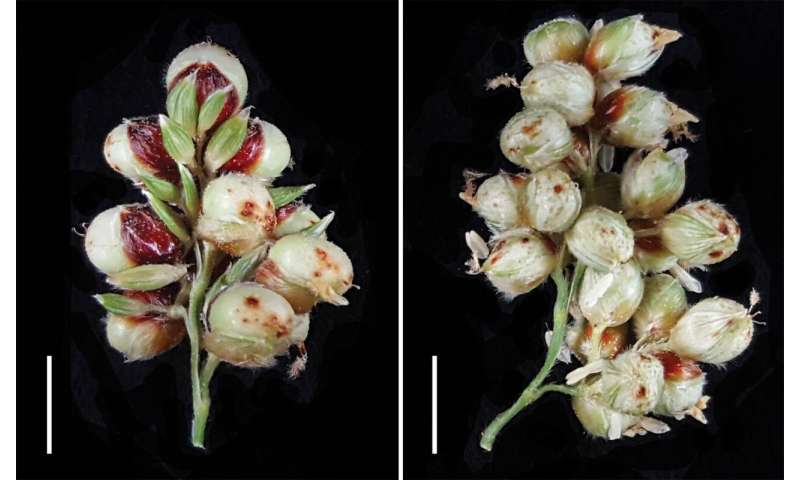
The left image shows the grains of a normal sorghum plant. The right image depicts how the amount of grains doubled in the genetic variant. Credit: Ware lab/CSHL, 2019
More

Plant scientists at Cold Spring Harbor Laboratory (CSHL) and USDA's Agricultural Research Service (ARS), in their search for solutions to global food production challenges, have doubled the amount of grains that a sorghum plant can yield.

Sorghum, one of the world's most important sources of food, animal feed, and biofuel, is considered a model crop for research because it has a high tolerance to drought, heat, and high-salt conditions. Increasing the grain yield has become even more important to plant breeders, farmers, and researchers as they try to address and overcome food security issues related to , growing populations, and land and water shortages.


Led by Doreen Ware, CSHL Adjunct Professor and research scientist at the U.S. Department of Agriculture, and USDA colleague Zhanguo Xin, Ph.D, the research team identified novel genetic variations that occurred in sorghum's MSD2 gene, increasing the grain yield 200 percent. MSD2 is part of a gene line that boosts flower fertility by lowering the amount of jasmonic acid, a hormone that controls the development of seeds and flowers.


"When this hormone is decreased, you have a release of development that does not normally occur," said Nicholas Gladman, a postdoctoral fellow in Ware's lab and first author on the study, recently published in The International Journal of Molecular Sciences. "That allows for the full formation of the female sex organs in these flowers, which then allows for increased fertility"


MSD2 is regulated by MSD1, a gene discovered by Ware's team last year. Manipulating either gene increases seed and flower production.


"Major cereal crops are very close to each other evolutionarily. A lot of the that they share have similar functions," said Yinping Jiao, a postdoctoral associate in the Ware Lab and an author on the study. "This gene that plays an important role controlling the sorghum yield may also help us improve the yield of other crops like maize or rice."


Ware's lab uses this type of genetic research to understand how plants have changed over time.


"These genetic analyses actually give us the molecular mechanisms that provide more opportunities to engineer crops in the future," she said.


Explore further


The secret to tripling the number of grains in sorghum and perhaps other staple crops


More information:
Gladman et. al, "Fertility of Pedicellate Spikelets in Sorghum is Controlled by a Jasmonic Acid Regulatory Module" appeared in The International Journal of Molecular Sciences on October 8, 2019.


Citation:
Researchers double sorghum grain yield to improve food supply (2019, October 30)
retrieved 30 October 2019
from https://phys.org/news/2019-10-sorghum-grain-yield-food.html


This document is subject to copyright. Apart from any fair dealing for the purpose of private study or research, no
part may be reproduced without the written permission. The content is provided for information purposes only.


#Biology | https://sciencespies.com/biology/researchers-double-sorghum-grain-yield-to-improve-food-supply/

Wednesday, October 30, 2019

GAO report critical of Air Force space command and control program

GAO said the Air Force Space C2 program requires more oversight from the Defense Department.


WASHINGTON — The Government Accountability Office in a new report gave low marks to the Air Force’s Space Command and Control program, a long troubled effort to provide commanders with better tools to monitor what is happening in space.


The Space Command and Control program, or Space C2, is managed by the Air Force Space and Missile Systems Center. In a report released Oct. 30, GAO said the program suffers from disjointed management and requires more oversight from the Defense Department.


Space C2 is the name the Air Force gives to a collection of systems that are being developed to help predict attacks and avoid collisions in space. According to GAO, the program is facing “challenges and unknowns, from management issues to technical complexity.”


GAO’s review was requested by the House Armed Services Committee in the National Defense Authorization Act for Fiscal Year 2018. The committee has been critical of the program and recommended a $21.5 million cut to the Air Force’s $72.8 million request for fiscal year 2020.


The Air Force over the past three decades started three space command and control projects — and all ended significantly over budget and schedule, and with key capabilities undelivered, GAO said. The Air Force’s latest effort uses agile software development methods to incrementally deliver updates.


GAO is not critical of the agile software approach but calls for greater oversight and metrics to track improvements. “Until the program develops a comprehensive acquisition strategy to more formally plan the program, it is too early to determine whether these efforts will help to ensure long-term program success,” says the report.


Kevin Fahey, assistant secretary of defense for acquisition, said in response to the report that DoD agreed with GAO’s critique. Fahey wrote in his response that the undersecretary of defense for acquisition and sustainment in a May 2019 memo directed the Air Force to provide an acquisition strategy for Space C2 by November 2019.


#Space | https://sciencespies.com/space/gao-report-critical-of-air-force-space-command-and-control-program/

MIT Engineers Develop Battery That Can Remove Carbon Dioxide From Air

More

A pair of MIT engineers just created a new way to efficiently remove carbon dioxide from the air. The system can be developed commercially at low cost and has a myriad of potential applications.


While there are alternative ways to remove carbon dioxide from gas, they typically only work well on carbon dioxide levels significantly higher than atmospheric concentrations and require lengthy chemical processes to ultimately remove the carbon dioxide.


This approach uses a unique battery that can absorb carbon dioxide while it is charging up and release pure carbon dioxide when the battery is discharged.


The paper outlining the recent research was published in Energy & Environmental Science and spearheaded by two engineers from the MIT Chemical Engineering department.


The battery consists of thin sheets coated with stacks of electrodes (using the compound polyanthraquinone). These electrodes have a natural affinity for carbon dioxide when charging and absorb the gas even at the 400 ppm concentration in the atmosphere.


When the battery is discharged, the electrodes switch to having no affinity to carbon dioxide and release the 100% carbon dioxide gas. The entire reaction can take place at room temperature and pressure.


There are a whole host of potential applications to this newly developed method. For instance, soft-drink bottling plants use carbon dioxide to carbonate their beverages, sometimes burning fossil fuels to get carbon dioxide. This method could essentially pull CO2 from the atmosphere and provide a pure source for beverage carbonation.


The batteries could be used dually on power plant exhausts, where one battery is charging while the other discharging, allowing for continuous capture of carbon dioxide.


That gas can then be compressed and injected underground, called carbon capture and storage. A growing method for removing carbon dioxide from the atmosphere is to pressurize it and inject it into depleted geologic formations. These geologic formations are commonly depleted oil and gas fields where porous rock has the ability to absorb significant volumes. Alternatively, the gas could be used for industrial applications requiring carbon dioxide.


The researchers estimate that this technology could be developed to a commercial scale in rolls similar to industrial paper. Also, the end cost is estimated to be significantly lower than competing processes to remove carbon dioxide from the air.


"In my laboratories, we have been striving to develop new technologies to tackle a range of environmental issues that avoid the need for thermal energy sources, changes in system pressure, or addition of chemicals to complete the separation and release cycles," says T. Alan Hatton from the research team.


#News | https://sciencespies.com/news/mit-engineers-develop-battery-that-can-remove-carbon-dioxide-from-air/

Hold On to Your Lederhosen: Oktoberfest Produces a Whole Lot of Methane Gas


Ah, Oktoberfest. The annual festival draws some six million revelers to Munich, where the music is thumping, the sausage is sizzling and the beer (so, so much beer) is flowing. But all of these good times might not be so great for the environment. As Kai Kupferschmidt reports for Science, a new study has found that Oktoberfest releases considerable amounts of methane gas into the atmosphere.


While the celebration was taking place in 2018, a team of scientists scurried around the perimeter of the festival sampling the air. (They weren’t allowed to enter the festival area due to safety concerns, and one can only imagine the FOMO.) Taking into account wind speed and direction, they estimated that 1,500 kilograms (3,306 pounds) of methane were emitted during the 16-day party.


In a preprint paper, which is under review in the journal Atmospheric and Chemistry Physics, the researchers note that they were not aware of any other studies dealing with methane emissions from festivals. So they decided to compare emissions from Oktoberfest to those wafting out of Boston, which is, the study authors write, known to be “a very leaky city.” On average, Oktoberfest released 6.7 micrograms of methane per square meter per second—10 times the average regional emission flux in Boston.


“Although it is difficult to compare the small and densely populated Oktoberfest premises with the entire city area of Boston,” the researchers acknowledge, “the comparison shows that the emission flux of Oktoberfest is significant.”


Methane is a greenhouse gas, the second most significant one after carbon dioxide. It doesn’t live for very long in the atmosphere, but it is highly effective at trapping radiation. “Per unit of mass, the impact of methane on climate change over 20 years is 84 times greater than [carbon dioxide]; over a 100-year period it is 28 times greater,” the Climate and Clean Air Coalition warns.


The amount of methane in the atmosphere has been on the rise since 2007, following a period of stability that began in the 1990s, reports Fred Pearce of Yale Environment 360. Pearce adds that researchers suspect the recent bump is being caused by the “the activities of microbes in wetlands, rice paddies, and the guts of ruminants,” which are mammals like cattle, sheep and goats that have a unique digestive system. Oil and gas drilling, along with hydraulic fracturing (or “fracking”), also play a major role in leaking methane gas into the environment.


Previous research has looked at the ways in which large festivals contribute to the emissions of other air pollutants, like nitrogen oxide and polycyclic aromatic hydrocarbons, but the connection between festivals and methane emissions had not previously been studied, according to the authors of the new report.


The major culprit was likely incomplete combustion in natural gas-powered cooking and heating appliances. (And in case you were wondering, the digestive byproducts of too much beer and greasy food—burps and flatulence, in other words—were probably not responsible for a significant portion of Oktoberfest’s methane output.)


Granted, there are more serious environmental concerns associated with big festivals, like people travelling by plane to get to them. But festivals take place around the world, and they have been an overlooked source of significant methane emissions, Jia Chen, lead author of the study, notes in an interview with the Guardian’s Ian Sample. This doesn’t mean that Oktoberfest and other celebrations should be canceled—just that festival organizers should implement measures, like improving gas appliances, to curb methane emissions.


“Small steps,” Chen tells Sample, “can bring us closer to achieving the world climate goals.”


#News | https://sciencespies.com/news/hold-on-to-your-lederhosen-oktoberfest-produces-a-whole-lot-of-methane-gas/

Carbon bomb: Study says climate impact from loss of intact tropical forests grossly underreported


Carbon bomb: Study says climate impact from loss of intact tropical forests grossly underreported

Road for oil palm plantations in West Kalimantan, Indonesia. Credit: Rainforest Action Network
More

A new study in the journal Science Advances says that carbon impacts from the loss of intact tropical forests has been grossly underreported.

The study calculates new figures relating to intact tropical lost between 2000-2013 that show a staggering increase of 626 percent in the long-term net impacts through 2050. The revised total equals two years' worth of all global land-use change emissions.


The authors of the study, from WCS, University of Queensland, University of Oxford, Zoological Society of London, World Resources Institute, University of Maryland, and University of Northern British Columbia, found that direct clearance of intact resulted in just 3.2 percent of gross carbon emissions from all deforestation across the pan-tropics. However, when they factored in full carbon accounting, which considers forgone carbon removals (carbon sequestration that would occur annually into the future if cleared or degraded forest had remained intact after year 2000), selective logging, edge effects and declines of carbon-dense tree species due to overhunting of seed-dispersing animals, they discovered that the figure skyrocketed by a factor of more than six times.


Said the study's lead author Sean Maxwell of WCS and the University of Queensland: "Our results revealed that continued destruction of intact tropical forests is a ticking time bomb for carbon emissions. There is an urgent need to safeguard these landscapes because they play an indispensable role in stabilizing the climate."


According to 2013 estimates, 549 million acres of intact tropical forests remain. Only 20 percent of tropical forests can be considered "intact," but those areas store some 40 percent of the above-ground carbon found in all tropical forests.


The authors say that intact forest retention rarely attracts funding from schemes designed to avoid land-use and land cover change emissions in developing nations.


Notably, the Reducing Emissions from Deforestation and Forest Degradation (REDD+) approach enables developing countries to receive for enhancing carbon stocks, or avoiding the loss of carbon that would otherwise be emitted due to land-use and land cover change. Among other activities, REDD+ covers support for conservation of forests not under immediate threat, and was formally adopted by parties to the United Nations Framework Convention on Climate Change in 2008 at the 14th Conference of the Parties in Poland. Since then, however, financial support and implementation has predominantly focused on areas with high historical rates of deforestation (i.e. 'deforestation frontiers'). This is widely believed to deliver more immediate and more clearly demonstrable emission reductions than conserving intact forest areas. The latter tend to be treated as negligible sources of emissions as a result of the short timescales and conservative assumptions under which REDD+ operates—assumptions which the present study suggests are causing key opportunities to be missed.


Said WCS's Tom Evans, a co-author of the study: "The relative value of retaining intact tropical forest areas increases if one takes a longer-term view and considers the likely state of the world's forests by mid-century—a milestone date in the Paris Agreement. Agricultural expansion, logging, infrastructure and fires reduced the global extent of intact forests by 7.2 percent between 2000 and 2013 alone, yet the eventual carbon emissions locked in by these losses have not been comprehensively estimated."


The authors go on to say that a comparable analysis is needed for intact forests outside of the tropics such as the boreal forests of Canada and Russia, given that approximately half to two-thirds of carbon removals on earth's intact ecosystems occur outside the tropics. Without this global clean-up service, CO2 from human activities would accumulate in the atmosphere markedly faster than it does at present.


Said co-author James Watson of WCS and the University of Queensland: "Clearly, the climate mitigation potential of retaining intact forests is significant, but without proactive conservation action by national governments, supported by the global community, this potential will continue to dwindle.


At least 35 percent of the intact forests studied are home to, and protected by, Indigenous Peoples. Intact forests also provide exceptional levels of many other environmental services—for example they protect watersheds much better than degraded forests, return moisture to the air that falls in distant regions as rain, and help to keep vast numbers of species safe from extinction. When compared to forests that have been degraded by large-scale human activities, intact forests are more resistant to shocks such as fire and drought and usually less accessible to logging and agriculture conversion, making them one of our best conservation bets in the face of a rapidly changing climate.


Explore further


Amazon deforestation has a significant impact on the local climate in Brazil


More information:
"Degradation and forgone removals increase the carbon impact of intact forest loss by 626%" Science Advances (2019). DOI: 10.1126/sciadv.aax2546 , https://advances.sciencemag.org/content/5/10/eaax2546


Citation:
Carbon bomb: Study says climate impact from loss of intact tropical forests grossly underreported (2019, October 30)
retrieved 30 October 2019
from https://phys.org/news/2019-10-carbon-climate-impact-loss-intact.html


This document is subject to copyright. Apart from any fair dealing for the purpose of private study or research, no
part may be reproduced without the written permission. The content is provided for information purposes only.


#Environment | https://sciencespies.com/environment/carbon-bomb-study-says-climate-impact-from-loss-of-intact-tropical-forests-grossly-underreported/